GEO & AEO for Auto Detailing Shops: How to Rank in AI Search (2026 Guide)
A Tesla owner in Austin opens ChatGPT and types: “best ceramic coating installer near me.” In about four seconds, ChatGPT names three local shops — confidently, conversationally, with no list of blue links to scroll through. The shop that’s been #1 on Google for “ceramic coating Austin” for two years isn’t one of them.
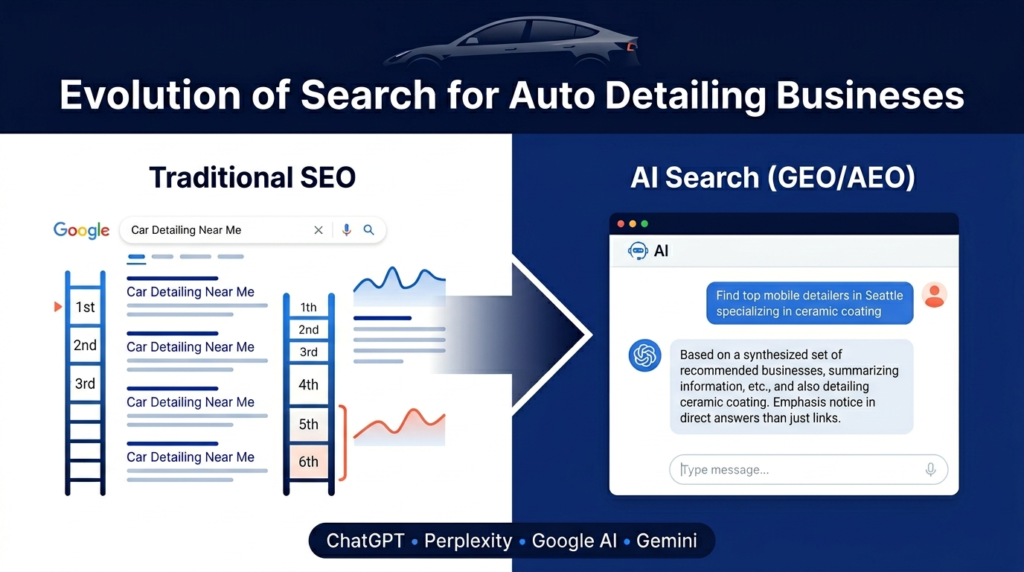
This is happening every day, in every city, across every detailing service line. Search has split into two systems running in parallel — traditional Google rankings and AI-generated answers — and most auto detailing shops, PPF installers, ceramic coating studios, and window tinting businesses are still optimizing only for the first one.
This guide is the playbook for the second one. After working with detailing operators across the U.S. on AI search visibility, we’ve narrowed the work down to a clear framework: Generative Engine Optimization (GEO) and Answer Engine Optimization (AEO) — the disciplines that decide whether ChatGPT, Perplexity, Google AI Overviews, Gemini, and Claude recommend your shop or someone else’s.
The Quiet Visibility Shift Killing Detailing Shop Lead Flow
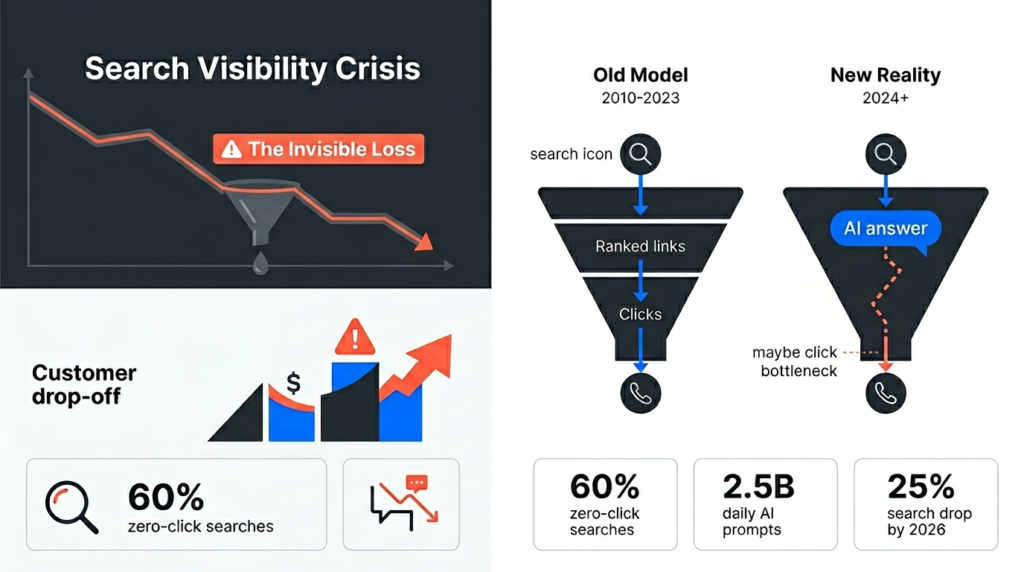
Direct answer: AI-powered search is reshaping how local services get discovered. Google AI Overviews now appear on roughly half of all searches, ChatGPT processes more than 2.5 billion prompts daily (with around 65% of those qualifying as search), and Gartner predicts a 25% drop in traditional search volume by 2026. Detailing shops are losing leads not because their Google rankings dropped, but because fewer people are reaching the rankings page at all.
What changed in local search for service businesses
For 20 years, the deal was simple. You ranked on Google, customers clicked, and your phone rang. That deal is breaking. Over 60% of Google searches now end without a click to a third-party website. AI Overviews answer the question on the search page itself. ChatGPT and Perplexity answer it before the user ever opens Google. The customer journey for high-consideration local services — the kind detailing shops sell — is shifting from “search → list of links → click” to “ask → conversational answer → maybe click.”
That “maybe click” is the entire game.
Why detailing, PPF, ceramic coating, and tint shops are especially exposed
High-ticket detailing services sit in the worst possible spot for the old model and the best possible spot for the new one. Buyers researching a $1,500 ceramic coating, a $6,000 full-front PPF, or a $700 ceramic window tint package don’t impulse-buy. They research — for days, sometimes weeks — comparing brands like XPEL, Ceramic Pro, CQuartz, SunTek, and LLumar, weighing PPF vs. ceramic coating, asking how long does ceramic coating last, what’s the best window tint percentage, and is ceramic coating worth it on a leased car.
That research used to happen on Google and YouTube. Increasingly, it happens inside ChatGPT and Perplexity. If those engines don’t know your shop exists — or know it but don’t trust it as a source — you’re invisible to a customer who’s about to spend thousands of dollars two zip codes from your bay.
SEO vs AEO vs GEO — What Each One Actually Means for a Detailing Business
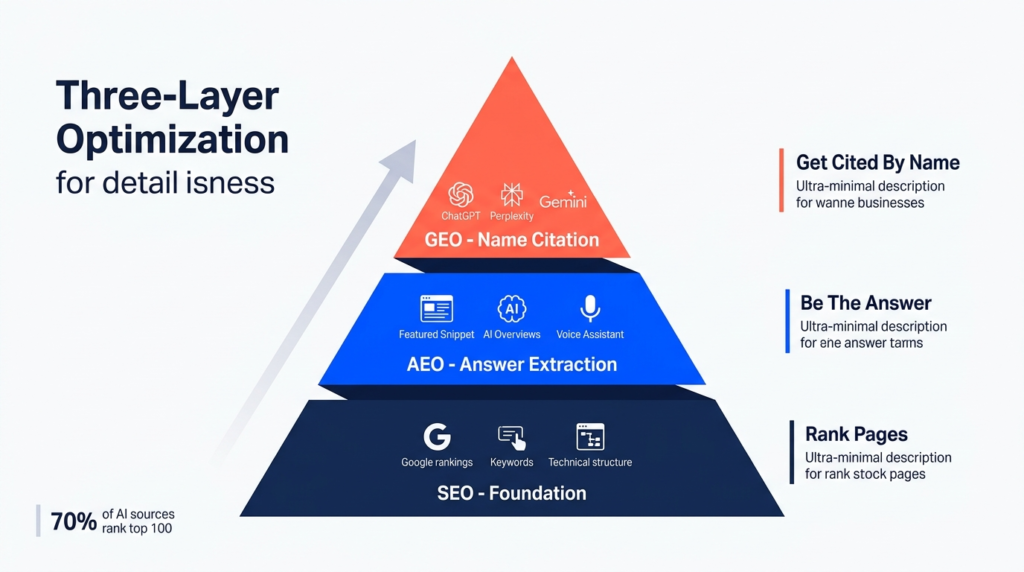
Direct answer: SEO ranks pages on Google. AEO (Answer Engine Optimization) gets your content extracted as the direct answer in featured snippets and AI Overviews. GEO (Generative Engine Optimization) gets your business cited by name when ChatGPT, Perplexity, Claude, or Gemini synthesizes a response. They overlap, but each requires distinct work.
SEO (Search Engine Optimization) — still the foundation
Search Engine Optimization is the practice of structuring your website, content, and authority signals so Google ranks your pages highly in traditional search results. For a detailing shop, that means service pages targeting “ceramic coating [city],” “PPF [city],” “window tinting [city],” and “auto detailing [city],” plus a strong Google Business Profile, fast page speed, mobile usability, and clean technical SEO.
SEO is not dead. Roughly 40% of pages cited in Google AI Overviews already rank in the top 10 organically — and nearly 70% rank in the top 100. Your AI visibility is built on top of your SEO foundation, not in place of it.
AEO (Answer Engine Optimization) — getting picked as the answer
Answer Engine Optimization is the practice of structuring content so it gets extracted directly into AI-generated answers — Google AI Overviews, Bing Copilot, Perplexity’s instant answers, and the snippets read aloud by Siri and Alexa. AEO is fundamentally about format: clear question-style headings, definition-first paragraphs, scannable structure, and FAQPage schema.
For a detailing site, AEO is the difference between a 1,200-word “Ceramic Coating Services” page that rambles, and a page that opens with “Ceramic coating is a liquid polymer applied to a vehicle’s exterior that bonds with the factory paint to create a hydrophobic, scratch-resistant layer lasting 2–10 years depending on grade and care.” The second version gets pulled into AI Overviews. The first one doesn’t.
GEO (Generative Engine Optimization) — getting cited by ChatGPT and Perplexity
Generative Engine Optimization is the practice of structuring your content, entities, and digital footprint so generative AI engines — ChatGPT, Perplexity, Gemini, Claude — cite your business by name when answering user prompts. GEO leans heavily on entity clarity, third-party validation (reviews, mentions on Reddit and YouTube), original data, and authoritative sourcing.
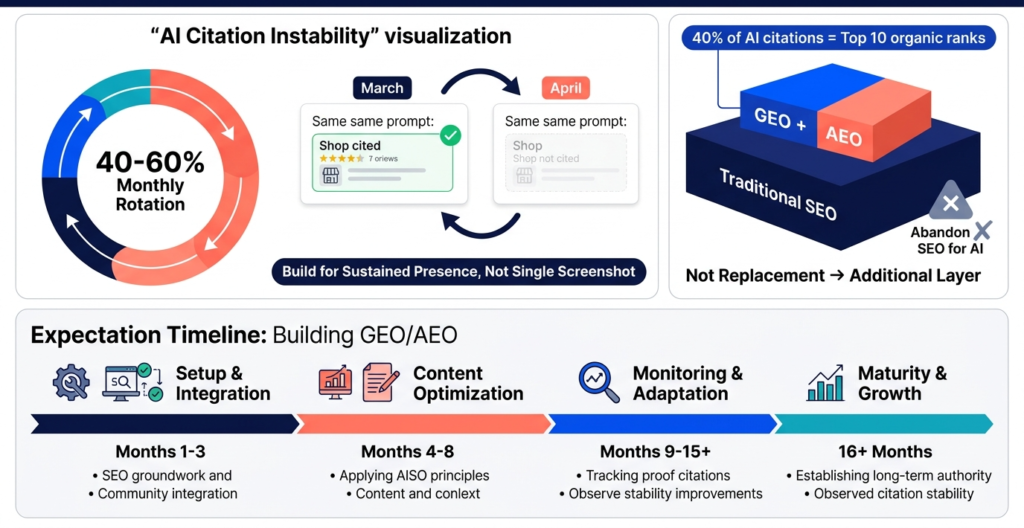
GEO is harder to measure than SEO, less stable (40–60% of cited sources change month-to-month across Google AI Mode and ChatGPT), but increasingly the only way to be present in the conversation a buyer is having with an AI assistant about your service.
How the three work together for a local service business
Discipline | Goal | Primary Surface | What It Optimizes |
SEO | Rank pages | Google, Bing | Keywords, links, technical health |
AEO | Be extracted as the answer | AI Overviews, voice assistants, featured snippets | Content structure, schema, direct answers |
GEO | Be cited by name | ChatGPT, Perplexity, Claude, Gemini | Entities, authority, original data, third-party signals |
The three are layers, not alternatives. Skip the foundation (SEO) and the upper layers crumble. Skip the upper layers (AEO + GEO), and you’ll keep ranking #1 on a page nobody’s looking at anymore.
How AI Search Engines Choose Which Detailing Shops to Recommend
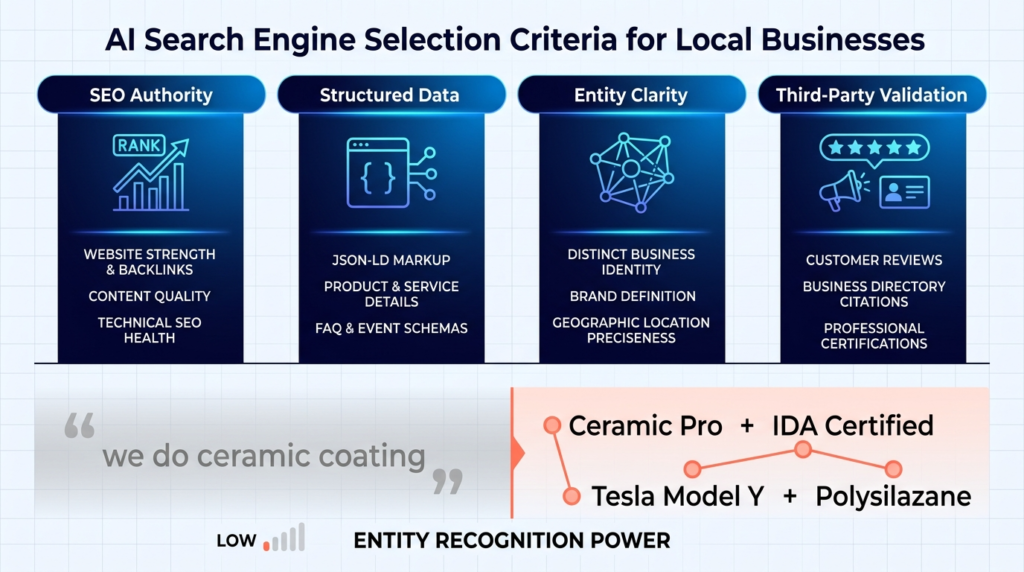
Direct answer: AI search engines select sources based on four signals: (1) traditional SEO authority and existing search rankings, (2) machine-readable structured data (schema), (3) entity clarity — whether the AI can confidently identify what your business is, where it operates, and what it does — and (4) third-party validation through reviews, brand mentions, and citations on trusted sites. Each major AI engine weights these slightly differently.
How ChatGPT Search picks sources
ChatGPT Search runs on the Bing index combined with OpenAI’s own ranking layer. Pages that rank well on Bing rank well in ChatGPT. The engine values direct, well-structured answers near the top of pages, authoritative domains, and clear schema markup. If your Google Business Profile is strong but your Bing Webmaster Tools account doesn’t even exist, you’re handing your competitor a free advantage.
How Perplexity selects citations
Perplexity uses its own crawler — PerplexityBot — and retrieves live content at query time, which means freshness matters more here than with any other AI engine. Perplexity also leans heavily on Reddit, YouTube, and community forum citations. For detailing shops, that means presence in r/AutoDetailing, AutopiaForums, and DetailingWorld — alongside YouTube videos showing real installations — directly drives Perplexity visibility.
How Google AI Overviews choose pages
Google AI Overviews favor pages that already rank in the top 10 organically and have valid structured data implemented. AI Overviews appear in roughly 50% of searches now, and the pages cited inside them tend to be well-optimized service pages with FAQPage schema, Article schema, and crisp answer-first paragraphs.
The role of entity recognition: why “Ceramic Pro Authorized Installer” beats “we do ceramic coating.”
This is the single most important shift in how to think about your content.
Traditional SEO treated language as keywords. AI search treats language as entities — the named, knowable things AI engines have already mapped in their knowledge graph. Ceramic Pro is an entity. XPEL is an entity. IDA Certified Detailer is an entity. Tesla Model Y is an entity. SiO2 is an entity. Polysilazane is an entity.
Compare two sentences on a service page:
- Generic: “We offer high-quality ceramic coatings to protect your vehicle.”
- Entity-rich: “As a Ceramic Pro Authorized Installer and IDA Certified Detailer, we apply Ceramic Pro Gold and CQuartz Finest Reserve — polysilazane-based nano-ceramic coatings — using factory-trained application protocols on Tesla Model Ys, Porsche 911s, and exotic vehicles in our climate-controlled facility.”
The first sentence is keyword-aware. The second is entity-aware. AI engines recognize, validate, and connect every named entity in the second sentence to their existing knowledge graph — and that recognition is what earns citations.
The 5 Pillars of AI Search Optimization for Detailing Shops
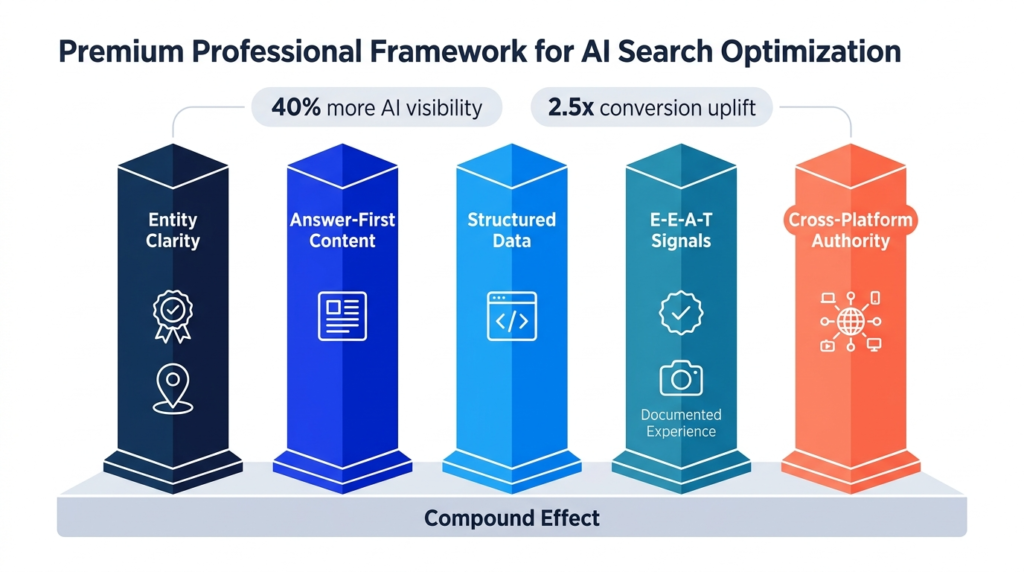
Direct answer: The five foundational disciplines that make a detailing shop visible to AI search engines are (1) Entity Clarity, (2) Answer-First Content Architecture, (3) Structured Data and Schema Stack, (4) E-E-A-T Signals, and (5) Cross-Platform Authority. Each compounds the others — you need all five working together, not one in isolation.
Pillar 1 — Entity Clarity
Tell AI engines exactly what you are, what you do, where you do it, and who validates you. That means naming your manufacturer certifications (XPEL Certified Installer, 3M Certified, LLumar SelectPro, Ceramic Pro Authorized, CQuartz Finest authorized), your industry credentials (IDA Certified Detailer, IWFA Accredited Dealer), your service categories (full front PPF, multi-stage paint correction, ceramic window tinting), and your service area down to neighborhoods and ZIP codes. Vagueness is invisibility.
Pillar 2 — Answer-First Content Architecture
Every important page on your site should answer the user’s question in the first one or two sentences. Ramble first, answer later, and AI engines skip you. The structure that wins is Question → Direct Answer → Expansion → Examples → Related Questions. It works for service pages, blog posts, and FAQs alike.
Pillar 3 — Structured Data and Schema Stack
Schema markup is how you translate your content into a language that AI engines can parse without ambiguity. The detailing-shop minimum is LocalBusiness (or the AutoDetailing subtype), Service, FAQPage, Organization, AggregateRating, and Review. Sites with complete schema stacks see up to 40% more AI Overview appearances and a 2.5x higher likelihood of being cited in AI-generated answers.
Pillar 4 — E-E-A-T Signals That Detailing Shops Uniquely Have
E-E-A-T stands for Experience, Expertise, Authoritativeness, and Trustworthiness — Google’s content quality framework, and the same framework AI engines use to decide who to trust. Most SaaS competitors fight uphill on the “Experience” pillar because they can’t show first-hand work.
You can. You literally do paint correction with your hands. You install PPF on real cars. You measure paint depth before machine polishing. You photograph before-and-afters daily. Document everything. First-hand experience is the rarest E-E-A-T signal on the open web — and detailing shops produce it as a byproduct of doing the job.
Pillar 5 — Cross-Platform Authority
AI engines don’t just read your website. They read Reddit threads where someone asks, “best ceramic coating installer in Phoenix.” They read YouTube comments under detailed reviews. They read Google reviews, BBB profiles, Yelp listings, AutopiaForums posts, and DetailingWorld threads. Your authority isn’t just on your site — it’s distributed across every place where your shop is mentioned, reviewed, or referenced. Brand mentions count even when they aren’t hyperlinked.
Schema Markup Every Detailing Shop Needs (With Real Examples)
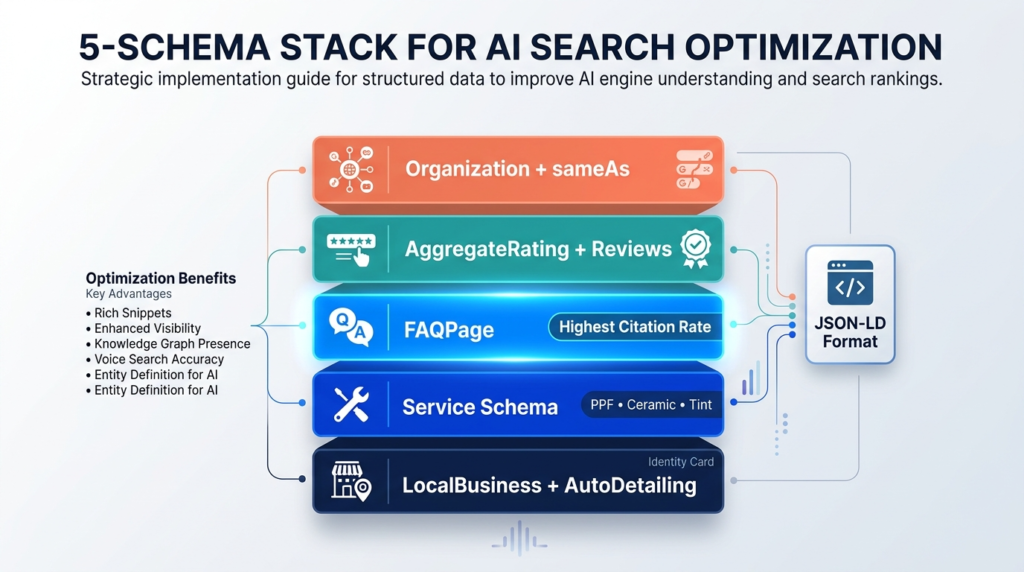
Direct answer: Every detailing shop should implement a five-schema stack: LocalBusiness with the AutoDetailing subtype, Service schema for each service line (PPF, ceramic coating, window tint, detailing), FAQPage schema (the highest AI-citation rate of any schema type), AggregateRating and Review schema, and Organization schema. Use JSON-LD format — it’s the only structured data format all major AI engines parse reliably.
LocalBusiness + AutoDetailing schema (the foundation)
Your LocalBusiness schema is your shop’s machine-readable identity card. Include the legal business name, address, phone, geo-coordinates, opening hours, accepted payments, service area radius, and sameAs links to your social and review profiles. Use the AutoDetailing subtype rather than generic LocalBusiness — specificity helps AI engines categorize you correctly.
Service schema for ceramic coating, PPF, and tint pages
Each service line gets its own Service schema entry, including serviceType, provider, areaServed, and offers with explicit pricing tiers when possible. A ceramic coating page should have a service schema describing the coating brand, durability tier, included paint correction level, and warranty period.
FAQPage schema (the highest AI-citation rate of any schema type)
The FAQPage schema has consistently shown the highest citation rate across ChatGPT, Perplexity, and Google AI Overviews. Add 6–10 question-and-answer pairs to each major service page. The questions should be the actual conversational queries customers ask — not marketing-flavored versions of them.
AggregateRating + Review schema
Review signals are the third-most-impactful local ranking factor and a powerful AI trust signal. Mark up your aggregate Google rating and feature individual reviews on relevant service pages with the Review schema. Authentic reviews with specific details (vehicle, service, technician name) carry more weight than generic five-star praise.
Organization schema and the role of sameAs for entity disambiguation
Organization schema with a complete sameAs array — linking to your Google Business Profile, Facebook, Instagram, LinkedIn, BBB profile, and any industry directory listings — helps AI engines confirm you’re a single, real, verifiable business rather than one of many similarly named shops. Entity disambiguation is what gets you mentioned by name instead of as “a local detailing shop.”
Writing Content That AI Engines Actually Cite — A Detailing-Specific Playbook
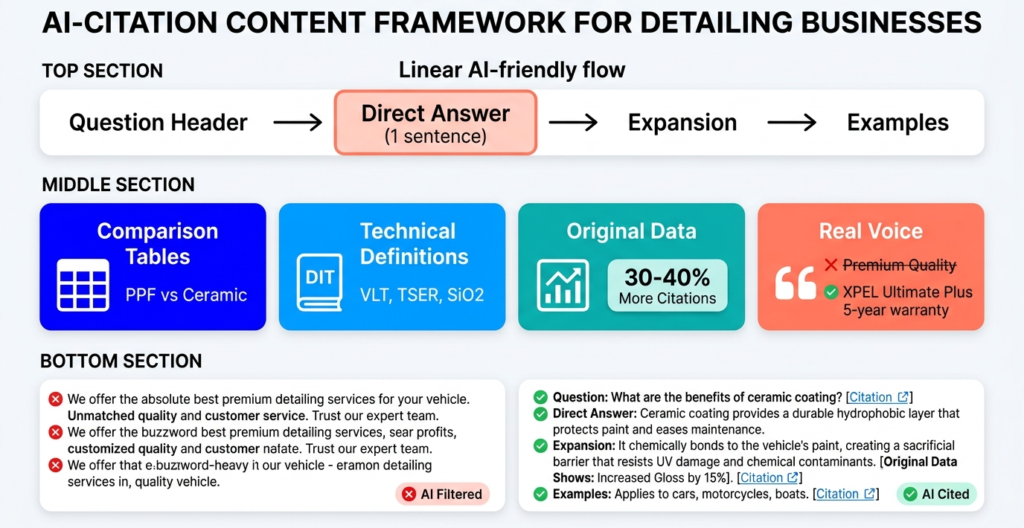
Direct answer: AI engines cite content that’s structured, factual, scannable, entity-rich, and free of marketing fluff. The format that wins is question-led headings, one-sentence direct answers, comparison tables, defined technical terms, original data, and a tone that sounds like a knowledgeable detailer talking — not a marketing department writing.
The Question → Direct-Answer → Expansion structure
Lead every major content block with a question your customer actually asks. Answer it in one sentence. Then expand. This isn’t a stylistic choice — it’s a structural match for how LLMs chunk and extract content.
How to use comparison tables (PPF vs ceramic coating, ceramic vs paint sealant)
Tables are an AI-citation magnet. Perplexity and Google AI Overviews extract tabular data at significantly higher rates than prose. Build tables for:
- PPF vs Ceramic Coating (cost, durability, scratch protection, gloss, application time)
- Ceramic vs Carbon vs Dyed Window Tint (heat rejection, UV blocking, longevity, price)
- Coating Tiers (entry-level vs premium vs flagship — durability and warranty)
Defining technical entities clearly
Define your industry vocabulary on the page — VLT (Visible Light Transmission), TSER (Total Solar Energy Rejected), polysilazane, SiO2, TPU film, self-healing topcoat, hydrophobic coefficient. Definitions create extractable knowledge units that AI engines can lift directly into answers, often citing your shop as the source.
Original data — the strongest citation magnet
This is the single most underused tactic in detailing SEO. Publish data only you have:
- A pricing transparency report (“What ceramic coating actually costs in [your metro] in 2026”)
- A real-world durability log (“How XPEL Ultimate Plus held up on 50 vehicles over three winters”)
- A before-and-after library with timestamps and paint-thickness measurements
Original data earns 30–40% more visibility in LLM-generated answers than purely qualitative content, and it earns natural backlinks that compound your authority over the years.
Voice and tone — why marketing-speak gets filtered out
AI engines have learned to filter promotional language. “Premium,” “world-class,” “the best in the business,” “unparalleled quality” — these phrases are noise. The signal is concrete: brand names, certifications, technical specs, warranty terms, real prices, named technicians, real vehicles, real timelines. Write like a detailer talking to another detailer who happens to be a customer. That voice gets cited.
Local SEO Is Now AI-Local-SEO: Google Business Profile in 2026
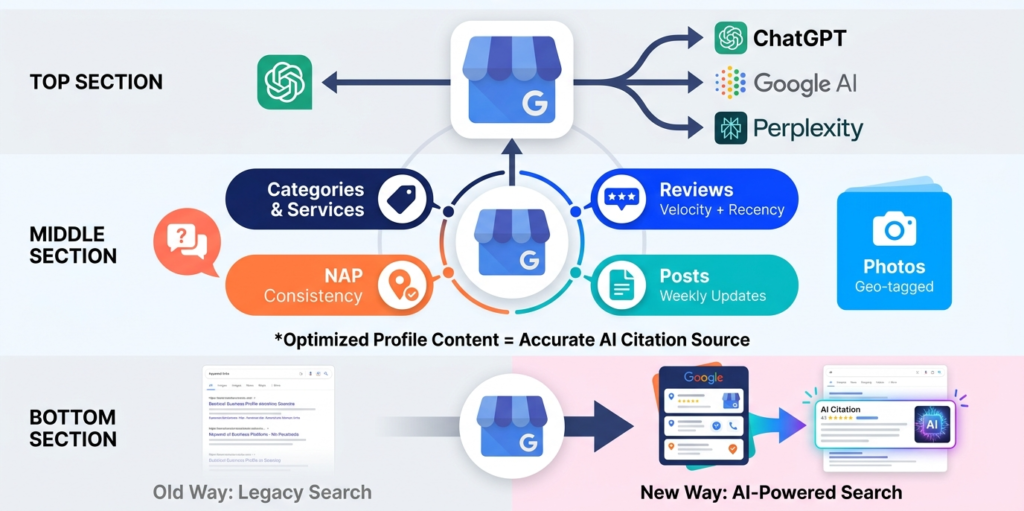
Direct answer: Google Business Profile is no longer just a local SEO tool — it’s a primary input for AI search engines. ChatGPT, Google AI Overviews, and Perplexity all lean on GBP signals (categories, services, reviews, photos, posts, Q&A) when generating local recommendations. A neglected GBP isn’t just costing you map-pack rankings; it’s costing you AI citations.
GBP categories, services, and attributes for detailing/PPF/tint/ceramic
Set your primary category precisely (Auto Detailing Service, Window Tinting Service, Car Detailing Service, depending on your lead service) and add every applicable secondary category. Populate the Services section with each service line — Ceramic Coating, Paint Protection Film Installation, Window Tinting, Paint Correction, Interior Detailing — including service-specific descriptions that mirror the entity-rich language on your website.
Reviews as an AI ranking factor
The Google 3-Pack and AI-driven local recommendations both weigh review velocity, recency, and content. A shop with 400 reviews averaging 4.9 stars over five years signals a different level of trust than a shop with 40 reviews from last quarter. Review content matters too — reviews mentioning specific services, vehicles, and technician names give AI engines extractable, verifiable detail.
GBP posts, photos, and Q&A — the underused AI signals
Post weekly. Add photos with descriptive filenames and geo-tagged metadata. Answer the Q&A section yourself before customers ask — these answers feed directly into AI summaries of your business. This isn’t busywork; it’s the structured-data layer of GBP.
NAP consistency and citation-building for service-area businesses
Name, Address, Phone (NAP) consistency across every directory — Yelp, BBB, Apple Maps, Bing Places, manufacturer locator sites (XPEL’s installer locator, Ceramic Pro’s locator, LLumar’s dealer finder) — confirms your entity to AI engines. Inconsistent NAP creates entity confusion, which is one of the fastest ways to lose AI visibility.
The llms.txt File and AI Crawler Access for Detailing Websites
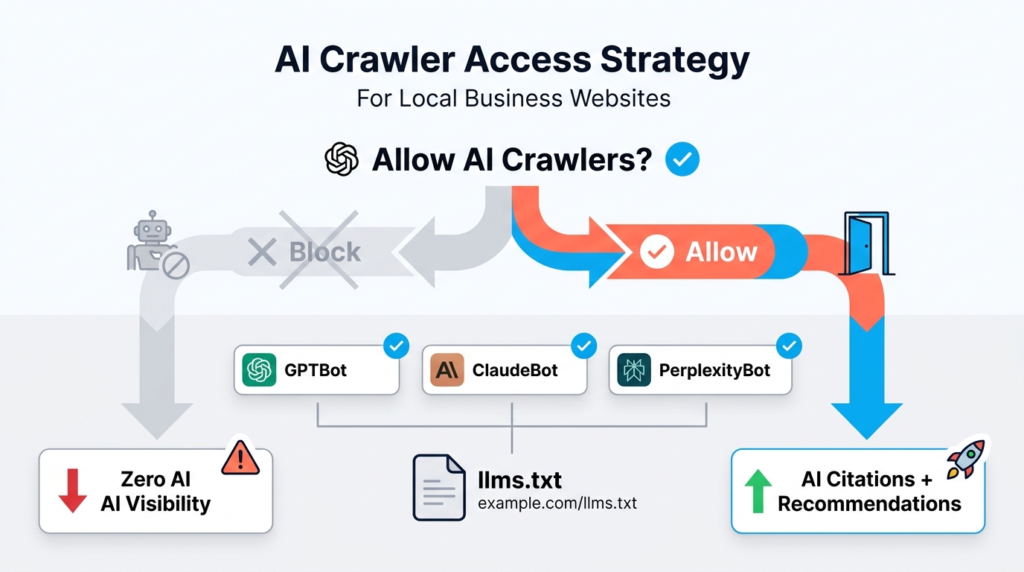
Direct answer: llms.txt is an emerging file standard that tells AI crawlers what content on your site is available and how it should be interpreted. Adoption by major LLM providers is partial as of 2026 — implement it because it’s low-effort and forward-looking, not because it’s the lever that will move your rankings tomorrow.
Should your detailing site allow AI crawlers? (Yes — here’s why)
Some operators block GPTBot, ClaudeBot, and PerplexityBot in robots.txt to prevent their content from “training AI.” For most local service businesses, this is a mistake. Blocking AI crawlers means your business cannot be cited or recommended in AI search, which means losing visibility to a fast-growing share of buyers. Allow them. The trade is worth it.
How to write an llms.txt for a local service business
A simple llms.txt should declare your business identity, list your most important pages (homepage, primary service pages, FAQ page, about page), and indicate how you’d like content to be referenced. Keep it factual and concise. Place it at the root of your domain (yourdomain.com/llms.txt).
Robots.txt mistakes that accidentally block AI engines
We routinely audit detailing websites where overly aggressive robots.txt rules — usually copied from a generic template years ago — block GPTBot, OAI-SearchBot, and PerplexityBot by accident. Audit your robots.txt today. If those bots are disallowed, you’ve been invisible to AI search by self-inflicted error.
A Real-World Example — Rebuilding a Ceramic Coating Page for AI Search
Direct answer: Rewriting a ceramic coating service page for AI search means restructuring it around a question, leading with a one-sentence factual answer, weaving in named entities (brands, certifications, materials), adding comparison tables and FAQs, implementing Service and FAQPage schema, and removing marketing-flavored language. The transformation isn’t subtle — it’s the difference between invisibility and citation.
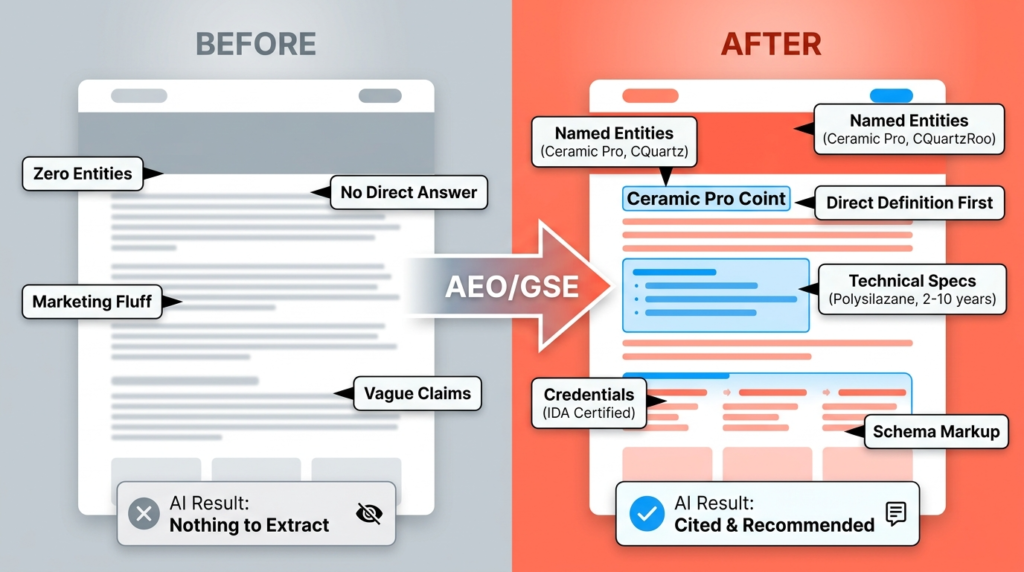
The before — a generic ceramic coating service page
A typical underperforming page opens like this: “Welcome to [Shop Name], your premier destination for world-class ceramic coating services. We pride ourselves on unmatched quality and a commitment to excellence. Our ceramic coatings provide long-lasting protection and a beautiful shine for your vehicle.”
Three sentences. Zero entities. Zero direct answers. Zero structured data hooks. AI engines have nothing to extract.
The after — an AEO/GEO-optimized ceramic coating page
The rewrite opens: “Ceramic coating is a polysilazane-based liquid polymer applied to a vehicle’s exterior that bonds with factory paint to create a hydrophobic, scratch-resistant layer lasting 2–10 years, depending on grade. As a Ceramic Pro Authorized Installer and IDA Certified Detailer in [City], we apply Ceramic Pro Gold (10-year warranty) and CQuartz Finest Reserve in our climate-controlled facility, including multi-stage paint correction before application.”
That single paragraph names: the material (polysilazane), the mechanism (bonds with factory paint), the property (hydrophobic, scratch-resistant), the durability (2–10 years), two manufacturer-authorized brands (Ceramic Pro, CQuartz Finest Reserve), two credentials (Authorized Installer, IDA Certified), the location (City), the facility type (climate-controlled), and the included service (multi-stage paint correction). Everyone is an extractable entity.
What changed and why each change matters for AI citation
The rewrite swapped marketing adjectives for technical specifics, replaced vague claims with named brands and credentials, added a direct definitional sentence at the top (AEO format), and converted the page into something an AI engine can confidently quote and cite. The schema stack (Service + FAQPage + Review) makes the content machine-readable. The before-and-after photo gallery with timestamps adds a first-hand E-E-A-T signal.
If you’d rather not rebuild every service page on your site by hand, that’s exactly what we do at autodetailingseo.com — niche-specific GEO and AEO work for detailing, PPF, ceramic, and tint operators.
How to Track Whether You're Showing Up in AI Search
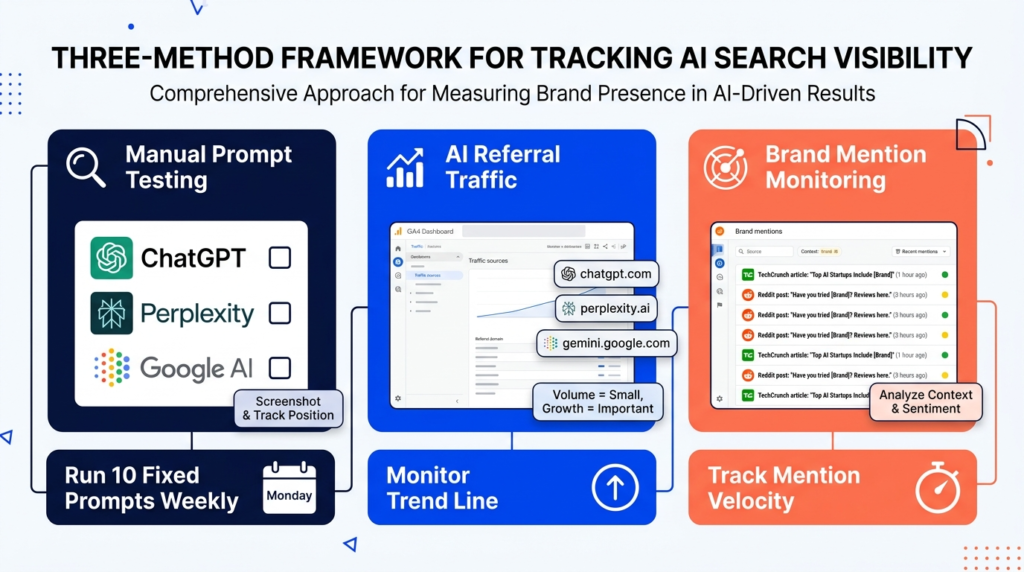
Direct answer: Track AI search visibility three ways: (1) manual prompt testing — running a fixed list of queries through ChatGPT, Perplexity, and Google AI Overviews weekly, (2) AI referral traffic in GA4, watching for visits from chatgpt.com, perplexity.ai, and similar domains, and (3) brand mention monitoring across Reddit, YouTube, forums, and review platforms. None is perfect alone; together they give a directional read.
Manual prompt testing — the 10 prompts every detailing shop should run weekly
Build a fixed prompt list and run it on ChatGPT, Perplexity, and Google AI Overviews every Monday. A good starter list:
- “Best ceramic coating installer in [your city]”
- “Where to get PPF in [your city]”
- “Best window tint shop near [your neighborhood]”
- “Where can I get a Tesla Model Y ceramic-coated in [your city]”
- “Best XPEL installer near [your zip code]”
- “Ceramic Pro vs Gtechniq — who installs both in [your city]”
- “How much does ceramic coating cost in [your metro]”
- “Best paint correction shop in [your city]”
- “Where to get full front PPF on a Porsche in [your city]”
- “Window tint shop with lifetime warranty in [your city]”
Screenshot every result. Track whether you appear, where, and how accurately you’re described.
Tracking AI referral traffic in GA4
In GA4, monitor referral sources for chatgpt.com, perplexity.ai, gemini.google.com, claude.ai, and copilot.microsoft.com. Traffic from these sources represents direct citation clicks. Volume is still small for most local businesses — but the trend line matters more than the absolute number, and assisted conversions from AI sources are growing measurably month over month.
Monitoring brand mentions across Reddit, YouTube, and forums
Set up Google Alerts and use a tool like Brand24 or Ahrefs Brand Radar to track unlinked mentions of your shop name across the web. Each authentic mention — especially on Reddit, YouTube, AutopiaForums, and DetailingWorld — strengthens your citation signal in AI engines, even when there’s no hyperlink.
The Honest Reality — What GEO and AEO Won't Do for Your Shop
Direct answer: GEO and AEO are real and increasingly important, but they’re not magic, they’re not stable, and they don’t replace traditional SEO or great work in your bay. Anyone who promises guaranteed AI citations is selling something. Here’s what you should actually expect.
AI citations are unstable — 40–60% rotate monthly
Cited sources in ChatGPT and Google AI Mode change month-to-month at rates between 40% and 60%. Your shop might get cited beautifully in March and disappear from the same prompt in April. This isn’t a sign your work failed — it’s the nature of generative engines, which sample sources differently across queries. Build for sustained presence over many prompts, not a single citation you can screenshot.
GEO doesn’t replace SEO
Roughly 40% of Google AI Overview citations come from pages already ranking in the top 10 organically. AI search optimization is a layer on top of solid SEO — not a replacement for it. Any agency telling you to abandon traditional SEO to chase AI search is selling a story, not a strategy.
Realistic timelines for AI visibility
For a detailing shop starting from a healthy SEO baseline:
- 30 days: Schema implemented, GBP optimized, top service pages rewritten — early signals appear in AI Overviews for low-competition long-tail queries.
- 90 days: Topical authority builds, AI citations begin appearing for moderate-competition local queries, manual prompt-test results start improving.
- 6–12 months: Compounding authority, original content earning brand mentions, citations stabilizing across multiple AI engines for higher-value local queries.
If someone promises faster, ask harder questions.
A 90-Day GEO/AEO Roadmap for a Detailing Shop
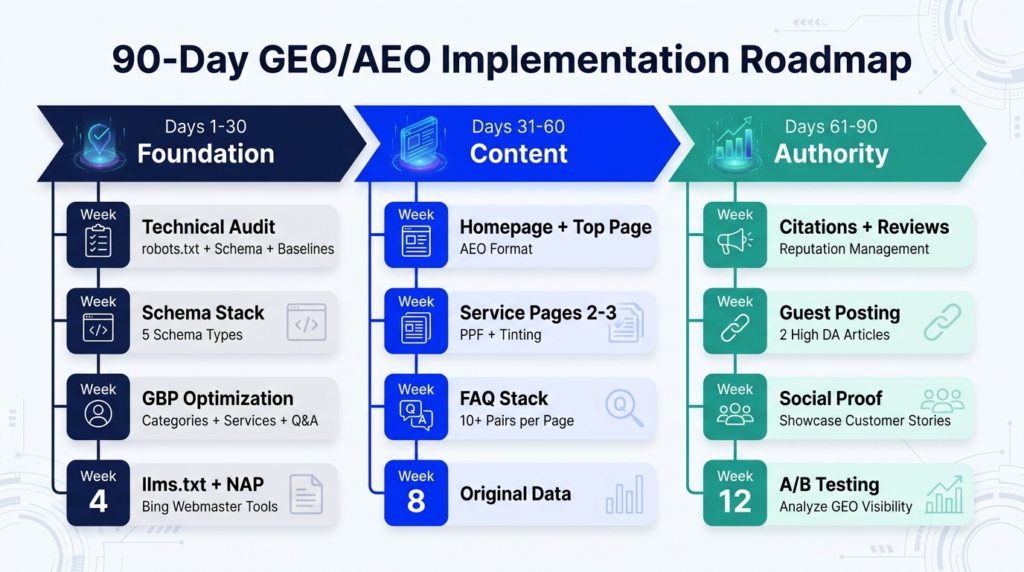
Direct answer: A practical 90-day GEO/AEO roadmap for a detailing shop runs in three phases: Days 1–30 (foundation — audit, schema, GBP, llms.txt), Days 31–60 (content — rewrite top 5 service pages, build the FAQ stack, publish original data), and Days 61–90 (authority — Reddit/YouTube presence, citation building, review-velocity push). Done in order, this is the work.
Days 1–30 — Foundation
- Week 1: Full technical audit. Check robots.txt for accidentally blocked AI crawlers. Audit existing schema. Pull Google Search Console and GBP Insights baselines.
- Week 2: Implement the five-schema stack (LocalBusiness/AutoDetailing, Service, FAQPage, Organization, AggregateRating).
- Week 3: Optimize Google Business Profile — categories, services, attributes, photos, GBP posts cadence, Q&A section seeded.
- Week 4: Publish llms.txt. Audit NAP consistency across top 30 directories. Submit XML sitemap to Bing Webmaster Tools (often skipped — costly mistake for ChatGPT visibility).
Days 31–60 — Content
- Week 5: Rewrite the homepage and top service page (usually ceramic coating or PPF) using the AEO format.
- Week 6: Rewrite the second and third service pages (PPF and window tinting, typically).
- Week 7: Build the FAQ stack — 10+ Q&A pairs per service page, all wrapped in FAQPage schema.
- Week 8: Publish one original data asset — a local pricing transparency report, a durability log, or a before/after library with measurements.
Days 61–90 — Authority
- Week 9: Active Reddit presence in r/AutoDetailing, r/CarDetailing, and city-specific subreddits — answering questions, not promoting.
- Week 10: Publish one detailed YouTube installation walkthrough. Embed it on the relevant service page.
- Week 11: Citation push — get listed on every relevant manufacturer locator (XPEL, Ceramic Pro, LLumar, CQuartz, SunTek), industry directory, and local chamber.
- Week 12: Review-velocity campaign. Automated post-service review request texts. Aim for 10–20 new authentic Google reviews per month and growing.
If you’d rather not run this 90-day plan in-house, this is exactly the work we do for detailing shops at autodetailingseo.com.
When to DIY vs. Hire a Specialist for AI Search Optimization
Direct answer: Run this in-house if you have 8–12 hours a week, technical comfort with schema markup and GA4, and an interest in marketing as a discipline. Hire a specialist if your time is better spent in the bay, you run multiple service lines or locations, or your average ticket is high enough that two extra premium jobs a month pay for the entire engagement.
Signs you can do this yourself
You’re a small one- or two-bay operation, your schedule has genuine slack, you’ve done your own website work before, and your competitive market is relatively soft. The 90-day roadmap above is enough — execute it patiently and you’ll see results.
Signs you should hire a specialist
You run multiple locations or premium service lines (full-front PPF, flagship ceramic coatings, exotic-vehicle work). Your average ticket is $1,500+. Your competitive market is dense — multiple shops fighting for the same metro. You’ve tried SEO before with a generalist agency and got generic results. You’d rather spend the next 90 days perfecting your paint correction than learning JSON-LD schema syntax.
What to look for in a detailing-industry SEO partner
The most important filter is vertical specialization. A generalist agency will send you a templated SEO plan that doesn’t understand the difference between Ceramic Pro Gold and Sport, doesn’t know why VLT matters for tint customers, and won’t recognize that XPEL’s installer locator is a higher-priority citation than half the directories in their default list. Ask any agency: “Walk me through the schema stack you’d build for a ceramic coating page.” If they can’t answer in detail, they’re not the right partner.
Frequently Asked Questions About GEO and AEO for Detailing Shops
GEO (Generative Engine Optimization) is the work that gets your shop cited by name when someone asks ChatGPT, Perplexity, or Gemini for detailing recommendations. AEO (Answer Engine Optimization) is the work that gets your content extracted as the direct answer in Google AI Overviews and voice search. Together, they decide whether AI search recommends you or someone else.
AI search answers the customer's question directly without sending them to a list of links, while regular Google search shows ranked websites that the customer clicks through. For a detailing shop, that means a customer asking ChatGPT "best ceramic coating in Dallas" hears three named recommendations — and if you're not one of them, you're invisible no matter where you rank on Google.
No, GEO and AEO don't replace SEO — they build on top of it. About 40% of pages cited in Google AI Overviews already rank in the top 10 organically. Strong traditional SEO is still the foundation. AI search optimization is an additional layer that determines whether AI engines pick you out of that top 10 and quote you.
Your shop probably isn't showing up in AI search for one of four reasons: weak entity clarity (AI can't confidently identify what you do), missing or incomplete schema markup, limited third-party validation across reviews and forum mentions, or robots.txt rules accidentally blocking AI crawlers like GPTBot and PerplexityBot. Most detailing shops have at least two of these issues simultaneously.
Most detailing shops begin seeing AI citations for low-competition long-tail queries within 30–60 days of solid GEO/AEO work. Moderate-competition local queries (like "ceramic coating [city]") typically take 90 days. Higher-value, more competitive queries can take 6–12 months. Anyone promising AI citations in two weeks isn't being honest about how this works.
An auto detailing shop needs five schema types implemented in JSON-LD format: LocalBusiness with the AutoDetailing subtype for your shop identity, Service schema for each service line (ceramic coating, PPF, window tinting, paint correction), FAQPage schema on every major page, Organization schema with sameAs links, and AggregateRating plus Review schema for trust signals.
AI search optimization for a detailing business typically runs $1,000–$5,000 per month, depending on market competitiveness, number of service lines, and whether content production is included. For a shop with a $1,500 average ticket, that's two extra jobs a month to break even. For premium shops doing $6,000 full-front PPF work, the math is dramatically more favorable.
You can absolutely do GEO and AEO yourself if you have 8–12 hours a week, basic technical comfort with schema markup, and patience for a 90-day timeline. The 90-day roadmap in this guide is genuinely complete. You should hire a specialist if your time is better spent installing PPF, you run multiple service lines or locations, or your competitive market is dense.
Yes, allowing AI crawlers like GPTBot, OAI-SearchBot, PerplexityBot, and ClaudeBot is the right call for almost every detailing shop. Blocking them prevents AI engines from citing or recommending your business — which means losing visibility to a fast-growing share of buyers. Some operators worry about AI training; for a local service business, the visibility gain dramatically outweighs that concern.
Yes, online reviews significantly affect AI search recommendations. Reviews are the third-most-impactful local ranking factor and a major AI trust signal. AI engines weigh review velocity (how often new reviews come in), recency, average rating, and the content of reviews — reviews mentioning specific services, vehicles, and technicians carry more weight than generic five-star praise.
For window tinting and PPF shops specifically, AEO focuses on getting your content extracted as the direct answer for queries like "what window tint percentage is legal in [state]" or "how much does full front PPF cost." GEO focuses on getting your shop named when someone asks ChatGPT or Perplexity, "best XPEL installer near me" or "where to get LLumar ceramic tint in [city]." Both matter; they target different surfaces.
Yes, when done correctly, AI search optimization brings measurable additional booked appointments — but the lead path is different from traditional SEO. Some leads come from AI referral traffic; others come from buyers who heard your shop named in an AI conversation, then searched your name directly. Track both branded search growth and direct-traffic growth alongside AI referral traffic to see the full picture.
You'll know an SEO agency understands the detailing industry when they can answer specific questions without hesitation: the difference between Ceramic Pro Gold and Sport, why VLT and TSER matter for tint customers, why XPEL's installer locator is a high-priority citation, the schema stack they'd build for a paint correction page, and how they'd handle a ceramic-vs-PPF comparison page. Generalist agencies fail this test fast.
The single most important first step is auditing your existing technical foundation — robots.txt, schema markup, and Google Business Profile completeness. About one in three detailing websites we audit have AI crawlers accidentally blocked, broken or missing schema, or a half-completed GBP. Fixing those three things alone often moves the needle within 30 days, before any new content gets written.