Google Business Profile Optimization for Auto Detailers: The Complete 2026 Playbook for Detailing, PPF, Ceramic Coating & Tint Shops
TL;DR: Google Business Profile (GBP) optimization for auto detailers is the process of fine-tuning your free Google business listing — categories, description, photos, reviews, posts, and citations — so your shop appears in the Local 3-Pack when customers search for detailing, PPF, ceramic coating, or window tinting near them. The three pillars Google uses to rank you are proximity, relevance, and prominence. Master those three, and you move from page two to the map pack.
Your work is showroom-grade. The paint correction is flawless, the XPEL install is razor-sharp, the ceramic coating beads water like a billboard ad. So why is the shop two zip codes over — the one with sloppy edges and worse reviews — outranking you on Google Maps?
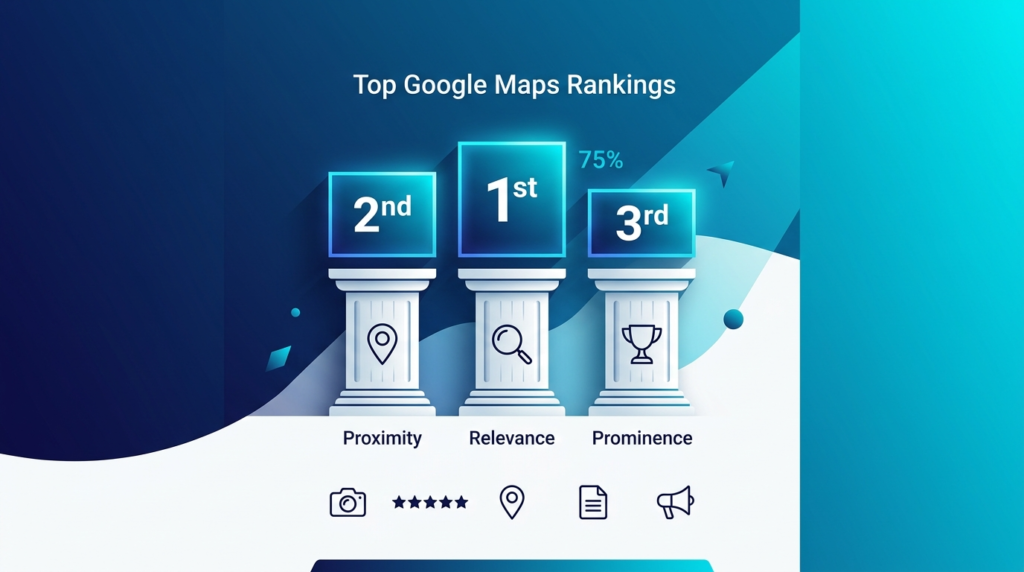
The answer almost never has anything to do with your craft. It has everything to do with how Google reads your Google Business Profile (formerly Google My Business). Detailing, PPF, ceramic coating, and window tinting are some of the most competitive local search categories in the auto industry, and the Local 3-Pack — those top three map results — captures roughly 75% of all clicks. If you’re not in it, you’re invisible.
This is the complete 2026 playbook to fix that. We’ll cover everything from picking the right primary category for a ceramic coating business to building a review engine that pulls in 50+ five-star reviews a year. Whether you run a mobile detailing operation, a single-bay tint shop, or a full ceramic coating and PPF studio, every tactic here is built for your vertical.
Why Most Detailing Shops Are Invisible on Google Maps (And the 3 Ranking Factors That Fix It)
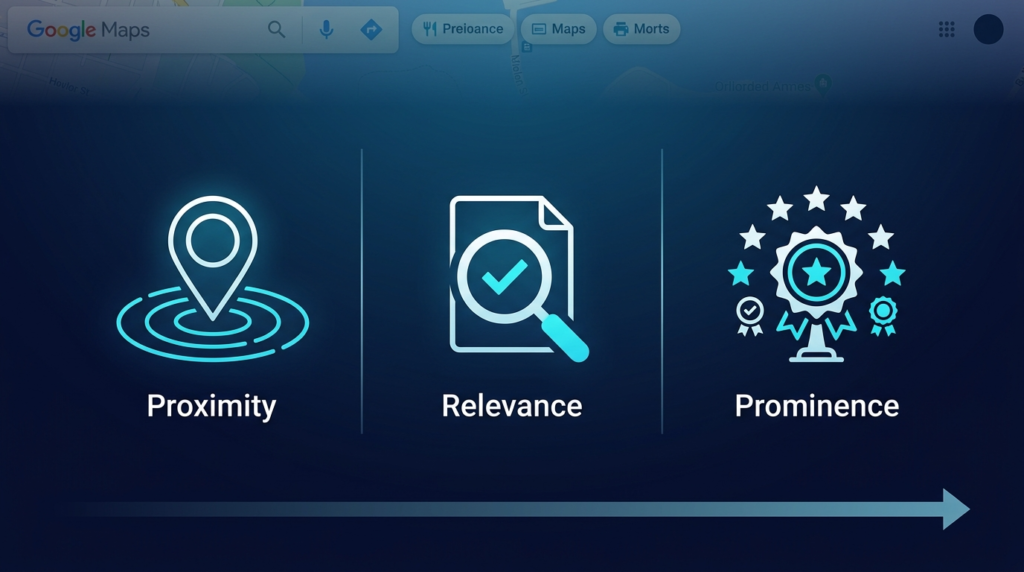
Most detailing shops are invisible on Google Maps because they fail one or more of Google’s three local ranking pillars: proximity, relevance, and prominence. Get all three right, and your shop ranks in the Map Pack. Miss one, and you’re buried — no matter how good your work is.
Google has been transparent about this. Local Pack rankings are determined by three factors, and every optimization tactic in this guide ladders back to one of them.
The Proximity Trap — Why Being “Down the Street” Isn’t Enough Anymore
Proximity is how close your business is to the searcher when they type a query. You can’t change your physical location, but you can change how Google understands your service area. For a storefront ceramic coating shop, proximity means the searcher needs to be near your address. For a mobile detailer, proximity means the searcher needs to be inside your service area.
This is where mobile detailers get burned. If you set a 50-mile service radius hoping to catch every possible customer, you dilute your relevance signal across too many zip codes. Google can’t figure out which city you actually dominate in, so it ranks you nowhere strongly. The 30-minute drive radius is almost always more effective than a 2-hour one.
Relevance — How Google Decides Your Shop Matches “Ceramic Coating Near Me”
Relevance is how well your profile matches what the searcher typed. Google reads your primary GBP category, secondary categories, services list, business description, reviews, and even your photo filenames to decide if you’re a match for “ceramic coating near me” or “PPF installer near me.”
The single biggest relevance lever is your primary category. We’ll get into the exact best categories for each vertical further down — this is where most shops leave rankings on the table.
Prominence — The Trust Stack Google Looks For
Prominence is Google’s measure of how established and trusted your business is. It’s built from review quantity and recency, citation consistency across the web, backlinks to your site, and signals like BBB accreditation, manufacturer authorizations from XPEL, Ceramic Pro, or Gtechniq, and certifications like the IDA Certified Detailer credential.
Prominence is the slowest pillar to build but the hardest for competitors to copy. A new shop can match your photos in a week. They cannot match your three-year review history overnight.
Storefront vs. Service Area Business — Choosing the Right Setup for Your Detailing Operation
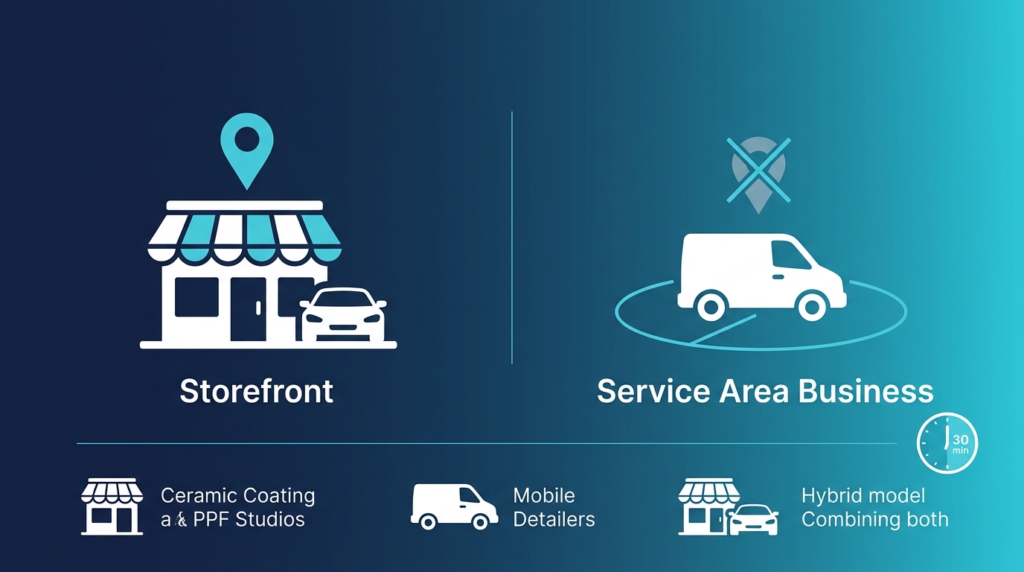
A storefront business has a public address customers visit; a Service Area Business (SAB) serves customers at their location and hides the address. Picking the wrong one can cripple your visibility — most ceramic coating, PPF, and tint shops should run as storefronts, while most mobile detailers should run as SABs.
Here’s the breakdown:
Setup | Best For | Address Display | Service Area |
Storefront | Tint shops, ceramic coating studios, PPF installers, fixed-bay detailers | Visible | Optional |
Service Area Business (SAB) | Mobile detailers, on-site PPF/coating (rare) | Hidden | Required |
Hybrid | Detailers with a shop and mobile service | Visible | Both |
When to Hide Your Address (And When Hiding It Hurts You)
Hide your address only if customers don’t visit your location — period. Mobile detailers working out of a residential garage absolutely should. But if you have a real shop with a sign on the door and customers drop their cars off, hiding the address is one of the worst ranking mistakes you can make. Google heavily favors verified storefronts in the Map Pack.
Setting a Realistic Service Radius — The 30-Minute Rule
For mobile detailers and hybrid operations, set your service area to roughly a 30-minute drive from your base. Listing 50 cities you’ll “technically” travel to looks like spam to Google and dilutes your relevance. Pick the 5–10 cities or zip codes you actually serve and dominate those.
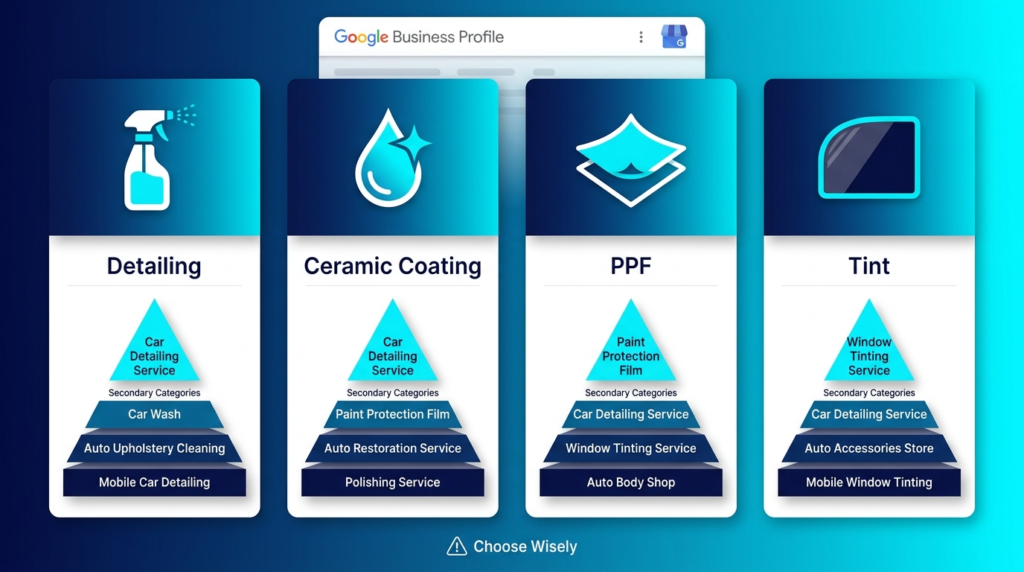
Picking the Right GBP Categories for Detailing, PPF, Coating & Tint (The Stack That Actually Ranks)
Your primary GBP category is the single most important relevance signal Google uses for local search rankings. The right primary category puts you in the running. The wrong one keeps you invisible no matter what else you optimize.
Here are the recommended category stacks for each vertical:
Best Primary Category for a Car Detailing Shop
Primary: Car detailing service Secondary: Auto restoration service, Car wash, Auto upholstery cleaning service, Window tinting service (if offered)
This stack tells Google you’re a full-service detailer with adjacent specialties. Don’t skip the secondary slots — Google uses them for relevance even though they don’t appear publicly.
Best Primary Category for a Ceramic Coating Business
Primary: Car detailing service Secondary: Auto restoration service, Paint protection film installer (if offered), Window tinting service (if offered)
Here’s the insight most articles miss: Google has no dedicated “ceramic coating” category. “Car detailing service” is the highest-relevance bucket Google offers for coating work. Reinforce the specialty in your business description, services tab, and Q&A — that’s where “9H ceramic coating,” “Gtechniq Crystal Serum Ultra,” and “graphene coating” live.
Best Primary Category for a PPF / Paint Protection Film Shop
Primary: Paint protection film supplier or Car detailing service (depending on whether PPF is your dominant revenue line) Secondary: Car detailing service, Auto restoration service, Window tinting service
If you do 70%+ PPF, lead with “Paint protection film supplier.” If PPF is one of several services, “Car detailing service” pulls more total searches. Either way, mention your XPEL, SunTek, 3M, or STEK authorizations directly in the description.
Best Primary Category for a Window Tinting Business
Primary: Window tinting service Secondary: Car detailing service, Auto sunroof shop (if applicable), Glass repair service (if offered)
The Hidden Risk of Picking the Wrong Primary Category
Changing your primary category later temporarily resets some local ranking signals — sometimes for several weeks. Pick correctly the first time. Tools like GMB Everywhere let you spy on what categories your top-ranking competitors use, which is the fastest way to validate your choice.
Writing a GBP Description That Sells (And Ranks) — Detailer's Template Inside
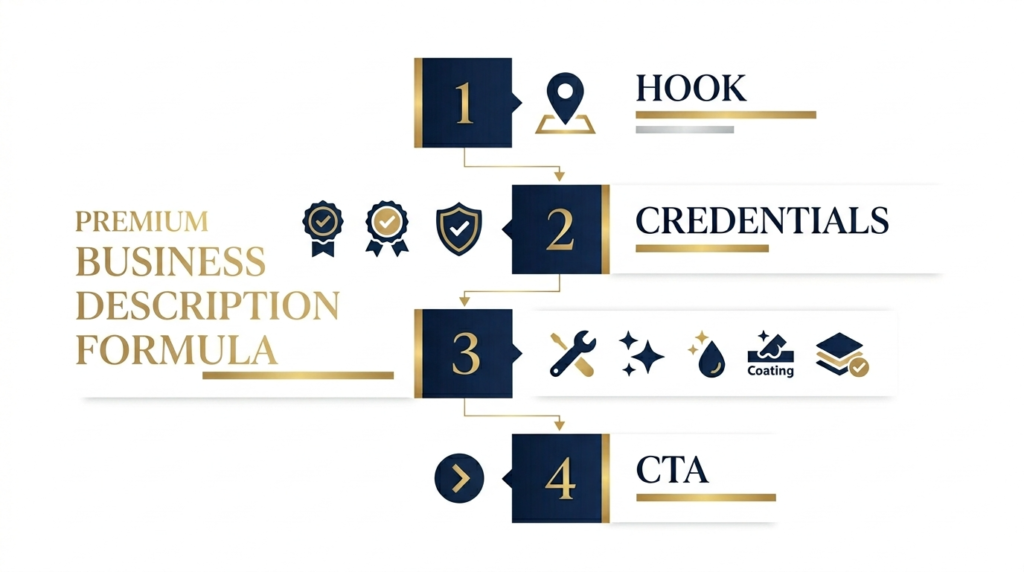
Your GBP business description should follow a 4-part formula: hook, credentials, services, and call-to-action — all within 750 characters. It won’t directly impact rankings, but it absolutely impacts click-through and conversion, both of which feed back into prominence.
The 4-Part Description Formula
- Hook (1 sentence): Who you are and where you serve
- Credentials (1–2 sentences): Certifications, brand authorizations, years in business
- Services (1–2 sentences): Core offerings with natural keyword placement
- CTA (1 sentence): Clear next step
3 Real-World Examples
Detailing shop example:
Premier Auto Spa is Austin’s family-owned car detailing service, established in 2014. Our IDA Certified Detailers specialize in paint correction, interior detail, and ceramic coating in a climate-controlled, dust-free facility. We protect your investment with documented pre/post inspections and a workmanship guarantee. Book your detail online or call us today.
Ceramic coating studio example:
Apex Coatings is a Ceramic Pro Authorized installer serving Dallas-Fort Worth since 2017. We apply Gtechniq Crystal Serum Ultra and Ceramic Pro 9H ceramic coatings backed by manufacturer-registered warranties up to 10 years. Every coating includes multi-stage paint correction and a documented vehicle inspection. Schedule your free consultation today.
PPF shop example:
ClearShield PPF is a Phoenix-based XPEL Certified Installer specializing in paint protection film, full-front PPF, and track packages. With over 2,000 vehicles wrapped and a Limited Lifetime Warranty on every install, we’re the trusted choice for Porsche, Tesla, and exotic owners across the valley. Request your free PPF quote online.
Notice how each template embeds entities (XPEL, Ceramic Pro, Gtechniq, IDA) and trust words (Certified, Authorized, Limited Lifetime Warranty, family-owned) without sounding like a keyword soup.
GBP Photos & Videos — The Detailer's Unfair Advantage
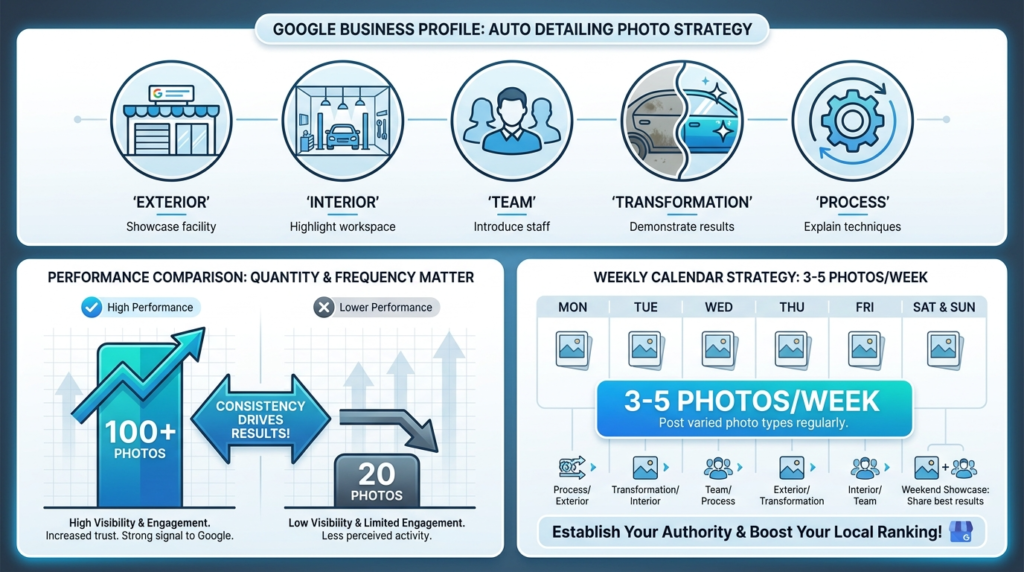
Detailing is a visual industry, and GBP photos directly influence both ranking and click-through rate. Shops with 100+ photos consistently outperform those with fewer than 20. This is your single biggest unfair advantage — most service businesses can’t visually demonstrate transformation. You can.
The 5 Photo Types Google Rewards (and Customers Click)
- Exterior facility shot — clean, branded, professional signage visible
- Interior bay or clean room — climate-controlled, dust-free, organized
- Team photos — humanizes the brand, builds trust
- Before-and-after transformation shots — paint correction, PPF install, coating beading
- Process shots — installation in progress, masking, polishing, taping
Should You Geotag Photos? (Honest Answer + Tools)
Google strips most EXIF metadata when photos upload, so traditional geotagging has limited direct SEO value. What still works: descriptive filenames. Save your photo as xpel-ppf-installation-austin-tx.jpg rather than IMG_4827.jpg before uploading. The filename is one signal Google retains.
How Often to Upload — The Weekly Rhythm That Signals an Active Business
Upload 3–5 new photos per week minimum. Google’s algorithm rewards profiles that show consistent activity, treating it as a freshness and legitimacy signal. Make it part of your workflow: end every detail or install with a 60-second photo session before the customer picks up.
The Review Engine — How Top Detailers Get 50+ 5-Star Reviews Per Year
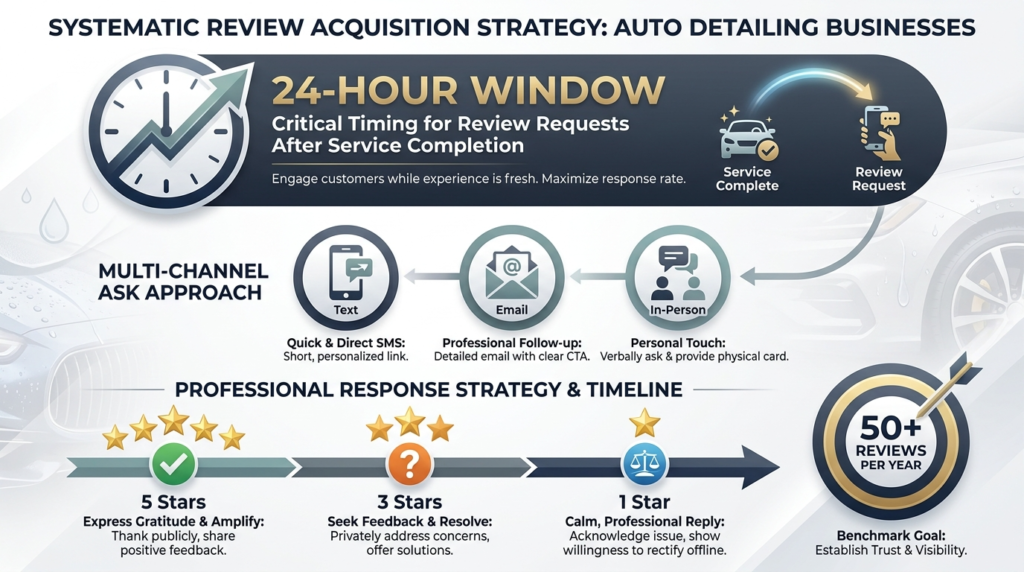
Top-ranking detailing shops average more than one 5-star review per week, achieved through a systematic ask process — not luck. Review velocity (how fast you accumulate reviews) and recency (how new your latest review is) are two of the strongest prominence signals Google measures.
When to Ask (The 24-Hour Window That Triples Response Rates)
Ask within 24 hours of pickup or delivery, while the customer is still emotionally connected to the result. Wait a week and response rates drop by more than half. The best moment is right after the customer sees the finished car for the first time.
How to Ask Without Sounding Desperate — Scripts for Text, Email & In-Person
Text script:
Hey [Name], hope you’re loving how the car turned out! If you have 60 seconds, would you mind leaving us a quick Google review? It genuinely helps our small shop. [Direct Google review link]
Email script:
Subject: Quick favor — and thank you Hi [Name], thank you for trusting us with your [vehicle]. We pour everything into our work and customer reviews are how other car owners find us. If you have a minute to share your experience on Google, here’s the direct link: [link]. Thanks again — it means more than you know.
In-person script:
“Most of our new customers come from Google reviews. If you’re happy with the work, would you mind leaving us one before you head out? I can text you the link right now.”
How to Respond to Reviews (Including the 1-Star Bombs)
Respond to every review within 24–48 hours. For 5-star reviews, thank them by name and reference the specific service. For 3-star reviews, acknowledge what worked and ask how you could earn the missing two stars. For 1-star reviews, never argue publicly — apologize briefly, take it offline, and let your professionalism speak louder than the complaint.
Are Review Gating & Incentives Worth the Risk?
No. Google’s terms of service prohibit review gating (filtering happy customers to Google and unhappy ones to a private form) and incentivized reviews. Both can trigger a profile suspension. The long game — earning genuine reviews through great work and a clean ask — wins every time.
💡 Want our 1-page GBP Audit Checklist for detailing shops? Grab the free PDF →
Google Posts, Q&A, and Services — The 3 Underused Features That Move the Needle
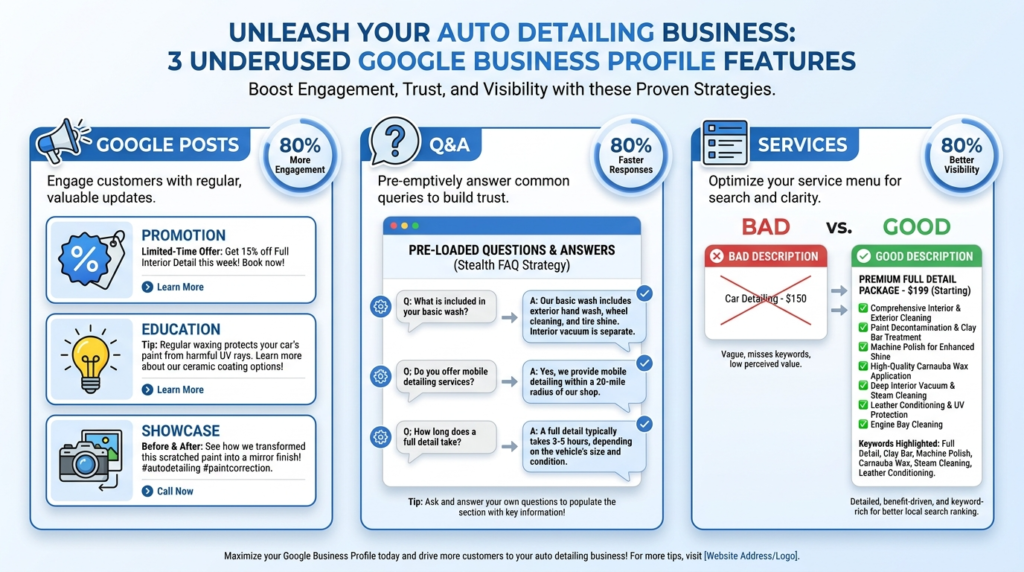
Google Posts, the Q&A section, and the Services tab are three GBP features most detailers ignore — and they’re exactly where you can leapfrog competitors. Each one is a free relevance and engagement signal, and using them consistently puts you ahead of 80% of local shops.
Google Posts — Weekly Templates for Detailers
Post at least once a week. Three formats that consistently perform:
- Promotion post: “Save $100 on full-front XPEL Ultimate Plus PPF this month — book by [date].”
- Education post: “What’s the difference between graphene and ceramic coating? Graphene resists water spotting better in humid climates.”
- Showcase post: Recent finished work with a one-line story behind it.
Seeding Your Own Q&A — The “Stealth FAQ” Tactic
Google allows business owners to post and answer questions on their own profile. This is a wide-open opportunity. Pre-load common questions like:
- “Do you offer mobile ceramic coating?”
- “What’s the warranty on XPEL Ultimate Plus PPF?”
- “Is your tint shop legal in [state]?”
- “How long does a full ceramic coating take?”
Each answer is another keyword-rich relevance signal living on your profile.
Filling Out the Services Tab With Keyword-Rich Descriptions
Every service entry is a mini SEO opportunity. Don’t write “Ceramic Coating — $1,500.” Write:
9H Nano-Ceramic Coating — Multi-stage paint correction followed by Gtechniq Crystal Serum Ultra ceramic coating with a 7-year manufacturer-backed warranty. Ideal for new vehicles and daily drivers.
That’s three entities (Gtechniq, Crystal Serum Ultra, paint correction), one trust word (manufacturer-backed warranty), and a clear description — all working for you.
NAP Consistency, Citations & Schema — The Technical Foundation Most Detailers Skip
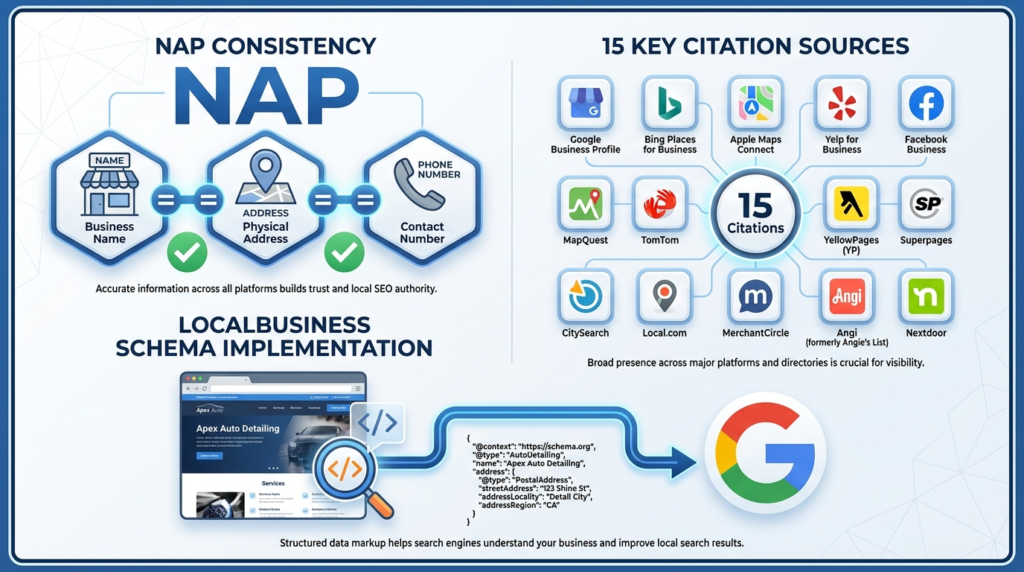
NAP stands for Name, Address, and Phone number, and it must be identical across every online listing — Google, Yelp, Facebook, BBB, and beyond. Inconsistencies confuse Google and weaken your prominence. Citation consistency is one of the highest-ROI technical fixes you can make.
The 15 Citations Every Detailer Must Lock Down
- Google Business Profile
- Bing Places
- Apple Maps (via Apple Business Connect)
- Yelp
- Better Business Bureau (BBB)
- Facebook Business Page
- Nextdoor
- Yellow Pages
- Foursquare
- Angie’s / Angi
- Thumbtack
- Manta
- Hotfrog
- MerchantCircle
- Local Chamber of Commerce listing
Tools like BrightLocal, Whitespark, and Yext can automate citation discovery and cleanup.
Adding LocalBusiness Schema to Your Website
Schema.org markup tells Google exactly what your website is about. Use the AutomotiveBusiness or AutoDetailing schema type with your full NAP, hours, and services. Most modern WordPress SEO plugins (Rank Math, Yoast) handle this in a few clicks.
Tracking What's Working — GBP Insights, Local Falcon, and the Numbers That Matter
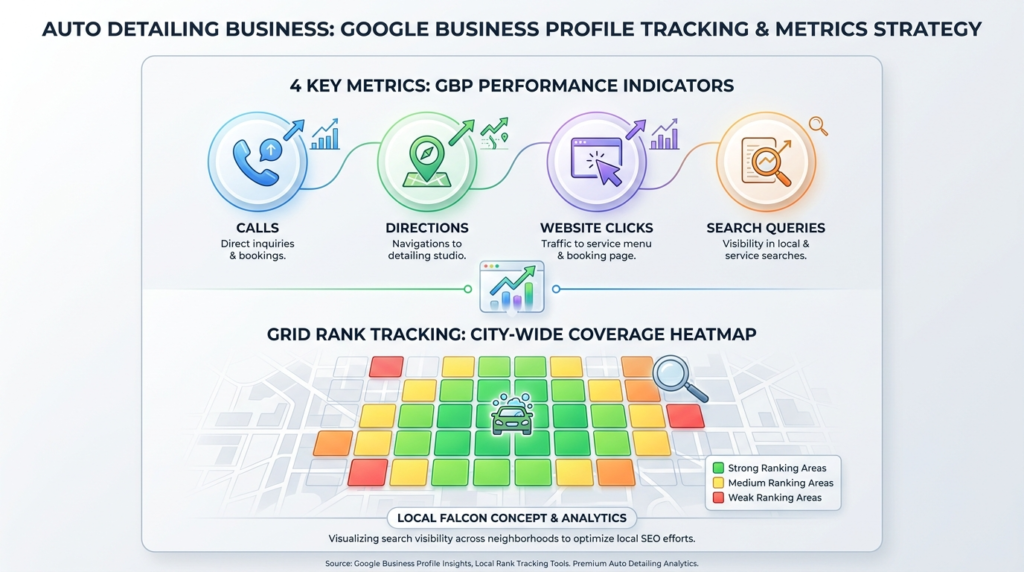
You can’t optimize what you don’t measure. GBP Insights and grid rank tracking tools like Local Falcon show exactly where you rank across your city — and where you’re losing.
The 4 Metrics Every Detailing Shop Owner Should Watch Monthly
- Calls — direct phone calls from your GBP listing
- Direction requests — high-intent buyers heading to your shop
- Website clicks — researchers comparing options
- Search queries that triggered your profile — shows the keywords actually finding you
Grid Rank Tracking — How to See Where You Actually Rank Across Your City
GBP Insights shows aggregate performance, but it doesn’t show where in your city you rank. Local Falcon generates a heatmap-style grid showing your Map Pack position in dozens of locations across your service area. You’ll instantly see which neighborhoods you dominate and which ones competitors own.
Your 30-Day GBP Optimization Action Plan
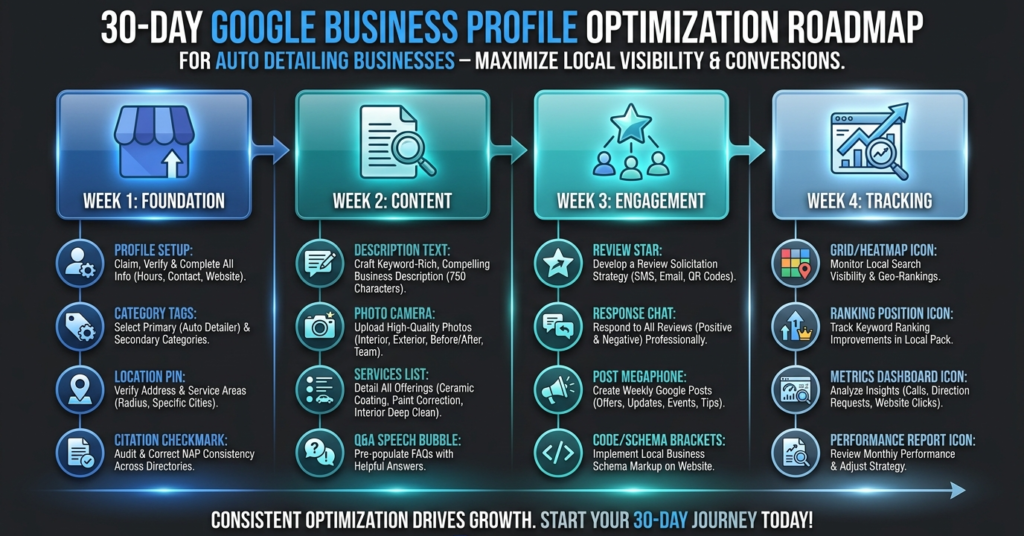
Here’s how to put everything above into motion. Block out 60–90 minutes a week and follow this sequence.
Week 1 — Foundation
- Claim and verify your Google Business Profile
- Set the correct primary and secondary categories
- Decide storefront vs. SAB and configure correctly
- Audit and standardize NAP across your top 15 citations
Week 2 — Content
- Rewrite your business description using the 4-part formula
- Upload 20+ photos with descriptive filenames
- Fill out every service in the Services tab with keyword-rich descriptions
- Post 5–10 stealth Q&As on your own profile
Week 3 — Reviews & Engagement
- Set up a review request workflow (text and email scripts)
- Respond to every existing review (yes, even the old ones)
- Publish your first Google Post and schedule weekly going forward
- Add LocalBusiness schema to your website
Week 4 — Tracking & Iteration
- Install Local Falcon or BrightLocal for grid rank tracking
- Document baseline rankings across 5–10 keywords
- Set a monthly review of GBP Insights metrics
- Plan the following month’s Google Posts calendar
💡 Want this 30-day plan executed for you? Book a free GBP audit →
Frequently Asked Questions About SEO for Auto Detailing Businesses
Most detailing shops see noticeable Map Pack ranking improvements within 60–90 days of consistent GBP optimization. Established shops with existing reviews can move faster — sometimes within 30 days. Brand-new profiles typically need 3–6 months to build the prominence signals Google requires for top positions.
The best primary category for a ceramic coating business is Car detailing service, because Google does not currently offer a dedicated "ceramic coating" category. Reinforce the specialty by mentioning ceramic coating, Gtechniq, Ceramic Pro, or graphene coating in your business description, services tab, and Q&A.
Your detailing shop probably isn't showing on Google Maps because of one of three issues: your profile isn't verified, your primary category is wrong, or your prominence signals (reviews, citations, photos) are too weak. Verify the listing first, fix the category second, and start the review engine third.
Yes, mobile detailers operating from a home or non-public location should hide their address and configure their profile as a Service Area Business. Hiding the address is required by Google's terms when the location isn't a customer-facing storefront, and it allows you to specify the cities or zip codes you actually serve.
Aim for at least 100 photos on your Google Business Profile, then add 3–5 new photos per week ongoing. Detailing shops with active photo uploads consistently outrank those with stale profiles, because Google treats fresh visual content as a sign of an active, legitimate business.
Yes, mentioning manufacturer authorizations like XPEL Certified Installer, Ceramic Pro Authorized, or Gtechniq Approved Detailer significantly boosts trust and conversion. These credentials function as third-party validation, helping both customers and Google's prominence algorithm recognize your shop as a vetted, professional installer.
The fastest way to get more Google reviews is to ask every customer within 24 hours of vehicle pickup, using a direct Google review link sent by text or email. Shops that systematize this single step typically triple their monthly review count within 90 days.
Yes, you absolutely still need GBP optimization even if you run Google Ads. Ads buy you visibility temporarily; GBP optimization earns you the free, organic Map Pack visibility that 75% of clicks actually go to. The two work together — most successful detailing shops use both.
Google Business Profile and Google My Business are the same product — Google rebranded "Google My Business" to "Google Business Profile" in 2021. The features and dashboard are identical. Both names still appear in search, but Google Business Profile is the current official name.
Changing your primary GBP category is safe but can cause a temporary 2–6 week dip in rankings while Google re-evaluates relevance. If you suspect your current category is wrong, change it once — correctly — and avoid further switches. Frequent category changes hurt more than they help.
A website isn't strictly required, but it's strongly recommended. Your website strengthens GBP rankings through backlinks, schema markup, and content depth — and it's where customers go to verify legitimacy before booking. Detailers with both a strong GBP and a quality website consistently outrank those with just one.
Google Business Profile optimization is ongoing, not one-time. The initial setup takes 4 weeks; the maintenance — weekly posts, photo uploads, review responses, and rank tracking — takes about 60 minutes per week. Shops that treat GBP as ongoing dominate the Map Pack year after year.
Final Word — From Invisible to Booked Solid
The detailing industry rewards craft. The Google Maps Map Pack rewards systems. The shops winning local search aren’t necessarily doing the best work — they’re doing the most consistent Google Business Profile optimization. They’ve nailed proximity by setting the right service area. They’ve nailed relevance with the correct primary category and a description packed with the right entities. And they’ve nailed prominence through reviews, citations, photos, and a steady drumbeat of Google Posts.
You can absolutely run this playbook yourself. The 30-day plan above is the exact sequence we use with detailing, PPF, ceramic coating, and tint clients. But if you’d rather keep your hands on cars instead of on dashboards, that’s what we do at autodetailingseo.com — local SEO built specifically for the auto detailing industry.
Either way, the next 90 days decide whether you stay invisible or start showing up first when someone in your city searches “ceramic coating near me.” The work is in your hands.