Auto Detailing SEO Checklist: 10 Things Your Website Must Have to Rank, Convert, and Grow in 2026
You run a detailing shop that turns out flawless ceramic coatings, crisp PPF installs, and window tints that look factory-spec. So why is a mediocre competitor ten miles down the road getting all the calls?
The answer is almost always the same: their website works harder than yours does.
Your website is either your hardest-working salesperson or your most expensive brochure. There’s no middle ground. In 2026, a detailing business without a properly optimized website is leaving real money on the table every single day — money that’s getting picked up by whoever ranks above you in the Google Maps Pack.
This auto detailing SEO checklist walks you through the 10 non-negotiable elements every ceramic coating, PPF, window tinting, and detailing website needs to rank, convert visitors into customers, and grow predictably. No fluff, no generic marketing theory — just the specific fixes that move the needle for service businesses like yours.
Why Most Auto Detailing Websites Fail to Rank (And Cost You Jobs)
Here’s the uncomfortable truth: most detailing websites are built by generic web designers who have never thought about how Google evaluates a local service business. They deliver something that looks nice and call it done.
But a pretty website isn’t the same as a ranking website, and a ranking website isn’t automatically a converting website.
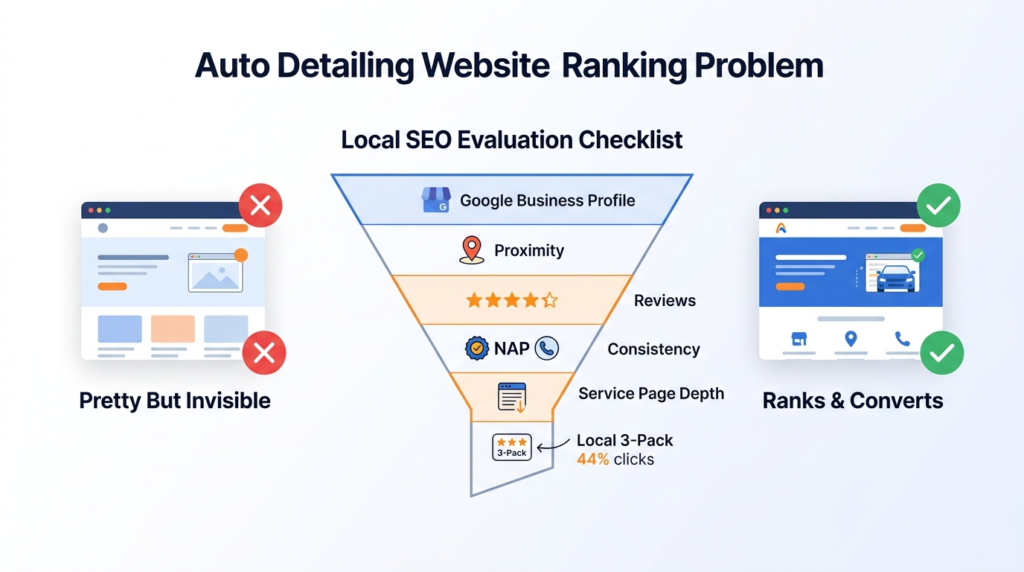
Google doesn’t evaluate your detailing site the way it evaluates an e-commerce store or a blog. It evaluates it through the lens of local SEO — looking at your Google Business Profile, your proximity to the searcher, your review signals, your NAP consistency across the web, and the depth of service information on your actual pages. Miss any of these, and you’re invisible in the Local 3-Pack where 44% of local clicks happen.
The detailers who win online in 2026 aren’t necessarily the best detailers in town. They’re the ones whose websites check every box on the list below.
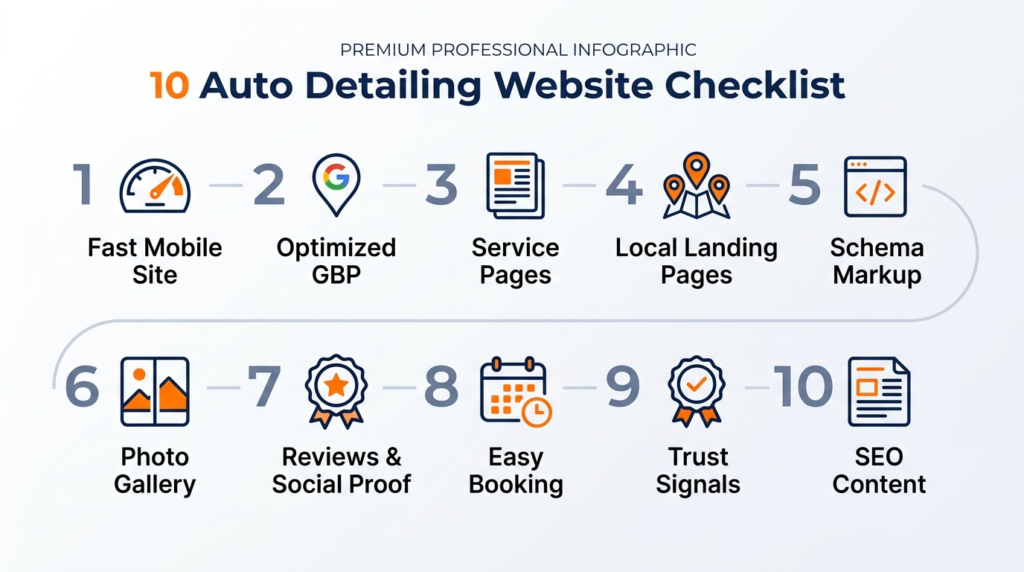
The 10-Point Auto Detailing Website Checklist
Jump to any section, or work through them in order. Either way, by the end you’ll know exactly what’s working, what’s broken, and what to fix first.
1. A Fast, Mobile-First Website (Under 3-Second Load Time)
The direct answer: Your detailing website must load in under 3 seconds on a mobile phone, or you’re losing more than half your potential leads before they ever see your work.
Over 70% of “detailing near me,” “ceramic coating near me,” and “window tint shop near me” searches happen on mobile devices — usually from someone sitting in a parking lot or driveway, making a decision right now. If your site takes 5 seconds to load, 53% of those visitors have already bounced back to Google and clicked on your competitor.
Google measures this through Core Web Vitals, three specific metrics that form part of its Page Experience signals:
- Largest Contentful Paint (LCP): How fast your main content loads — should be under 2.5 seconds
- Interaction to Next Paint (INP): How responsive your site feels when tapped — should be under 200ms
- Cumulative Layout Shift (CLS): How stable the page is as it loads — should be under 0.1
Quick test: Open your site on your phone right now, over cellular data, not WiFi. Time it. If you’re waiting more than three seconds, you have a problem.
Run a free check at Google’s PageSpeed Insights tool. Oversized gallery photos are the #1 culprit in the detailing industry — those stunning 8MB before-and-after shots are silently killing your rankings.
2. An Optimized Google Business Profile Linked to Your Site
The direct answer: Your Google Business Profile is your local SEO foundation — a fully optimized GBP linked to your website will drive more leads than almost anything else you do online.
Think of your GBP as the front door to your digital shop. When someone searches “best ceramic coating near me,” Google pulls the top three results into the Maps Pack based largely on GBP signals — not your website alone.
To optimize properly:
- Claim and verify your profile at google.com/business
- Ensure NAP consistency (Name, Address, Phone) matches exactly between your GBP, your website footer, and every citation across Yelp, BBB, Angi, and Thumbtack
- Choose the most specific primary category available — “Car Detailing Service” for most, “Window Tinting Service” or “Car Wrapping Service” for niche specialists
- Add every secondary service you offer with detailed descriptions
- Upload fresh photos weekly — Google rewards active profiles, and detailing is a visual service
- Post updates, offers, and new work through GBP Posts at least twice a month
- Respond to every single review, positive or negative, within 48 hours
The detailers dominating local search treat their GBP as seriously as their physical shop. It deserves 30 minutes a week, minimum.
3. Dedicated Service Pages for Each Offering (Ceramic Coating, PPF, Tint, Detailing)
The direct answer: Every high-value service you offer needs its own dedicated, keyword-optimized page — bundling everything onto a single “Services” page is one of the most common mistakes in the detailing industry.
Someone searching for “paint protection film installer near me” has completely different intent than someone searching for “interior detailing” or “nano-ceramic coating.” They’re looking for specialists, not generalists. One catch-all page can’t rank for multiple commercial-intent keywords.
At minimum, your site should have separate, in-depth pages for:
- Ceramic Coating (covering SiO2, graphene, and nano-ceramic options)
- Paint Protection Film / Clear Bra (including self-healing film, partial front, and full-body wraps)
- Window Tinting (with specifics on VLT percentages, ceramic vs. dyed film, heat rejection, and IRR ratings)
- Paint Correction (one-stage, two-stage, swirl mark removal)
- Full Detailing (interior, exterior, engine bay, headlight restoration)
Each page should include: what the service is, what problem it solves, what brands you install (XPEL, SunTek, 3M, Gtechniq, CQuartz, Ceramic Pro, Feynlab), what your process looks like, what it costs, what warranty it carries, and what the results look like.
This isn’t padding — it’s the depth Google expects for a commercial-intent page to rank.
4. Local Landing Pages for Every City and Service Area You Cover
The direct answer: If you serve five cities, you need five separate city landing pages — not one “Service Areas” page with a bulleted list of town names.
This is how mobile detailers and shops with wide service radiuses dominate local search beyond just their immediate area. Each landing page targets a geo-specific query like “ceramic coating [City Name]” or “mobile detailing [City Name].”
The key is making each page genuinely useful, not thin duplicate content. A strong city page includes:
- Unique opening that references the specific city, its driving conditions, local landmarks, or neighborhoods served
- Services offered in that specific area
- Local testimonials from customers in that city
- Pricing or packages (even “starting at” ranges help)
- A clear call-to-action with local phone number or booking link
- Embedded map and driving directions if you have a physical location nearby
Done right, city pages turn one shop into a regional presence. Done lazily — by copying the same 200 words and swapping city names — they get flagged as spam and can actually hurt your rankings.
5. Proper Schema Markup (LocalBusiness + Service Schema)
The direct answer: Schema markup is structured code that tells Google exactly what your business is, what it does, and who it serves — and without it, you’re making search engines guess.
Think of schema as labeling a parts bin. You know what’s inside, but unless it’s labeled clearly, anyone looking has to dig through and hope. Schema labels everything for Google.
The three types every detailing website should implement:
- LocalBusiness schema (or the more specific AutoRepair schema) — establishes your business name, address, phone, hours, and service area
- Service schema — defines each offering (ceramic coating, PPF, window tint) as a distinct service with its own description and price range
- Review schema — surfaces your star ratings directly in search results as rich snippets, dramatically improving click-through rates
Properly implemented schema is invisible to users but gives Google the clarity it needs to rank you for the right queries. It also directly supports how AI-powered search (Google’s AI Overviews, ChatGPT, Perplexity) understands and recommends your business.
If your current site doesn’t have schema, you’re competing with one hand tied behind your back.
6. A High-Converting Before-and-After Photo Gallery
The direct answer: A properly organized before-and-after gallery is the single most powerful conversion tool on a detailing website — but only if it’s optimized so Google can actually see it.
Prospects buying a $2,000 ceramic coating or a $7,000 full PPF wrap are making a high-trust purchase. They need visual proof that you deliver showroom finish results. A gallery delivers that proof.
To make it work for both conversion and SEO:
- Organize by service — separate galleries for ceramic coating, PPF, paint correction, and interior detailing
- Use descriptive file names — “black-porsche-911-ceramic-coating-dallas.jpg” not “IMG_2847.jpg”
- Write real alt text — describe what’s in each image naturally: “Two-stage paint correction removing swirl marks from a black Tesla Model 3”
- Compress aggressively — use WebP format, keep each image under 200KB
- Enable lazy loading — images load as the visitor scrolls, not all at once
- Include captions with context — service performed, vehicle, city, any relevant details
A strong gallery doesn’t just convert — it ranks. Those descriptive file names and alt texts feed directly into Google Images search, which drives meaningful traffic for a visual industry like detailing.
7. Verified Reviews and Social Proof Above the Fold
The direct answer: Reviews don’t just build trust — they’re a direct ranking factor, and placing your best social proof above the fold (visible without scrolling) can lift conversion rates by 30% or more.
Google’s local algorithm weighs three review signals heavily:
- Total review count (quantity)
- Average star rating (quality)
- Recency of reviews (freshness)
A detailer with 150 reviews averaging 4.9 stars will consistently outrank one with 20 reviews, even if the latter is closer to the searcher.
On your website, social proof should appear:
- In the hero section — a star rating badge, review count, and one standout testimonial visible the moment the page loads
- On every service page — testimonials specific to that service (ceramic coating testimonials on the ceramic page, PPF testimonials on the PPF page)
- As a dedicated reviews page — pulling in verified reviews from Google, Yelp, and Facebook
- With Review schema — so star ratings appear directly in Google search results
Ask every satisfied customer for a review. Send a follow-up text with a direct Google review link 24 hours after the job. Detailers who systematize this grow their review count by 5–10 per month, which compounds into dominant local rankings within a year.
8. Clear, Friction-Free Online Booking and Contact Options
The direct answer: Every extra click between a visitor and booking your service costs you conversions — your website needs online booking, click-to-call, and a quote form all visible within two seconds of landing.
The modern detailing customer expects to book a ceramic coating the same way they book a haircut or a dinner reservation. If your only contact option is a generic form that promises “we’ll get back to you within 24-48 hours,” you’re losing high-intent leads to any competitor offering instant booking.
Essential conversion elements:
- Click-to-call button prominently displayed, especially on mobile (one tap, they’re calling you)
- Online booking widget showing real availability for at least your most popular services
- Quick quote form — name, vehicle, service interested in, preferred contact method (keep it under 5 fields)
- Messaging options — SMS and WhatsApp buttons for lower-friction inquiries
- Sticky contact bar — phone and book-now buttons that stay visible as visitors scroll
Transparent pricing matters too. You don’t have to publish exact prices, but “Ceramic Coating starting at $1,200” sets expectations and filters out tire-kickers. Free estimates and no-risk consultations should be featured prominently as trust-building CTAs.
9. Trust Signals That Build E-E-A-T (Certifications, Warranties, Credentials)
The direct answer: Google’s E-E-A-T framework (Experience, Expertise, Authoritativeness, Trustworthiness) heavily rewards sites that display real credentials — and detailers have more untapped trust signals than almost any other service industry.
Every certification, every authorized dealer badge, every manufacturer partnership is an E-E-A-T goldmine that most detailers bury on an “About” page no one reads. Bring them forward.
Trust signals to feature prominently:
- Manufacturer certifications: XPEL Certified Installer, SunTek PPF Installer, 3M Authorized Dealer, Ceramic Pro Installer, Gtechniq Accredited Detailer, Feynlab Certified
- Industry credentials: IDA Certified Detailer (CD), Skilled Auto Enthusiast (SAE), International Detailing Association membership
- Warranty backing: Lifetime warranty on PPF, 10-year warranty on ceramic coating, manufacturer-backed protection (specify transferable warranties where applicable)
- Business credentials: Licensed, insured, bonded, BBB Accredited, years in business
- Experience indicators: “Over 3,000 vehicles protected since 2015” carries real weight
- Media mentions: “Featured in” badges if you’ve been covered by local news or industry publications
These signals tell both Google and your prospect that you’re not a weekend detailer working out of a driveway — you’re a factory-certified, manufacturer-trained installer with real accountability. That’s the difference between a $200 wash job and a $5,000 ceramic coating lead.
10. SEO-Optimized Content: Service Descriptions, FAQs, and a Blog
The direct answer: Content is what actually ranks on Google — thin service descriptions don’t stand a chance against competitors publishing genuinely useful information that answers customer questions.
This final checklist item separates detailing sites that plateau at page 2 from those that dominate page 1.
Three content layers every detailing site needs:
- In-depth service descriptions — 800–1,500 words per core service page, covering what it is, how it works, what to expect, pricing, and warranty details
- Robust FAQ sections — answering real questions like “how long does ceramic coating last,” “is PPF worth it,” “what’s the difference between ceramic and graphene coating“
- An active blog — publishing educational content monthly: “Ceramic Coating vs. PPF: Which Does Your Car Actually Need,” “How to Maintain Your Ceramic Coating Between Services,” “What Window Tint Percentage Is Legal in [State]”
A blog isn’t vanity — it’s a compounding asset. Every article is a new entry point where someone searching an informational query (“how much does ceramic coating cost”) lands on your site, trusts your expertise, and books a service six weeks later when they’re ready.
Content is also how you earn real estate in AI search results. When someone asks ChatGPT or Perplexity about ceramic coating, the sites with deep, authoritative content get cited. The sites with a skimpy 200-word services page get ignored.
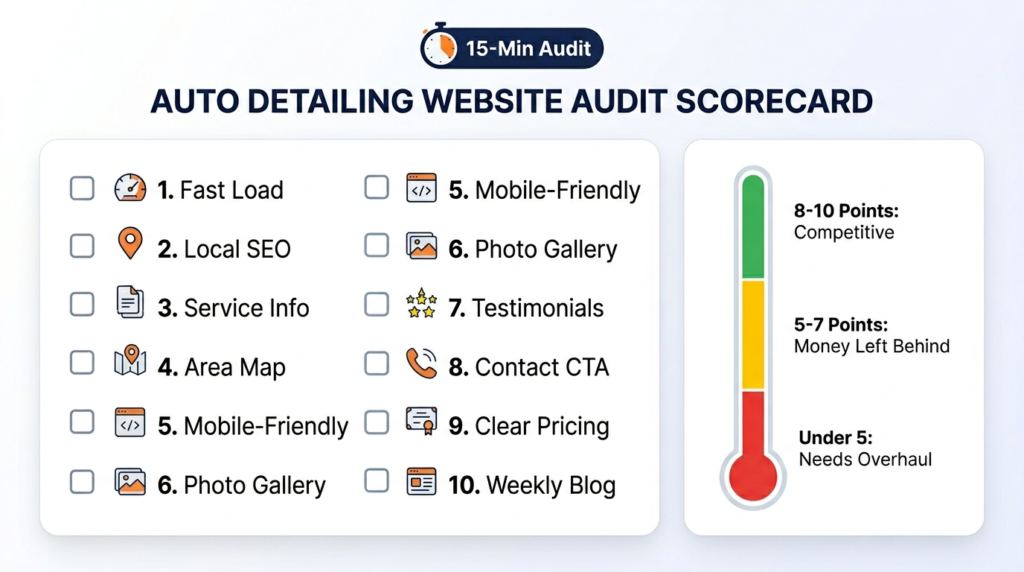
How to Audit Your Current Detailing Website in 15 Minutes
Run your own site through these 10 checkpoints and score yourself honestly. Give yourself one point for each item that fully passes.
- Loads in under 3 seconds on mobile (test at PageSpeed Insights)
- Google Business Profile claimed, optimized, and linked
- Dedicated service pages for each core offering
- Individual city landing pages for each service area
- LocalBusiness, Service, and Review schema implemented
- Before-and-after gallery organized by service with proper alt text
- Reviews and star rating visible above the fold
- Click-to-call, online booking, and quote form all one tap away
- Certifications, warranties, and credentials featured prominently
- Blog with at least monthly new posts and 800+ word service pages
Scoring:
- 8–10: Your site is competitive. Focus on refinement and content velocity.
- 5–7: You’re leaving serious money on the table. Fix the gaps systematically.
- Under 5: Your website is costing you more than it’s earning. Full overhaul recommended.
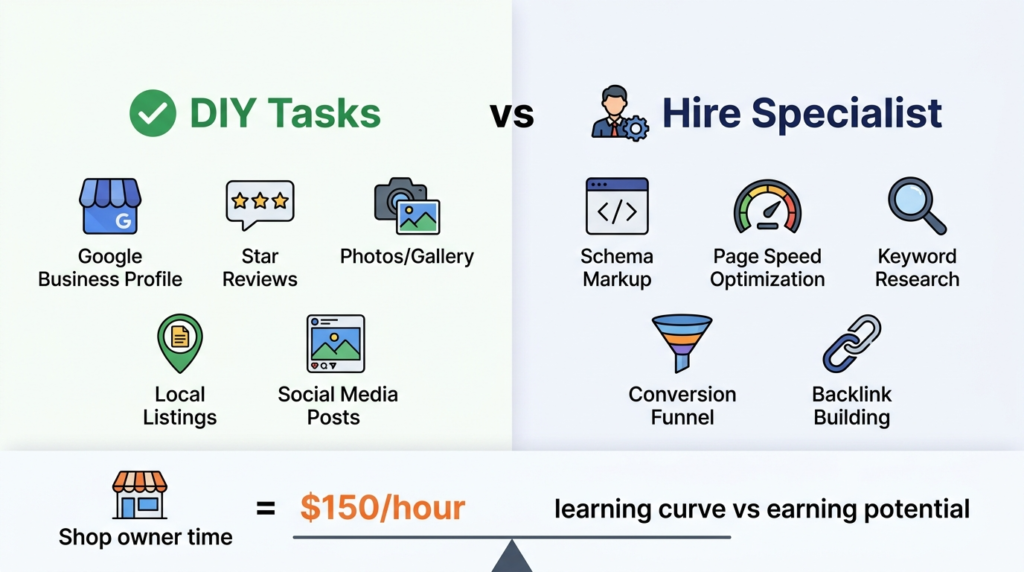
When to DIY Your Detailing SEO vs. Hire a Specialist
Not everything on this checklist requires a professional. Here’s an honest breakdown:
What most detailing owners can handle themselves:
- Claiming and optimizing your Google Business Profile
- Requesting reviews systematically from customers
- Taking and uploading better gallery photos
- Writing authentic city-specific content
- Posting regularly to GBP and social media
What typically requires a specialist:
- Technical SEO audits and schema markup implementation
- Core Web Vitals optimization and page speed
- Keyword research and content strategy
- Conversion rate optimization
- Backlink building and local citation cleanup
The owner who built a ceramic coating business from scratch has every skill needed to tackle the first list. But spending 15 hours a week learning schema markup when you could be installing PPF at $150/hour isn’t smart math.
The right move depends on your growth stage, your time, and what your website is currently costing you in missed leads.
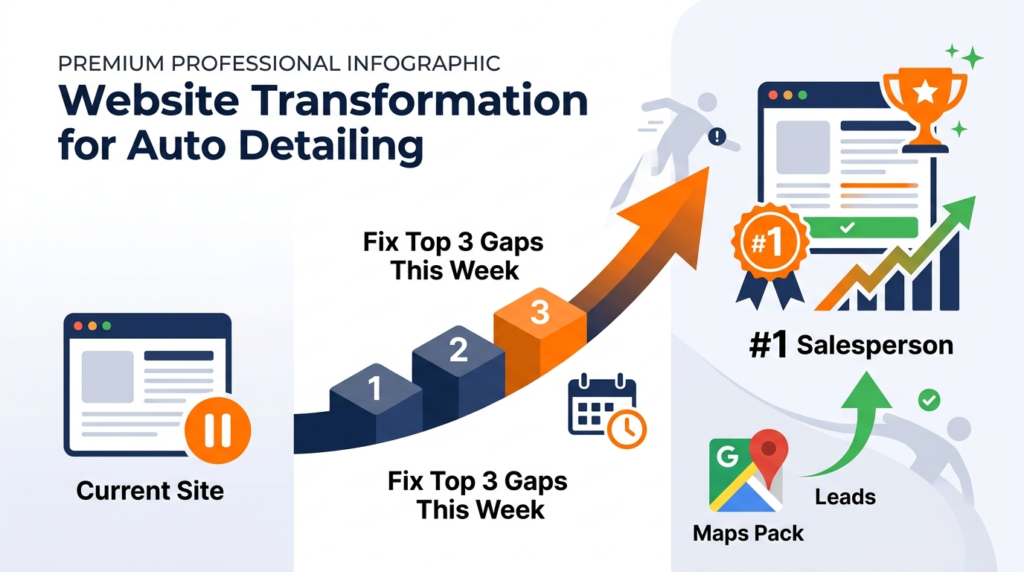
Ready to Turn Your Website Into Your #1 Salesperson?
If you’ve read this far, you already know where your site stands.
The detailers who will dominate their local markets over the next five years are the ones investing in digital now — before their competitors figure it out. Every month of ranking below the Maps Pack is another month of leads going to someone else’s shop.
Whether you tackle this checklist yourself or bring in help, start today. Open your site, run it through the 15-minute audit above, and pick the three biggest gaps to fix this week.
Your work is already premium. It’s time your website matched it.
Frequently Asked Questions About SEO for Auto Detailing Businesses
Most auto detailing websites start seeing meaningful ranking improvements within 3 to 6 months of implementing proper SEO, with significant results typically visible by month 9. Local SEO moves faster than national SEO because of Google Business Profile signals and lower keyword competition in most service areas. Consistent review generation, content publishing, and technical optimization compound over time.
Yes — your Google Business Profile and your website work together, not as substitutes for each other. A GBP alone caps your visibility at the Maps Pack and can't rank for informational queries like "ceramic coating vs PPF." Your website supports your GBP with the depth Google needs to verify your expertise, while GBP drives local visibility. Detailers with both consistently outperform those with only one.
Most established auto detailing businesses invest between $800 and $3,500 per month on professional SEO, depending on market size and competition. Shops in major metros with competitive ceramic coating and PPF markets typically need to invest more. The better measure is ROI — if SEO generates three ceramic coating leads per month averaging $1,500 each, that's $4,500 in monthly revenue from a single ranking service page.
For a local detailing shop, the single most important SEO factor is your Google Business Profile combined with review signals — particularly review count, average star rating, and review recency. These factors disproportionately influence Local 3-Pack rankings, which drive the majority of "near me" searches. A detailer with 100+ recent five-star reviews and an optimized GBP will often outrank competitors with larger websites.
The fastest way to get more Google reviews for your car detailing business is to send every customer a follow-up text with a direct review link within 24 hours of service completion. This simple system typically generates 5 to 10 new reviews per month for an average shop. Make it frictionless — one tap from the text opens the review form on their phone.
Yes, each service requires its own targeted SEO strategy because searchers use completely different keywords and have different intent. Ceramic coating searches often focus on longevity and brand comparisons, PPF searches prioritize installer certifications and warranty terms, and window tinting searches emphasize legal tint percentages and heat rejection. Generic service pages can't rank for any of them effectively.
A professionally built, SEO-optimized detailing website typically costs between $3,500 and $12,000 upfront, depending on the number of services, service area pages, and custom features. Mobile detailing businesses with multiple city pages fall at the higher end. Ongoing SEO maintenance is separate and usually runs monthly. Compared to the lifetime value of a properly ranking site, this is one of the highest-ROI investments a detailing business can make.
Ranking is possible without a blog, but it's significantly harder and limits your long-term growth ceiling. A blog captures informational searches ("how long does ceramic coating last") that your service pages can't rank for, builds topical authority, and positions you as the expert in your market. Detailers without a blog typically plateau at a certain ranking level while competitors who publish regularly keep climbing.
You can tell if your SEO company is doing good work by tracking three specific metrics monthly: your Google Business Profile ranking for your top keywords, the number of calls and form submissions from your website, and your Google Search Console impressions and clicks. A legitimate SEO provider reports on these transparently. If you're getting monthly invoices but no clear data on what's improving, that's a red flag.
An IDA Certified Detailer has passed standardized testing through the International Detailing Association, verifying their knowledge of professional detailing techniques, chemistry, and safety. A regular detailer has no verified credentials beyond their own claims. This certification is a genuine E-E-A-T signal that builds trust with both customers and search engines — and it should be featured prominently on your website if you've earned it.
Yes, manufacturer certifications like XPEL, SunTek, Ceramic Pro, and Gtechniq are absolutely worth pursuing because they unlock transferable warranties, access to the manufacturer's installer locator tools, and powerful trust signals for your website. These certifications often pay for themselves through higher-ticket jobs and the ability to charge premium pricing backed by manufacturer-backed guarantees that uncertified competitors can't offer.
Optimize your detailing website for voice search and AI chatbots by writing in a conversational tone, structuring content with clear question-and-answer formats, and providing direct definitive answers within the first 40-50 words of each section. AI systems like ChatGPT, Claude, and Perplexity favor content with strong structure, proper schema markup, and demonstrable expertise through credentials and experience signals — the same factors that support traditional SEO.
Ready to stop guessing about marketing and start building a system that actually fills your bays? The right channel mix is different for every shop — and choosing wrong costs more than just money. It costs momentum.