National SEO vs. Local SEO for Detailers: Which One Actually Books More Cars?
If you own a car detailing, PPF, ceramic coating, or window tinting shop, here’s the short answer: local SEO will book more cars for your business than national SEO — almost every single time.
But here’s the problem: agencies keep selling national SEO packages to single-location detailing shops, and owners keep paying for them, wondering why their phones aren’t ringing. This guide breaks down the real difference between national SEO and local SEO, why one of them was practically built for service-area businesses like yours, and exactly how to use it to dominate your market.
Why Most Detailing Shops Are Wasting Money on the Wrong Type of SEO
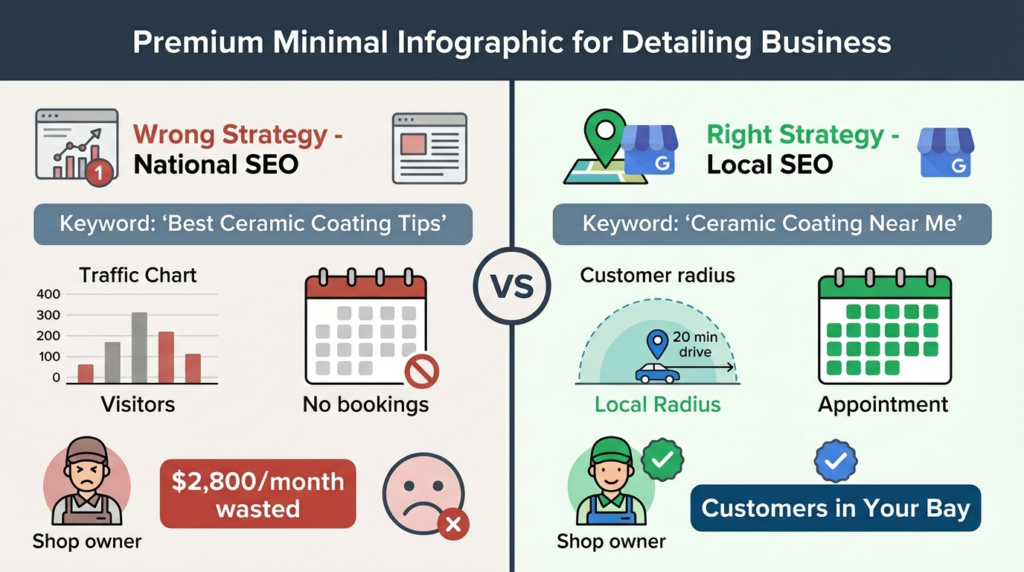
Picture this: A ceramic coating shop owner in Austin signs a $2,800/month contract for “SEO services.” Six months later, his website ranks for “best ceramic coating tips” — but his bay is still half-empty on weekdays.
This happens constantly. After auditing dozens of detailing businesses, the same pattern shows up: shops are paying for national SEO strategies when their customers are searching with local intent. A buyer in Dallas isn’t comparing your shop to one in Miami. They’re comparing you to the three closest installers within a 20-minute drive.
The agency wasn’t lying — they were just selling the wrong product for the job. National SEO and local SEO are two completely different disciplines with different goals, different ranking signals, and very different ROI for a service business that needs the car physically in the bay.
Let’s break both down.
What Is National SEO? (And Who It's Actually For)
Definition and Core Goals of National SEO
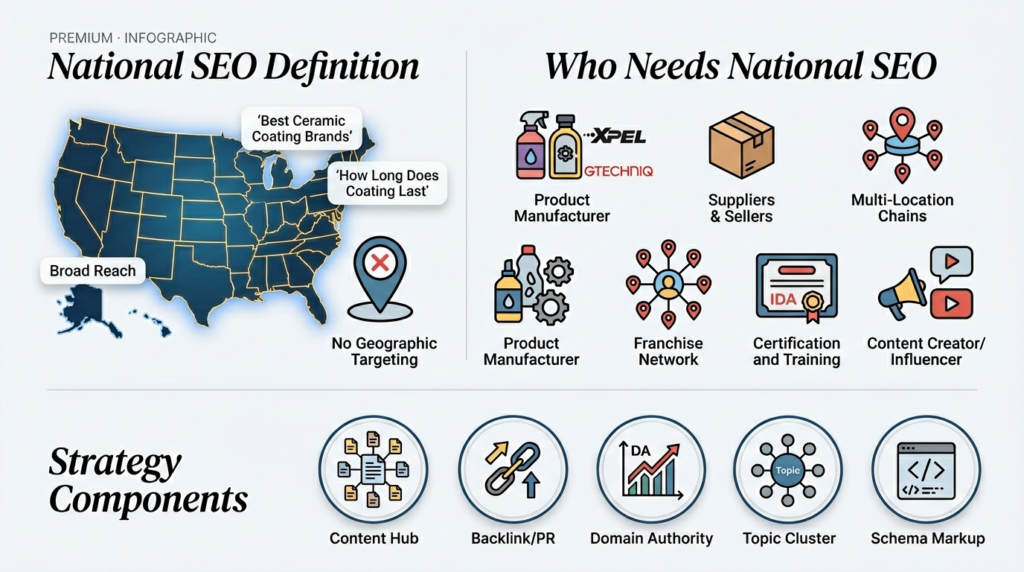
National SEO is the practice of optimizing a website to rank in organic search results across an entire country, without geographic targeting. The goal is broad reach, brand awareness, and capturing top-of-funnel informational or transactional searches at scale.
Instead of competing for “ceramic coating in Phoenix,” a national SEO strategy targets phrases like “best ceramic coating brands” or “how long does ceramic coating last” — keywords with massive search volume and no location attached.
Who National SEO Works Best For
National SEO is built for businesses that serve customers anywhere in the country. In the detailing world, that means:
- Product manufacturers like XPEL, Gtechniq, CarPro, and Ceramic Pro
- E-commerce brands selling detailing supplies (Chemical Guys, Adam’s Polishes)
- Franchise headquarters managing a national brand presence
- Training and certification companies like the International Detailing Association (IDA)
- Detailing influencers and publications monetizing through content
If you’re a single-location shop — or even a 3-location regional operation — your customers do not live “anywhere in the country.” They live within a 30-minute drive. National SEO targets the wrong audience for you.
Typical National SEO Tactics
National strategies lean heavily on:
- High-volume content marketing and content hubs
- Aggressive backlink and digital PR campaigns
- Domain authority building
- Topic clusters around informational keywords
- Schema markup for articles, products, and brand entities
These tactics take 12–18 months to show meaningful ROI and require substantial budgets. They’re a long game played at scale.
What Is Local SEO? (And Why It's Built for Detailing Shops)
Definition and Core Goals of Local SEO
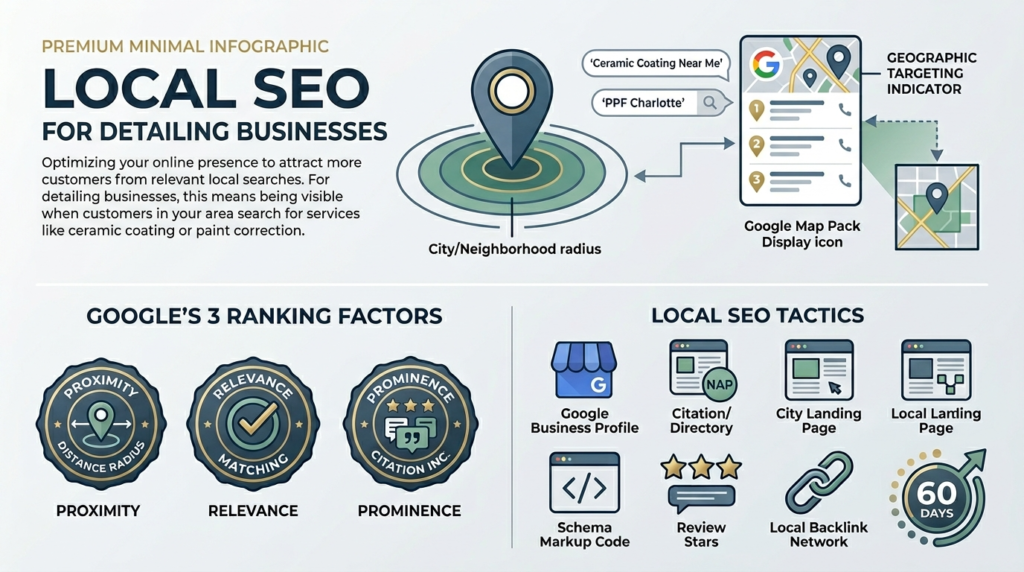
Local SEO is the practice of optimizing your online presence to attract customers from a specific geographic area — typically the city, neighborhoods, and suburbs your shop physically serves. Its primary goal is to rank in Google’s Local Pack (also called the Map Pack or 3-Pack), Google Maps, and geo-modified organic search results.
When someone searches “ceramic coating near me” or “PPF installer in Charlotte,” local SEO is what determines whether your shop shows up — or your competitor does.
Why Local SEO Dominates for Service-Area Businesses
Google ranks local businesses using three documented factors: proximity, relevance, and prominence.
- Proximity: How close your shop is to the searcher’s location
- Relevance: How well your business matches what they’re searching for
- Prominence: How well-known and reputable your business is online (reviews, citations, backlinks)
Notice that two of the three factors are inherently local. As a Service Area Business (SAB), your entire model is geographic. A shop in San Diego cannot serve a customer in Atlanta, no matter how authoritative their website is. Google knows this, and its algorithm prioritizes nearby, relevant, well-reviewed businesses for location-specific queries.
Core Local SEO Tactics for Detailers
Local SEO has its own playbook:
- Optimizing your Google Business Profile (GBP) with accurate categories, services, photos, and posts
- Building local citations with consistent NAP (Name, Address, Phone) data on Yelp, Angi, BBB, Foursquare, and Data Axle
- Creating city + service landing pages (e.g., “/ppf-installation-houston”)
- Implementing LocalBusiness Schema and AutoRepair Schema structured data
- Earning verified Google reviews and managing your reputation
- Building hyperlocal backlinks from car clubs, dealerships, and local automotive publications
These tactics typically show measurable results in 60–120 days — far faster than national SEO.
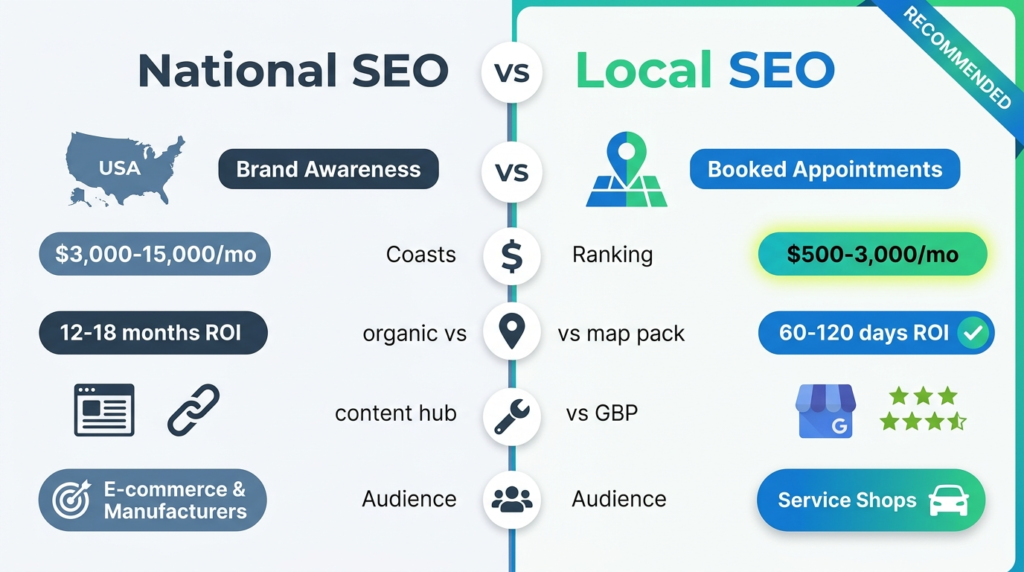
National SEO vs. Local SEO: Side-by-Side Comparison for Detailers
Here’s the clearest way to see the difference:
Factor | National SEO | Local SEO |
Primary Goal | Brand awareness, broad organic traffic | Booked appointments, walk-in customers |
Target Audience | Anyone in the country | Customers within your service radius |
Where You Rank | Organic search results | Local Pack, Google Maps, geo-modified organic |
Key Ranking Signals | Backlinks, domain authority, content depth | Proximity, GBP optimization, reviews, citations |
Primary Tools | Content hubs, link building, technical SEO | Google Business Profile, citations, reviews, location pages |
Schema Used | Article, Product, Organization | LocalBusiness, AutoRepair, Service |
Time to ROI | 12–18 months | 60–120 days |
Typical Monthly Cost | $3,000–$15,000+ | $500–$3,000 |
Best For | E-commerce, manufacturers, franchises | Single & multi-location service shops |
ROI Type | Brand equity + scaled traffic | Direct lead generation |
The bottom line: If a customer needs to physically bring their car to you, local SEO is the channel that turns searches into bookings.
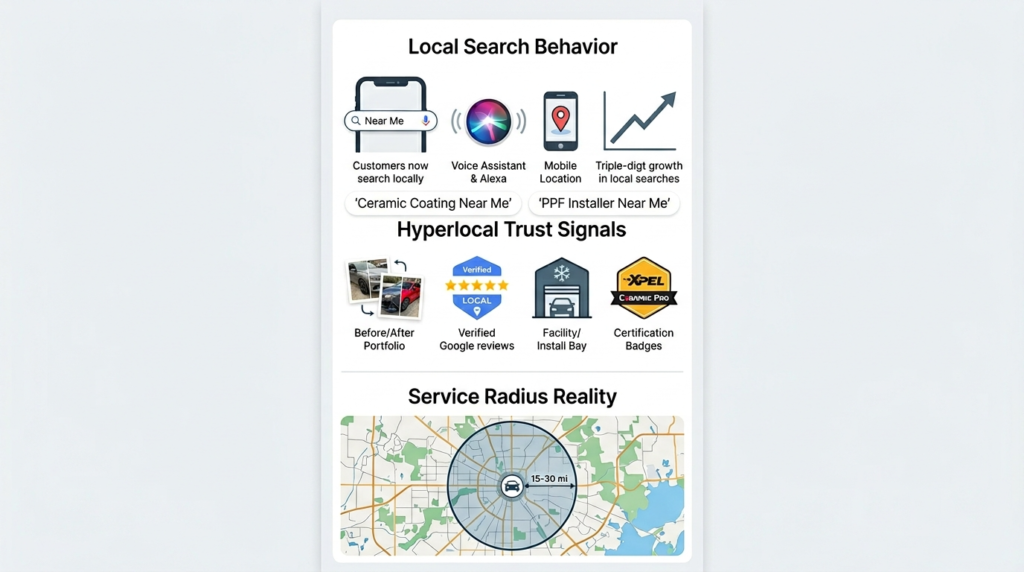
Why Local SEO Wins for PPF, Ceramic Coating, and Window Tint Shops
Customers Search With Local Intent (“Near Me” Behavior)
The way people search for detailing services has fundamentally changed. Modern buyers pull out their phones and type — or speak — phrases like:
- “ceramic coating near me”
- “PPF installer near me”
- “window tint shop near me”
- “best paint protection film in [city]”
- “mobile detailing near me open now”
Google has reported that “near me” searches in the auto services category have grown by triple-digit percentages year over year, and most of these searches happen on mobile devices with location services enabled. Voice search through Siri, Alexa, and Google Assistant amplifies this even further — voice queries are almost always location-aware.
National SEO cannot capture these searches efficiently. Local SEO is built for them.
Trust Is Hyperlocal in the Detailing Industry
A customer about to spend $1,500 on ceramic coating or $6,000 on full-vehicle PPF wants to see proof — and that proof has to be local and verifiable. They want to see:
- Your before-and-after portfolio (not a manufacturer’s stock photos)
- Your verified Google reviews from real customers in their city
- Your install bay and climate-controlled facility
- Your credentials as a manufacturer-authorized installer (XPEL Certified, Ceramic Pro Authorized, IDA Certified Detailer)
This trust is impossible to build through national SEO. It’s built through your Google Business Profile, your local reviews, your portfolio, and your community presence — every one of which is a local SEO asset.
Service Radius and Geographic Reality
Here’s a question that ends most national SEO debates instantly: How far will your customers actually drive?
For most detailing services, the realistic service radius is 15–30 miles. Mobile detailers might cover slightly more. PPF and ceramic coating customers occasionally drive 60–90 minutes for a top-rated installer, but they’re the exception.
If your customers won’t drive more than 30 miles, why would you pay to rank in 200 cities? Local SEO concentrates your investment exactly where your revenue lives.
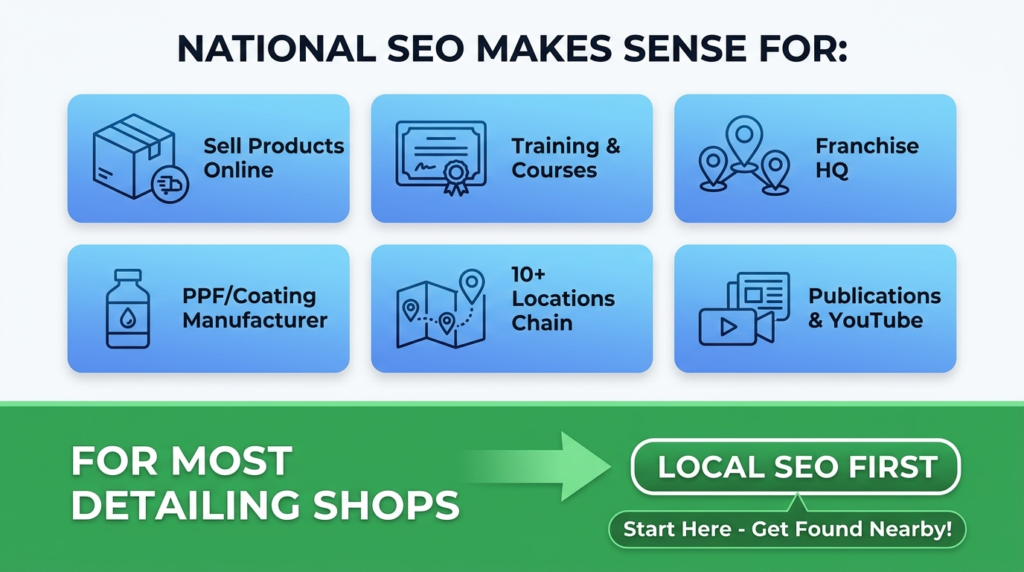
When (If Ever) Should a Detailing Business Invest in National SEO?
To be straightforward: there are real scenarios where national SEO makes sense for a detailing-related business.
You should consider national SEO if you:
- Sell physical products online (ceramic coatings, polishers, microfibers) and ship nationwide
- Offer training, certification, or courses to detailers in any location
- Operate a franchise headquarters with a network of locations
- Run a manufacturer or distributor brand like a PPF or coating manufacturer
- Are scaling a multi-state chain with 10+ locations and need cohesive brand authority
- Run a high-traffic detailing publication, YouTube channel, or affiliate site
For everyone else — meaning the vast majority of detailing shop owners — local SEO is where every dollar should go first. A hybrid strategy can make sense once your local presence is fully optimized and revenue allows for expansion, but local always comes first.
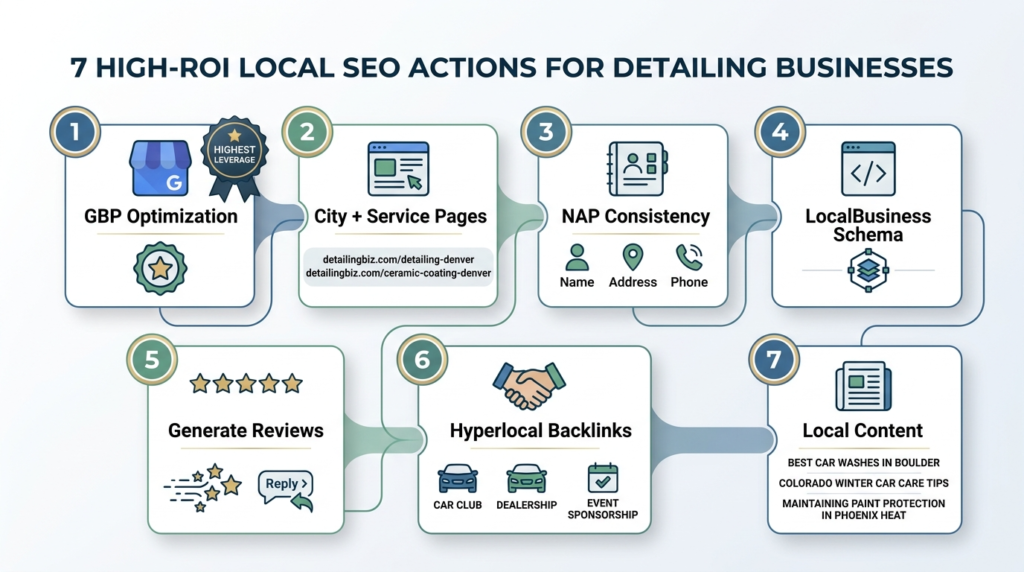
The Local SEO Playbook for Detailers: 7 High-ROI Actions
If you only do seven things to grow your detailing business through search, do these:
1. Optimize Your Google Business Profile (GBP) the Right Way
Your GBP is the single highest-leverage asset in local SEO. Choose the most accurate primary category (Car Detailing Service, Window Tinting Service, etc.), add every relevant service with descriptions and pricing, upload high-quality photos of your bay and recent work weekly, and use Google Posts to announce specials and new services.
2. Build City + Service Landing Pages
Don’t lump everything onto a single “Services” page. Build dedicated landing pages for each core service in each city you serve:
- /ceramic-coating-[city]
- /paint-protection-film-[city]
- /window-tinting-[city]
- /auto-detailing-[city]
Each page should have unique content, local references, embedded Google Maps, and customer testimonials from that area.
3. Earn Local Citations and Maintain NAP Consistency
Your business name, address, and phone number must be identical across every directory: Yelp, Angi, Nextdoor, BBB, Facebook, Foursquare, and major data aggregators like Data Axle. Even small inconsistencies (St. vs. Street, suite numbers) can hurt your local rankings.
4. Implement LocalBusiness and Service Schema Markup
Structured data tells Google exactly what your business is, where it’s located, what services you offer, and what your hours are. Implementing LocalBusiness, AutoRepair, and Service schema following Google’s documented guidelines is a technical step that pays compounding dividends.
5. Generate and Respond to Verified Google Reviews
Reviews are one of the strongest local ranking signals — and one of the strongest trust signals. Build a simple post-service request flow (text message with a direct review link works best), aim for a steady stream of new reviews each month, and respond to every single one, positive or negative.
6. Build Hyperlocal Backlinks
National backlinks from huge sites are nice. Local backlinks are gold. Pursue links from:
- Local car clubs and enthusiast groups
- Dealership partnerships (your shop as their preferred PPF installer)
- Local automotive event sponsorships (cars and coffee, car shows)
- Local automotive bloggers and YouTube channels
- Chamber of Commerce and BBB profiles
7. Create Educational, Locally-Relevant Content
Write content that ties your services to local realities. Examples:
- “Best Ceramic Coating for [Your State’s] Climate”
- “Window Tint Laws in [State]: VLT Limits Explained”
- “How [Local Road Conditions] Damage Paint and Why PPF Is Worth It”
This content ranks for local long-tail queries and signals to Google that you’re an authority in your geographic market.
How to Choose: A Decision Framework for Your Detailing Business
Still unsure? Run your business through these five questions:
- Do customers need to physically bring their vehicle to you? → If yes, local SEO.
- Is your service radius under 50 miles? → If yes, local SEO.
- Do you sell products online that ship nationwide? → If yes, add national SEO to the mix.
- Do you have 10+ locations across multiple states? → If yes, blend local SEO at each location with national brand authority.
- Are you a manufacturer, training provider, or franchise HQ? → If yes, national SEO is your primary play.
For 95% of independent detailing shops, the answer is simple: invest in local SEO first, master it, and only consider national tactics once your local market is locked down.
Ready to Dominate Your Local Market? Here's Your Next Step
The detailing shops winning right now aren’t the ones with the biggest marketing budgets. They’re the ones executing the local SEO fundamentals with discipline — claiming the Map Pack, stacking real reviews, and building the kind of trust that turns “near me” searches into booked appointments.
If you’d like a clear picture of where your shop currently stands, we offer a free local SEO audit specifically for detailing, PPF, ceramic coating, and window tinting businesses. No hidden fees, no high-pressure sales — just an honest assessment of your visibility, your competitors, and the highest-impact opportunities to grow.
[Book Your Free Detailing SEO Audit →]
Frequently Asked Questions About SEO for Auto Detailing Businesses
Local SEO targets customers in your specific service area through Google Maps, the Local Pack, and "near me" searches, while national SEO targets a country-wide audience through organic content rankings. For detailing shops where customers physically bring their cars in, local SEO drives bookings — national SEO mostly drives unqualified traffic.
Local SEO typically starts producing measurable results in 60 to 120 days for most detailing shops. Google Business Profile optimizations and review generation can move the needle within weeks, while citation building, schema implementation, and content-driven ranking improvements compound over 3 to 6 months.
Most independent detailing shops should budget between $500 and $3,000 per month for local SEO, depending on market competitiveness and the number of services or locations. Single-location shops in mid-sized cities can often see strong ROI at the lower end, while shops in highly competitive metros may need to invest more aggressively.
You can absolutely handle the basics of local SEO yourself, especially Google Business Profile optimization, review generation, and posting fresh content. However, technical work like schema markup, citation cleanup, location landing page builds, and competitive backlink strategies usually require either deep self-education or a specialized agency to execute properly.
Having an optimized Google Business Profile is essential, but it's not enough on its own. Your website is where Google verifies your authority, where you build city and service-specific landing pages, where schema markup lives, and where you convert visitors into bookings. The two work together — GBP gets you found, your website gets you booked.
National SEO generally does not produce a strong return for a single-location ceramic coating shop because your customers can only realistically drive a limited distance. Investing in national rankings means competing with manufacturers and publications for traffic that won't convert into local bookings. Focus your budget on local SEO instead.
You should optimize for both, because they capture different searcher behaviors. "Near me" searches are dominated by Google Business Profile rankings and proximity signals, while "in [city]" searches are won through dedicated city-specific landing pages, local content, and on-page optimization. A complete local SEO strategy targets both query types.
To rank in the Google Map Pack, you need a fully optimized Google Business Profile with the correct primary category, a steady flow of recent verified reviews, consistent NAP citations across major directories, location-specific landing pages on your website, and proximity to the searcher. The Map Pack rewards businesses that signal both relevance and local prominence.
Display every legitimate manufacturer authorization and industry certification you hold, such as XPEL Certified Installer, Ceramic Pro Authorized, SunTek Select Dealer, IDA Certified Detailer, and BBB Accreditation. These credentials build credibility with both customers and search engines, and they're powerful E-E-A-T signals that support your local SEO rankings.
Yes — reviews are one of the strongest local SEO ranking factors and one of the most influential trust signals for potential customers. Google looks at review quantity, recency, star rating, keyword content within reviews, and how consistently you respond. A steady flow of recent, detailed five-star reviews can directly improve your Map Pack visibility.
Local SEO and Google Ads serve different purposes and work best together. Google Ads delivers immediate visibility while you wait for SEO to compound, but local SEO builds a long-term, lower-cost lead source that doesn't disappear the moment you stop paying. Most successful detailing shops run ads for fast wins and invest in local SEO for sustainable growth.
The single highest-impact action you can take today is fully optimizing your Google Business Profile. Verify your listing, choose the correct primary category, add all services with descriptions, upload at least 20 high-quality photos of your work and facility, and start a system to request a Google review from every satisfied customer.
Ready to stop guessing about marketing and start building a system that actually fills your bays? The right channel mix is different for every shop — and choosing wrong costs more than just money. It costs momentum.