Auto detailing SEO is the process of optimizing your detailing business’s online presence so that local customers can find you on Google when they search for services like ceramic coating, paint protection film (PPF), and window tinting. It combines local search strategy, keyword targeting, website optimization, and content marketing — all working together to bring high-intent customers directly to your door.
If your work is flawless but your phone isn’t ringing, this guide is for you. You’re about to learn exactly how detailing shops, PPF installers, and ceramic coating studios go from invisible to ranking on page one — and how to stay there.
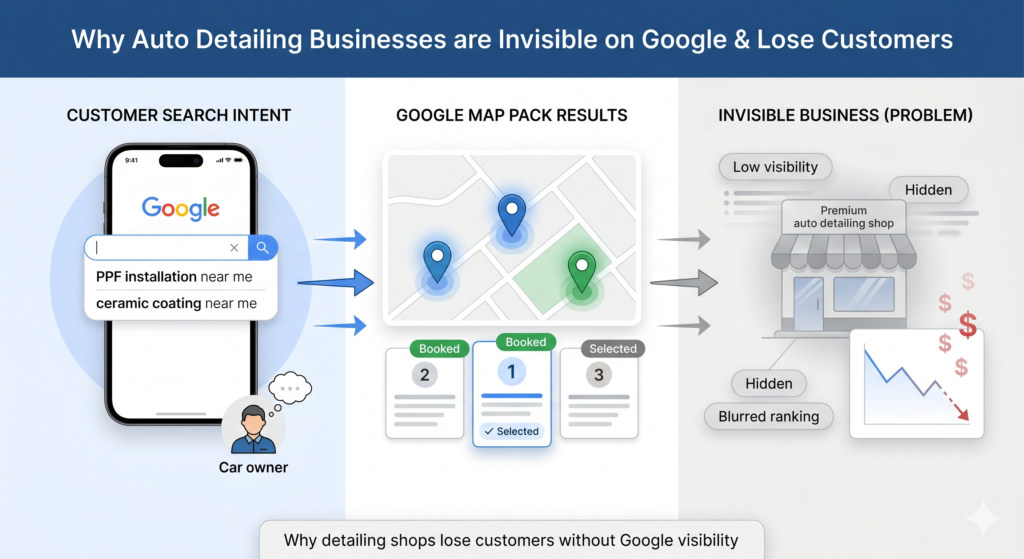
Why Most Detailing Shops Are Invisible on Google — and What It’s Costing Them
Here’s a scenario that plays out every single day. A car owner just bought a new Tesla. They want paint protection film installed before the first scratch appears. They pull out their phone and type: “PPF installation near me.” Google returns three local businesses in the map pack. Your shop — despite being the most skilled installer in the city — isn’t one of them.
That customer books with your competitor.
Now multiply that by every person searching “ceramic coating near me,” “window tinting near me,” or “best auto detailing service” in your area every week. That’s the revenue gap that poor Google visibility creates — and most detailing shop owners don’t even know it exists.
The gap between doing great work and getting found online
Exceptional skill doesn’t automatically translate into search engine visibility. Google can’t watch you install a full XPEL Ultimate Plus wrap or evaluate the hydrophobic properties of your Gyeon ceramic coating. What it can do is read your website, assess your Google Business Profile, count your reviews, and determine whether your content answers the questions your potential customers are actually typing.
Search intent is the key concept here. When someone searches “ceramic coating service,” they’re ready to book. When they search “PPF vs ceramic coating,” they’re in research mode and want an expert to guide them. Most detailing websites fail to address either type of searcher.
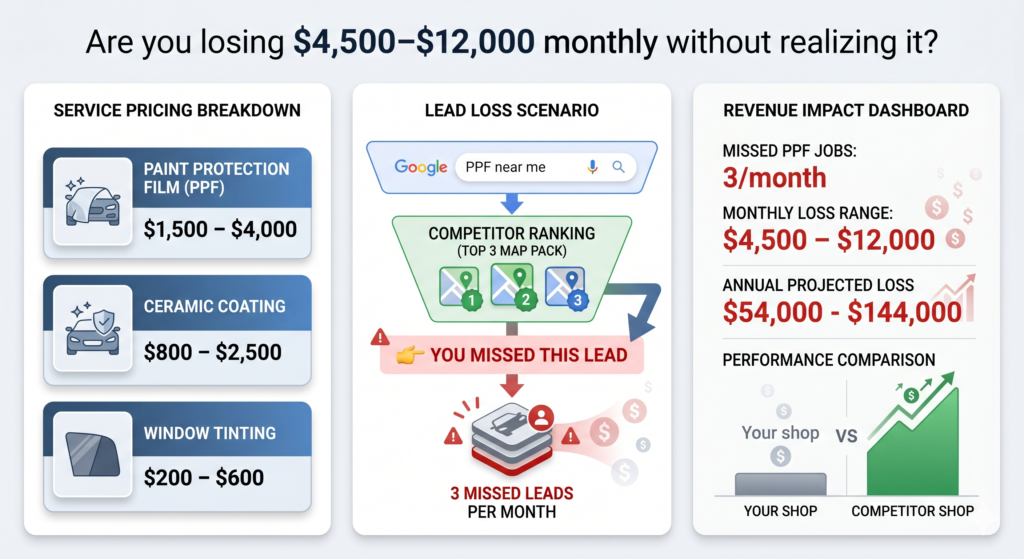
How much revenue are you losing to competitors ranking above you?
Consider the math. A full paint protection film package on a luxury vehicle averages $1,500–$4,000. A ceramic coating service runs $800–$2,500. Even a window tinting job brings in $200–$600. If poor Google visibility causes you to miss just three PPF inquiries per month, that’s potentially $4,500 to $12,000 in monthly revenue handed directly to the shop ranking above you.
Local SEO for auto detailers isn’t a marketing luxury — it’s a revenue system.
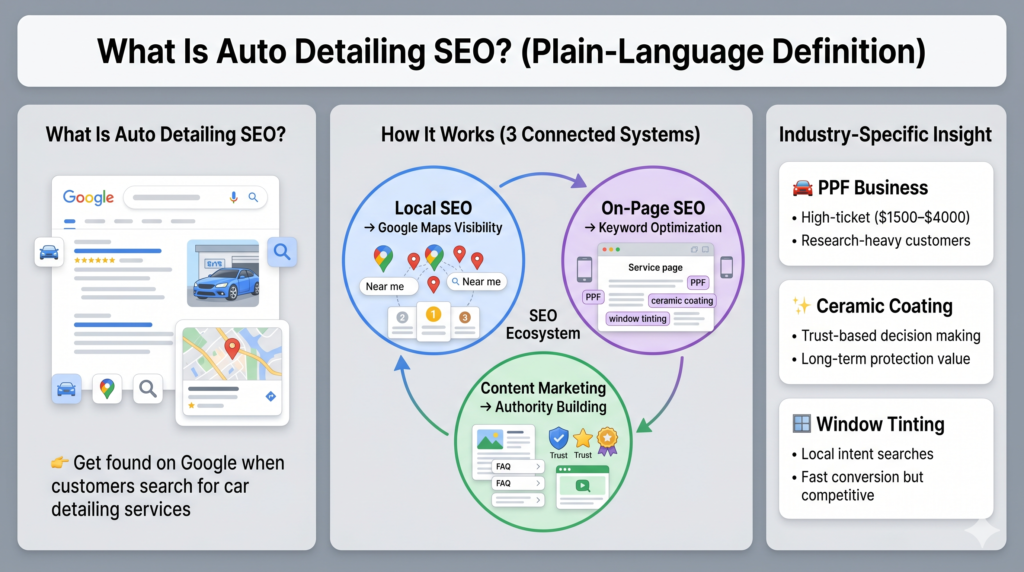
What Is Auto Detailing SEO? (Plain-Language Definition)
Auto detailing SEO is the practice of making your car detailing, PPF, ceramic coating, or window tinting business appear at the top of Google search results when local customers search for those services.
It covers three interconnected disciplines: local SEO (getting into Google Maps and the local pack), on-page optimization (making your website pages rank for specific service keywords), and content marketing (building authority through educational content that earns trust from both Google and prospective customers).
Unlike paid ads that stop the moment you stop paying, SEO builds compounding visibility. A well-optimized detailing website generates inbound leads every day — without ongoing ad spend.
How SEO differs for PPF, ceramic coating, and window tinting businesses
Not all auto service SEO is the same. A basic car wash optimizes for volume and repeat visits. A PPF installer, ceramic coating studio, or window tinting shop operates in a completely different market — one defined by high-ticket transactions, longer customer decision cycles, and buyers who research heavily before committing.
This changes your SEO strategy in three important ways:
• Educational content matters more. A customer considering a $3,000 PPF package wants to understand what they’re buying before they book. Content that answers “how long does paint protection film last” positions your business as the trusted expert.
• Brand authority is a ranking signal. Being an XPEL authorized dealer, a Ceramic Pro authorized installer, or an IDA certified detailer tells Google — and your customers — that you’re credentialed.
• Niche keywords convert at higher rates. Someone searching “full front PPF installation” is far closer to booking than someone searching “car protection.”
The three pillars of detailing SEO: local, technical, and content
1. Local SEO — Dominating Google Maps and “near me” searches in your service area
2. Technical SEO — Ensuring your website loads fast, is mobile-friendly, and uses schema markup
3. Content Marketing — Building topical authority with service pages, blog posts, and FAQs
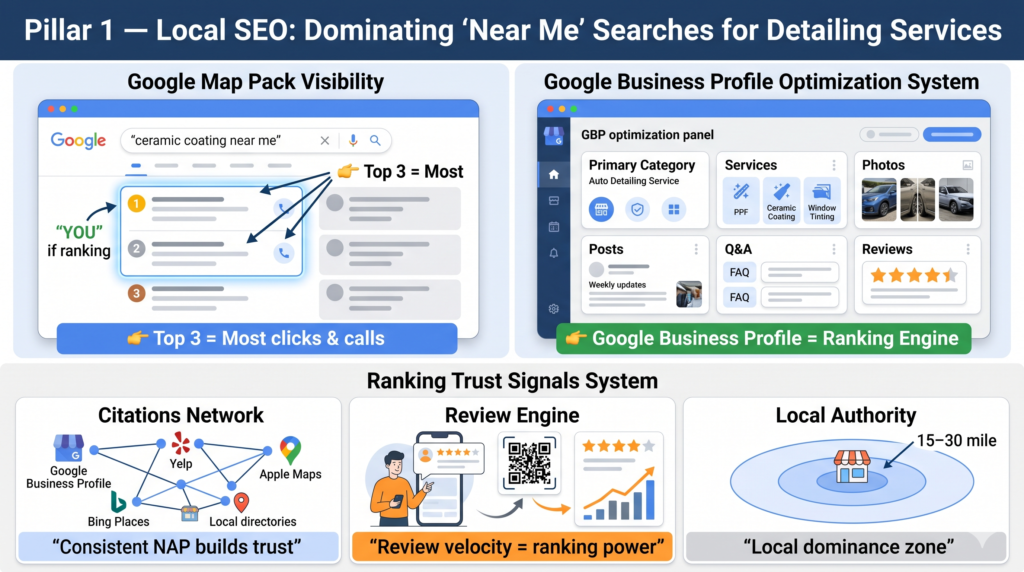
Pillar 1 — Local SEO: Dominating “Near Me” Searches for Detailing Services
For most auto detailing, ceramic coating, PPF, and window tinting businesses, local SEO is the single highest-leverage channel available. The majority of your customers live within 15–30 miles of your shop. They search with local intent. Google knows this — which is why it shows a map pack of three local businesses at the very top of results, above all organic listings.
Getting into that map pack is the most impactful thing you can do for your detailing business.
Optimizing your Google Business Profile as a ceramic coating or PPF installer
Your Google Business Profile (GBP) is the engine that powers your map pack visibility. A fully optimized profile directly influences where you rank for searches like “ceramic coating near me” and “PPF installer near me.”
Here’s what a fully optimized GBP looks like for a detailing business:
• Primary category: Auto Detailing Service (or Car Detailing Service)
• Additional categories: Window Tinting Service, Auto Body Shop (if applicable)
• Services listed individually: Create separate service entries for PPF installation, ceramic coating, paint correction, and window tinting with keyword-rich descriptions
• Business description: 750 characters that include your core services, location, and credentials like “XPEL authorized installer” or “Ceramic Pro certified”
• Photos: Upload 20–30 before-and-after photos. Name files descriptively before uploading — Google reads file names
• Google Posts: Publish weekly posts featuring recent jobs to signal an active, engaged business
• Q&A Section: Pre-populate with common questions like “Do you offer a warranty on ceramic coating?”
How to build local citations that actually move your rankings
A local citation is any online mention of your business name, address, and phone number (NAP). Google cross-references these to verify your business is legitimate. Consistent, accurate citations are a foundational trust signal.
• Tier 1 (highest authority): Google Business Profile, Bing Places, Apple Maps, Yelp, Facebook Business
• Tier 2 (automotive niche): CarGurus, RepairPal, AutoMD, Detailing World directory, SEMA Industry Directory
• Tier 3 (local): Chamber of Commerce, Better Business Bureau, local business directories
Critical rule: your business name, address, and phone number must be identical across every platform — character for character. “St.” vs. “Street” creates NAP inconsistency that dilutes your local authority.
Review generation strategies for high-ticket detailing services
Reviews are one of the three core ranking factors for Google’s local map pack. For a ceramic coating or PPF business, reviews do double duty — they rank you higher and they convert skeptical buyers researching your shop.
The timing window is everything. The highest review response rate comes from asking within 30 minutes of job completion — when the customer is standing in your shop, delighted by their freshly coated vehicle:
“I’m really glad you love how it turned out. If you have 60 seconds, a quick Google review would genuinely help us out — I’ll text you the direct link right now.”
Additional review generation tactics:
• Review cards: A branded card with a QR code linking to your Google review page, handed with every invoice
• Automated follow-up: A text message sent 24 hours after service with a direct review link
• Respond to every review: Signals to Google that you’re an active business and demonstrates service quality to prospects
Aim for review velocity, not just volume. Ten new reviews per month signals growth far more effectively than 100 reviews accumulated over three years with nothing recent.
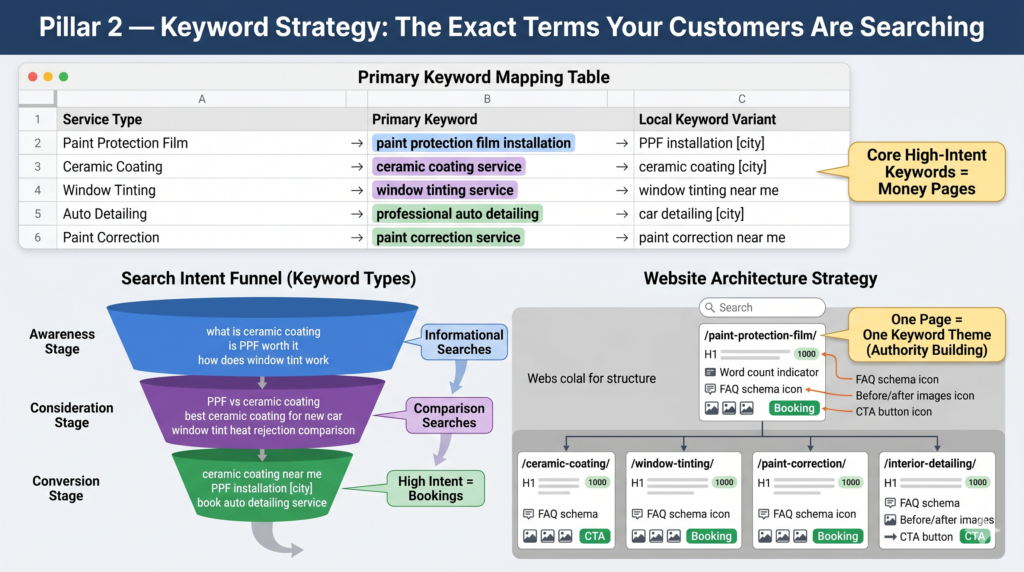
Pillar 2 — Keyword Strategy: The Exact Terms Your Customers Are Searching
Keyword strategy for a PPF, ceramic coating, or window tinting business is about mapping your content to the specific language your customers use at every stage of their decision-making process — from first awareness to booking.
Primary keywords every detailing website must rank for
These are the high-commercial-intent keywords that belong on your core service pages — not buried in blog posts:
| Service | Primary Keyword | Local Variant |
| Paint Protection Film | paint protection film installation | PPF installation [city] |
| Ceramic Coating | ceramic coating service | ceramic coating [city] |
| Window Tinting | window tinting service | window tinting near me |
| Auto Detailing | professional auto detailing | car detailing [city] |
| Paint Correction | paint correction service | paint correction near me |
Each of these terms belongs in your page’s H1 tag, URL slug, meta title, meta description, first paragraph, and image alt text. That’s not keyword stuffing — that’s proper on-page signal alignment.
Long-tail gold: low-competition queries that convert at the highest rate
Long-tail keywords reveal exactly what a buyer is thinking. They have lower search volume than broad terms but convert at dramatically higher rates because the searcher’s intent is crystal clear.
• “is ceramic coating worth it for a new car”
• “how much does paint protection film cost”
• “PPF vs ceramic coating — which is better”
• “how long does ceramic coating last on a car”
• “ceramic coating near me with warranty”
• “window tint laws in [state]”
• “best window tint for heat rejection”
• “can you ceramic coat over PPF”
• “mobile detailing service near me”
How to build separate service pages for PPF, ceramic coating, and window tinting
A single “Services” page that lists everything splits your page’s authority across every topic without fully ranking for any of them. The correct architecture is one standalone, fully optimized page per service:
• /paint-protection-film/
• /ceramic-coating/
• /window-tinting/
• /paint-correction/
• /interior-detailing/
Each service page should include a keyword-optimized H1, 600–1,000 words covering the service and materials used (XPEL, SunTek, Gyeon, etc.), before-and-after photos with descriptive alt text, a dedicated FAQ section using FAQ schema markup, and a clear call-to-action with a booking link or contact form.
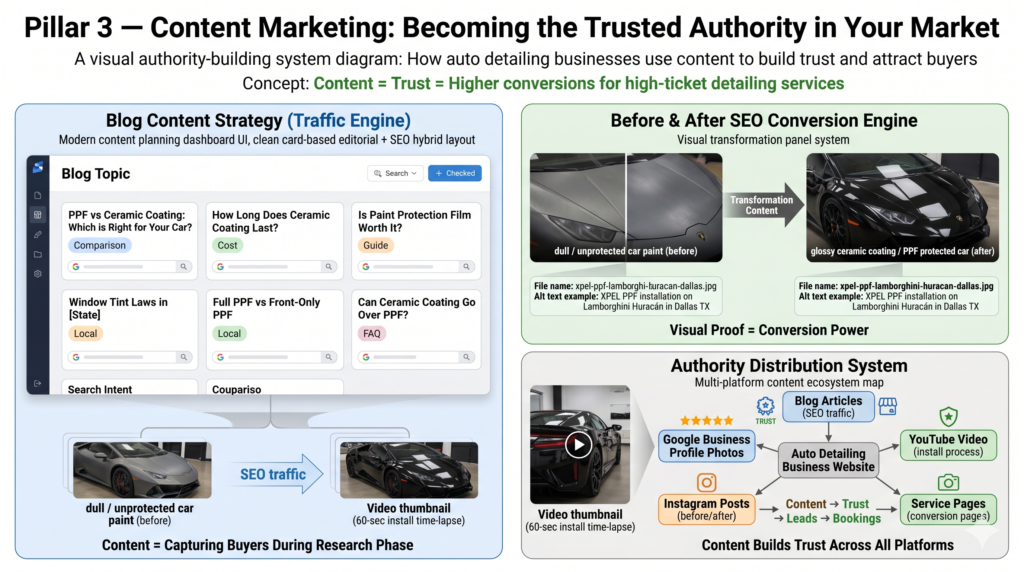
Pillar 3 — Content Marketing: Becoming the Trusted Authority in Your Market
Local SEO gets you found. Content marketing earns you trusted. For a business selling high-ticket services like ceramic coating, PPF, and window tinting, trust is the conversion currency. Buyers spending $2,000+ on paint protection want to feel confident they’re choosing the right shop — and the shop that educates them most thoroughly almost always wins.
Blog topics that attract high-intent PPF and ceramic coating customers
The goal of your blog is to intercept high-intent buyers during their research phase and establish your expertise before they ever pick up the phone. Here are proven blog topics that attract buyers at the exact moment they’re ready to decide:
• “PPF vs Ceramic Coating: Which Is Right for Your Car?” — Targets the highest-volume comparison query in the paint protection space
• “How Long Does Ceramic Coating Last? (And How to Make It Last Longer)” — Answers the #1 question from ceramic coating buyers
• “Is Paint Protection Film Worth the Cost? A Detailer’s Honest Answer” — Targets “worth it” queries signaling high buyer intent
• “Window Tint Laws in [Your State]: What You Need to Know Before You Tint” — Geo-specific piece with strong local search demand
• “The 5 Signs Your Car Needs Paint Correction Before Ceramic Coating” — Educates buyers and creates a natural upsell path
• “How to Care for Your Ceramic Coating After Installation” — Targets post-purchase queries and builds loyalty
• “Full Car PPF vs Front-Only PPF: What Most Installers Won’t Tell You” — Positions you as an honest expert
• “Can You Apply Ceramic Coating Over Paint Protection Film?” — Addresses a specific buyer question with high conversion potential
Using before-and-after photos and video for SEO and conversion
Before-and-after imagery is the auto detailing industry’s single most powerful conversion asset. Most shops waste its SEO potential entirely by uploading photos with meaningless file names like IMG_4821.jpg.
Photo SEO best practices for detailing businesses:
• File naming: xpel-ppf-installation-lamborghini-huracan-dallas-tx.jpg
• Alt text: “Full front XPEL PPF installation on Lamborghini Huracán at [Business Name] in Dallas, TX”
• Caption: Include the service, vehicle make/model, and a brief outcome statement
• Google Business Photos: Upload your best before-and-after shots directly to GBP — they appear in map searches
• Video: A 60-second time-lapse of a ceramic coating or PPF installation performs strongly on both GBP and as embedded content on service pages
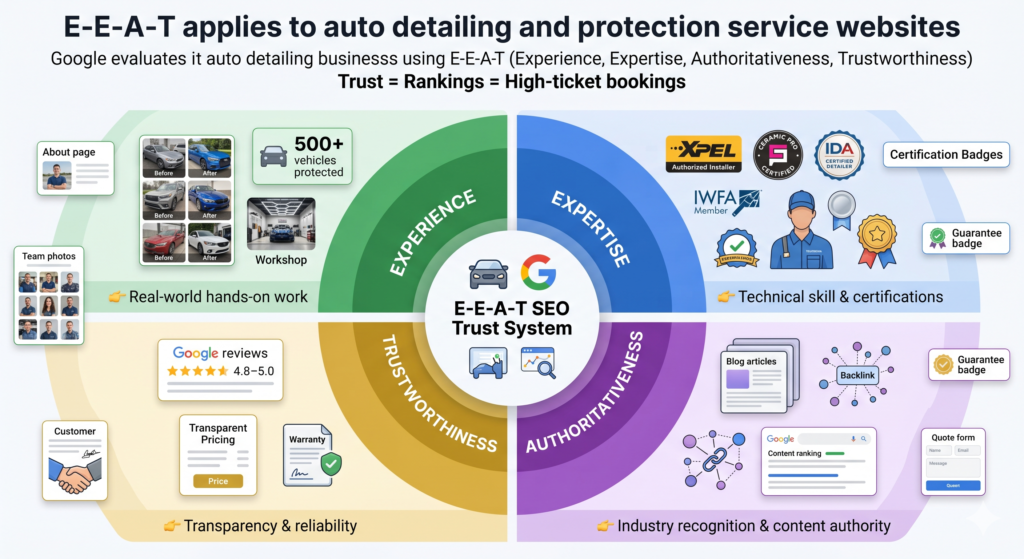
How E-E-A-T applies to auto detailing and protection service websites
Google’s E-E-A-T framework — Experience, Expertise, Authoritativeness, and Trustworthiness — is the lens through which it evaluates whether your content deserves to rank for high-value queries.
• Experience: Demonstrated through your portfolio, number of vehicles protected, and years in operation
• Expertise: Comes from your certifications — XPEL authorized dealer, Ceramic Pro authorized installer, IDA certified detailer, IWFA member. Display these prominently in your site header, About page, and footer
• Authoritativeness: Built through content that consistently answers buyer questions and earns references from other websites
• Trustworthiness: Demonstrated through transparent pricing, a written quote process, a published satisfaction guarantee, and a manufacturer-backed warranty on your services
Action item: Create a dedicated About page that tells your story, lists your certifications with badge images, shows your team’s faces, and explains your philosophy. This page alone can significantly elevate your site’s perceived authority.
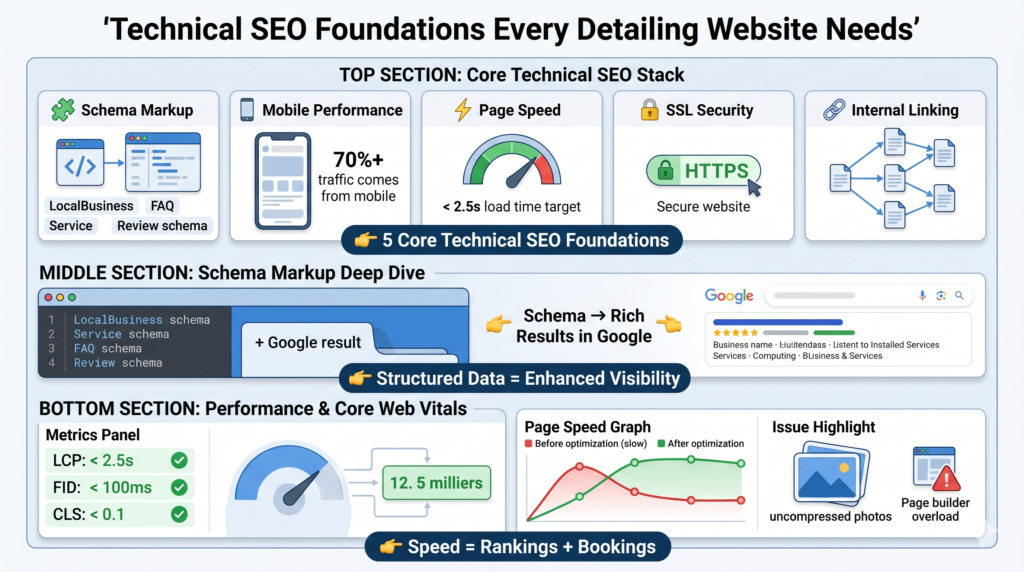
Technical SEO Foundations Every Detailing Website Needs
Technical SEO is the infrastructure that makes everything else work. Five technical elements have an outsized impact for a local detailing business:
• Schema markup — Tells Google exactly what your business is and what it offers
• Mobile performance — Over 70% of local service searches happen on mobile; a slow mobile site kills both rankings and conversions
• Page speed — Google uses Core Web Vitals as a ranking factor; aim for under 2.5 seconds load time
• SSL certificate — An HTTPS site is a baseline trust signal; no exceptions
• Internal linking — Connects service pages to each other and to blog content, distributing page authority throughout your domain
Schema markup for auto detailing, PPF, and ceramic coating shops
Schema markup is code that tells Google — in plain structured language — exactly what your business is, what it does, and how customers can interact with it. It’s one of the most underutilized technical SEO tools in the detailing space, which makes it a significant competitive advantage.
Essential schema types for detailing businesses:
• LocalBusiness + AutoRepair schema: Business name, address, phone, hours, service area, price range, and aggregate rating
• Service schema: Individual entries for ceramic coating, PPF, window tinting — each linked to your service pages
• FAQ schema: Added to service pages and blog posts to make your Q&As eligible for rich results in Google search
• Review/AggregateRating schema: Displays your star rating directly in search results, increasing click-through rates significantly
Mobile speed and Core Web Vitals — why they matter for appointment bookings
A customer searching “car detailing near me” on their iPhone is not going to wait five seconds for your homepage to load. Google’s data shows that bounce rates increase by 32% when page load time increases from 1 second to 3 seconds.
Target these Core Web Vitals benchmarks:
• LCP (Largest Contentful Paint): Under 2.5 seconds
• FID (First Input Delay): Under 100 milliseconds
• CLS (Cumulative Layout Shift): Under 0.1
Use Google’s free PageSpeed Insights tool to audit your current performance. The most common speed issues on detailing websites are uncompressed before-and-after photo galleries and bloated page builders. Compress every image before uploading.
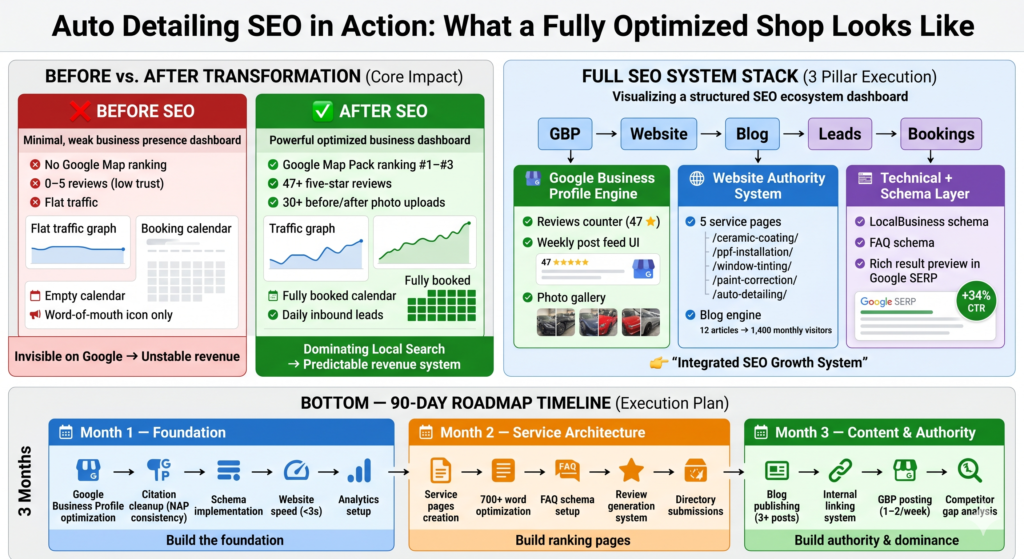
Auto Detailing SEO in Action: What a Fully Optimized Shop Looks Like
Let’s put it all together. Imagine a ceramic coating and PPF installer in Austin, Texas. Before SEO, they rely entirely on word-of-mouth — inconsistent revenue and zero presence when new residents search for paint protection services.
After implementing the three-pillar strategy:
• Google Business Profile is fully optimized with 47 five-star reviews, 30+ before-and-after photos, and weekly posts
• Five individual service pages, each ranking independently for their target keyword + city combination
• A blog covering 12 articles pulling in 1,400 monthly organic visitors
• LocalBusiness and FAQ schema markup earning rich results in Google search, boosting click-through rate by 34%
• Customers arrive pre-educated and pre-sold by content, requiring far less sales conversation
Within 90 days, they’re appearing in the local map pack for “ceramic coating Austin.” Within six months, they rank organically in the top five — and inbound inquiry volume has tripled.
A realistic 90-day SEO roadmap for a PPF and ceramic coating shop
Month 1 — Foundation
• Fully optimize your Google Business Profile (categories, services, description, photos, Q&A)
• Conduct a NAP audit and fix any citation inconsistencies across Yelp, Bing, Apple Maps, and automotive directories
• Implement LocalBusiness + AutoRepair schema markup on your website
• Ensure your website is HTTPS, mobile-responsive, and loads in under 3 seconds
• Set up Google Search Console and Google Analytics
Month 2 — Service Architecture
• Build or rebuild individual service pages for each core service
• Optimize each page: keyword-targeted H1, 700+ words, FAQ schema, before-and-after photos with proper alt text, CTA
• Begin systematic review generation — implement the 30-minute post-job ask and 24-hour follow-up text
• Submit your business to all Tier 1 and Tier 2 citation directories
Month 3 — Content and Authority
• Publish your first three blog posts targeting high-intent long-tail queries
• Implement internal linking strategy — connect blog posts to relevant service pages
• Begin a Google Business Profile posting cadence (1–2 posts per week)
• Audit your top competitor’s GBP and content strategy; identify gaps you can fill
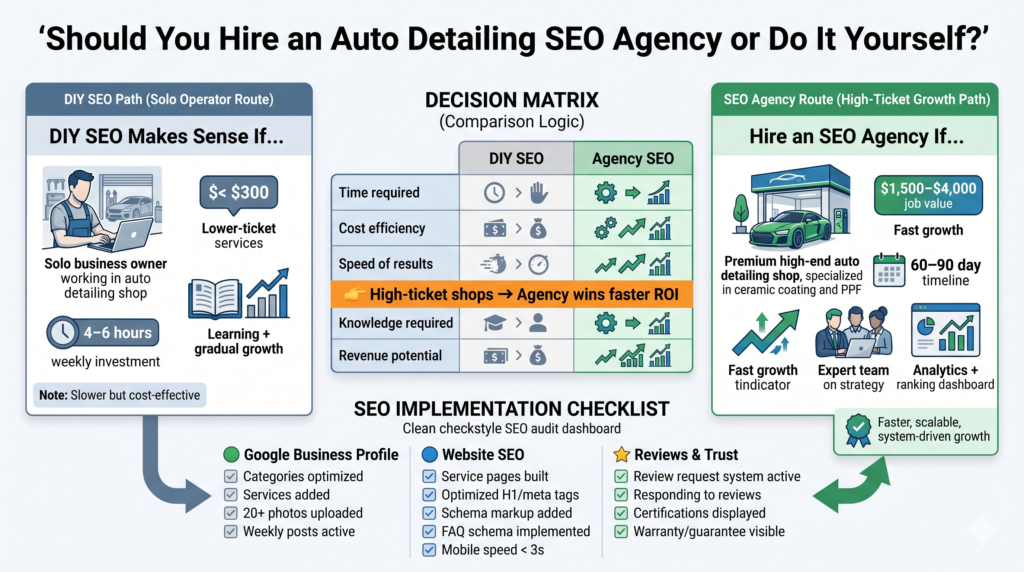
Should You Hire an Auto Detailing SEO Agency or Do It Yourself?
This is one of the most common questions from detailing shop owners, and the honest answer depends on two variables: your time and your average ticket value.
DIY SEO makes sense if:
• You’re a solo operator with time to learn and implement consistently
• Your services are lower-ticket (basic detailing packages under $300)
• You’re willing to invest 4–6 hours per week in the beginning
Hiring an SEO agency makes sense if:
• You run a ceramic coating or PPF-focused business where a single job is worth $1,500–$4,000
• Your time is better spent in the shop than behind a keyboard
• You want results in 60–90 days rather than 6–12 months of trial and error
• You want someone who already knows the auto detailing industry’s keyword landscape and competitive dynamics
When evaluating an SEO agency, ask specifically about their experience with local service businesses, their approach to Google Business Profile optimization, and whether they’ve worked with automotive protection services before. Look for an agency that provides a written quote, operates with no hidden fees, offers transparent reporting, and has verifiable case studies from the automotive niche.
Key Takeaways: Your Auto Detailing SEO Action Checklist
Google Business Profile
□ Correct primary and secondary categories selected
□ All services listed individually with keyword-rich descriptions
□ 20+ before-and-after photos uploaded with descriptive file names
□ Business description written with core service keywords and credentials
□ Weekly Google Posts cadence established
Website & Technical SEO
□ Individual service pages built for each core service
□ Each page has a keyword-optimized H1, meta title, and meta description
□ LocalBusiness + AutoRepair schema implemented
□ FAQ schema added to service pages
□ Site loads in under 3 seconds on mobile
Reviews & Trust Signals
□ Post-job review request process implemented (30-min ask + 24-hour text)
□ Responding to all Google reviews within 48 hours
□ Certifications (XPEL, Ceramic Pro, IDA, IWFA) displayed on website
□ Warranty and satisfaction guarantee information clearly published