Auto Detailing SEO vs. Paid Ads: Which One Is Right for Your Shop in 2026?
You spent $2,000 on Facebook ads last quarter and got one ceramic coating booking. Or maybe you hired an “SEO expert” six months ago, and you’re still not sure if anything is actually working. Sound familiar?
If you own a detailing shop, PPF studio, ceramic coating business, or window tint operation, you’ve probably been told a hundred different things about marketing — most of them by people who’ve never installed a piece of paint protection film in their lives. This guide cuts through that noise.
By the end, you’ll know exactly which channel deserves your next marketing dollar based on your shop’s stage, budget, and goals. No fluff, no agency-speak — just an honest, data-driven comparison built specifically for the detailing industry.
The $1,000 Question Every Detail Shop Owner Faces
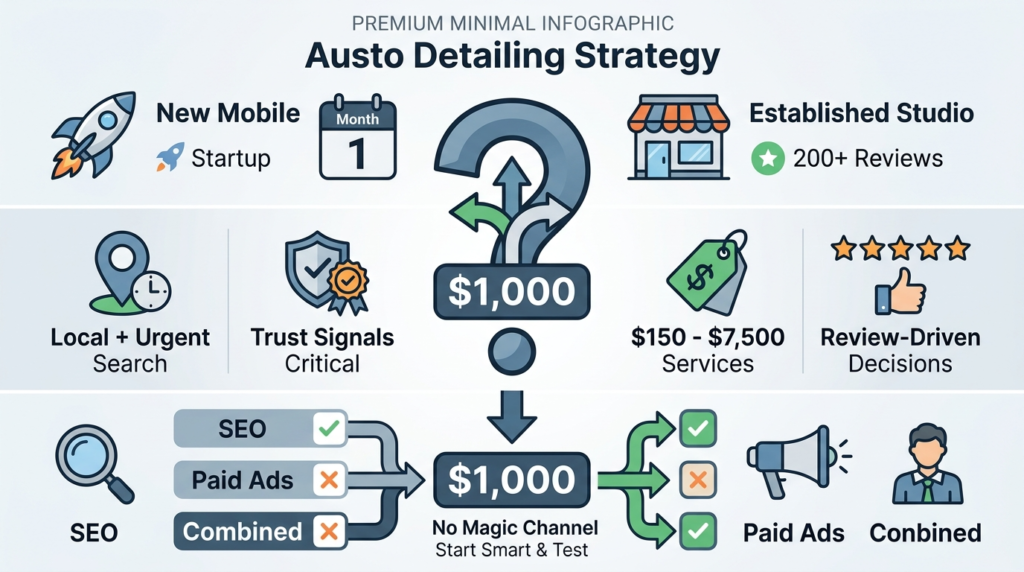
Here’s the question every shop owner eventually asks: “If I have $1,000 to spend this month on marketing, where should it go?”
It’s a great question. It’s also the wrong one.
The real question is: “What stage is my shop in, and which channel matches that stage?” Because the right answer for a brand-new mobile detailing operation in month one is completely different from the right answer for an established ceramic coating studio with 200 five-star reviews.
Why Generic Marketing Advice Fails Detailing Shops
Most marketing advice was written for e-commerce stores or SaaS companies — businesses with totally different buyer behavior than yours. Detailing customers behave uniquely:
- They search locally and urgently. “Ceramic coating near me” and “PPF installer near me” dominate search volume.
- Trust is everything. Customers are handing over a $60,000 vehicle. They need credibility signals before they ever call.
- Tickets vary wildly. A $150 interior detail and a $7,500 full-front PPF wrap require completely different marketing approaches.
- Reviews drive decisions. Detailing is one of the most review-influenced industries online — more than restaurants, salons, or auto repair.
Generic “run Facebook ads” advice ignores all of this. So does generic “you need SEO” advice.
What This Guide Will (and Won’t) Tell You
This guide gives you a framework — not a one-size-fits-all answer. We’ll show you exactly when SEO wins, when paid ads win, when to combine them, and how to make the call based on your specific situation.
What we won’t do is tell you there’s a magic channel. There isn’t. There’s only the right channel for your shop right now.
Quick Verdict — SEO vs. Paid Ads at a Glance
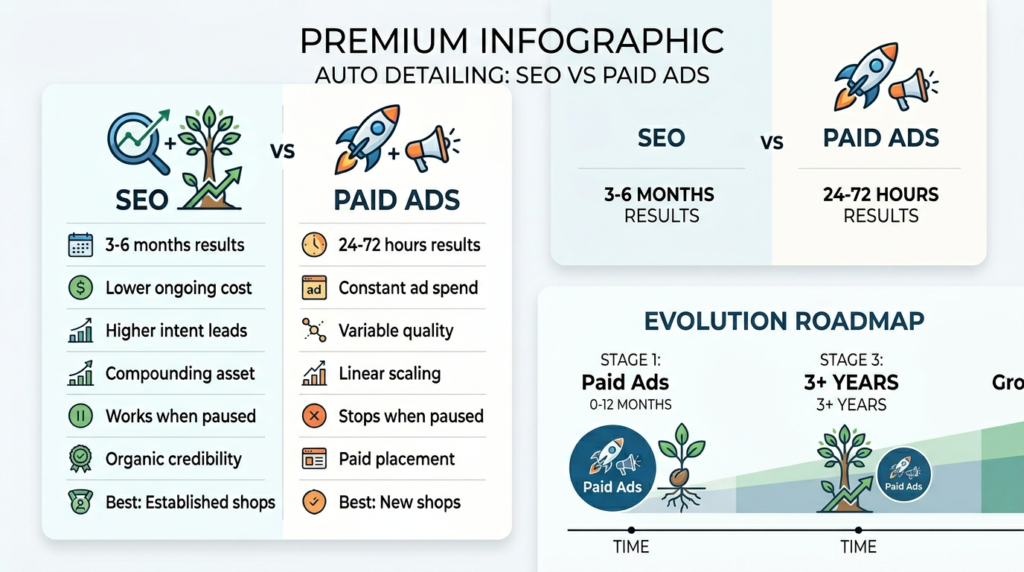
For shop owners who want the answer first: paid ads win for speed and immediate leads, SEO wins for long-term ROI and sustainability, and most successful detailing businesses use both. Your current stage determines the mix.
Side-by-Side Comparison
Factor | SEO | Paid Ads |
Time to first results | 3–6 months | 24–72 hours |
Upfront cost | Moderate (setup) | Low (ad spend only) |
Ongoing cost | Lower over time | Constant — pay per click forever |
Lead quality | Higher intent | Variable (depends on platform) |
Scalability | Compounding asset | Linear — more spend, more leads |
Sustainability | Continues working if you pause | Stops the day you pause spend |
Control & predictability | Less control over ranking | Highly precise targeting |
Trust signal to customers | Strong (organic = credibility) | Lower (ads = paid placement) |
Best for | Established shops, premium services | New shops, urgent leads, launches |
The 30-Second Recommendation by Shop Stage
- Brand new shop (0–12 months): Lead with paid ads. Build SEO foundations in parallel.
- Growing shop (1–3 years): Split investment 50/50 between SEO and paid ads.
- Established shop (3+ years): Lead with SEO. Use paid ads tactically for promotions and seasonal pushes.
What Is SEO for Auto Detailing Shops? (And Why Local SEO Is Different)
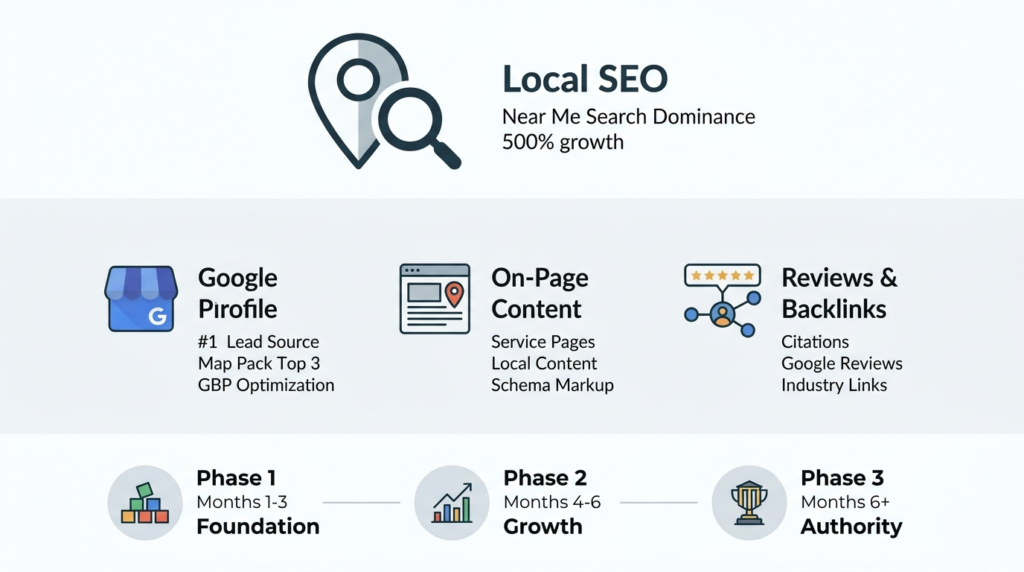
SEO for auto detailing is the practice of optimizing your online presence so your shop appears at the top of Google when local customers search for services like ceramic coating, PPF, window tinting, or detailing. Unlike traditional SEO, detailing SEO is overwhelmingly local — meaning your Google Business Profile and Map Pack visibility matter more than blog posts or backlinks.
The Three Pillars of Detailing SEO
- Google Business Profile (GBP) — Your #1 Lead Source
Your Google Business Profile is the single most important asset in your entire marketing stack. When someone searches “ceramic coating near me,” the three businesses that appear in the Map Pack (also called the Local 3-Pack) get the overwhelming majority of clicks and calls. Optimizing your GBP — accurate categories, service descriptions, photos, posts, and consistent NAP (Name, Address, Phone) — is non-negotiable.
- On-Page & Local Content
This includes dedicated service pages for each offering (separate pages for ceramic coating, PPF, window tinting, and paint correction), location-specific content if you serve multiple areas, and educational blog content that answers buyer questions. Schema markup — specifically LocalBusiness and AutoRepair schema — helps search engines understand exactly what you offer.
- Citations, Reviews & Backlinks
Citations are mentions of your business name, address, and phone number across the web (Yelp, BBB, Angi, automotive directories). Reviews — especially on Google — are the single biggest local ranking factor outside of GBP optimization itself. Backlinks from local sources, industry associations like the International Detailing Association (IDA), and brand partners like XPEL, SunTek, or Ceramic Pro authorized installer pages add domain authority.
How “Near Me” Searches Dominate the Detailing Industry
“Near me” searches have grown over 500% in the last few years, and the detailing industry is particularly affected. Customers don’t typically type “best ceramic coating shop in Dallas, Texas” — they type “ceramic coating near me” or speak it into their phone.
This is why ranking in the Map Pack is worth more than ranking #1 in regular search results for most detailing shops. The Map Pack appears above traditional results, includes phone numbers and directions, and converts at dramatically higher rates.
Realistic SEO Timeline for a Detail Shop
Anyone who promises SEO results in 30 days is lying. Here’s what to actually expect:
- Months 1–3 (Foundation): GBP optimization, on-page work, citation building, review generation systems. You’ll see early movement on long-tail keywords and possibly Map Pack improvements.
- Months 3–6 (Early Traction): Steady rankings improvements, more organic calls and form fills. Map Pack visibility for less competitive terms.
- Months 6–12 (Compounding ROI): This is where SEO starts paying for itself many times over. Ranking for high-volume terms, consistent inbound leads, lower customer acquisition cost than paid ads.
What Are Paid Ads for Detailing Shops? (Beyond Just Boosting Posts)
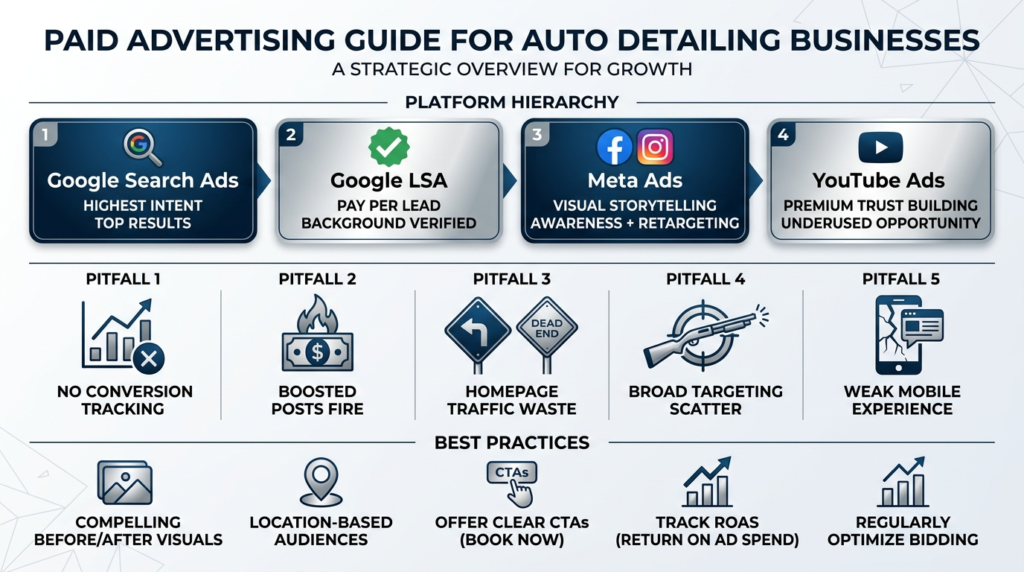
Paid ads for detailing shops are advertising campaigns on platforms like Google Ads, Local Services Ads, Meta (Facebook/Instagram), and YouTube that drive targeted traffic to your business immediately. Done right, they generate leads within days. Done wrong — which is how most shops do them — they burn money fast.
The Main Paid Ad Channels for Detailing Businesses
Google Search Ads: When someone searches “PPF installer near me,” your ad appears at the top. Highest intent, typically highest cost-per-click, but excellent ROI when targeting and landing pages are dialed in.
Google Local Services Ads (LSA): These are the “Google Guaranteed” ads at the very top of local searches. You pay per lead instead of per click, and you must pass background checks and licensing verification. Excellent for established, vetted shops.
Meta Ads (Facebook & Instagram): Best for visual storytelling — before-and-after paint correction reels, ceramic coating water beading footage, PPF installation timelapses. Lower intent than Google but powerful for awareness, retargeting, and seasonal promotions.
YouTube Ads: Underused but powerful for premium services. A 30-second video showcasing your XPEL or SunTek PPF installation builds the trust needed for $5,000+ tickets.
Why Most Detail Shops Waste Money on Paid Ads
After auditing hundreds of detailing shop ad accounts, the same mistakes appear over and over:
- No conversion tracking. Without Google Tag Manager and proper conversion tracking, you literally cannot tell which ads are making money.
- Boosted posts ≠ campaigns. Hitting “Boost” on a Facebook post is not advertising. It’s lighting money on fire.
- Sending traffic to homepages. Every campaign needs a dedicated landing page focused on one service and one action.
- Targeting too broadly. “Anyone interested in cars within 50 miles” is not targeting. Geo-target tightly, exclude irrelevant audiences.
- No call tracking. Most detailing leads come by phone. Without CallRail or equivalent, half your data is invisible.
Realistic Cost Per Lead in the Detailing Industry
Cost per lead (CPL) varies significantly by service and market, but here are reasonable benchmarks:
- Standard detailing: $15–$40 per lead
- Ceramic coating: $35–$90 per lead
- PPF installation: $50–$150 per lead
- Window tinting: $20–$60 per lead
Premium services have higher CPLs but also significantly higher tickets, so ROAS (return on ad spend) often exceeds 5x or 10x when campaigns are properly managed.
SEO vs. Paid Ads — The Deep Comparison
This is where the rubber meets the road. Let’s compare both channels across every dimension that actually matters for a detailing business.
Speed to Results — Who Wins When You Need Leads Now?
Paid ads win, decisively.
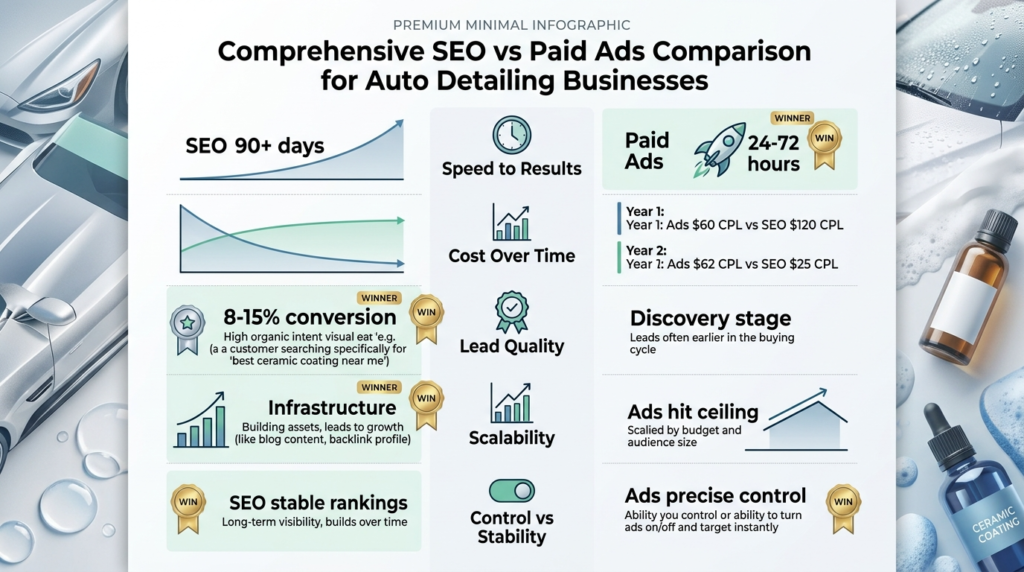
You can launch a Google Ads campaign today and have your first booked ceramic coating consultation tomorrow. SEO doesn’t work that way. Even aggressive SEO efforts take 90+ days to produce meaningful traffic.
If your shop needs leads in week one — because you just opened, you have empty bays, or you’re launching a new service — paid ads are the only realistic answer.
Cost Comparison — Upfront, Ongoing & Long-Term
This is where the math gets interesting.
Paid ads = renting traffic. The day you stop paying, the leads stop. Period. Costs typically rise over time as competition increases and platforms raise minimum bids.
SEO = building an asset. Your investment compounds. A service page that ranks #1 for “ceramic coating [your city]” generates leads for years with minimal additional spend.
A typical breakdown for a mid-sized detailing shop:
- Year 1 paid ads: $24,000 spent → ~400 leads → $60 CPL
- Year 1 SEO: $18,000 invested → ~150 leads → $120 CPL
- Year 2 paid ads: $26,000 spent → ~420 leads → $62 CPL
- Year 2 SEO: $12,000 maintenance → ~480 leads → $25 CPL
By year two, SEO usually wins on cost-per-lead. By year three, it’s not even close.
Lead Quality — Who Brings Better Customers?
SEO typically wins on lead quality, especially for premium services.
Someone who searches “PPF installer near me” and clicks your organic result is in active buying mode. They’ve done research. They likely have a vehicle in mind and a budget. Conversion rates from organic search to consultation routinely hit 8–15% for established detailing shops.
Facebook ad leads, by contrast, are often discovery-stage. They saw a cool ceramic coating reel, gave you their info, but may not actually be ready to spend $1,500. This isn’t a flaw — it just means you need a stronger sales process to convert them.
Google Search Ads sit in between: high intent, but slightly lower than organic because ad clickers are sometimes comparison-shopping.
Scalability & Sustainability
SEO is scalable but slow. Paid ads are fast but capped.
You can scale paid ads by spending more — but you’ll hit ceilings. Once you’re spending $5,000/month in a mid-sized market, more spend often produces diminishing returns because you’ve saturated qualified search demand.
SEO scales differently. Each new ranking page is a perpetual lead generator. You’re not buying leads — you’re building infrastructure that generates them.
The sustainability difference is stark: turn off paid ads, and your phone stops ringing within hours. Stop investing in SEO, and you’ll continue ranking for months or even years before significant decline.
Control & Predictability
Paid ads win on control. SEO wins on stability.
With Google Ads, you control exactly who sees your ad, when, where, and what they see. You can scale up tomorrow or pause this afternoon. This predictability makes paid ads excellent for capacity planning.
SEO is less controllable in the short term. Algorithm updates can shift rankings. Competitors can outrank you. But once established, organic rankings tend to be remarkably stable.
Trust & Credibility Signals
Organic rankings carry more credibility weight than ads.
Studies consistently show that consumers — especially for high-trust, high-ticket services like PPF and ceramic coating — trust organic results more than ads. When a shop ranks #1 organically and has 300 five-star reviews on Google, that combination is an enormously powerful trust signal.
This matters more for detailing than for most industries because the customer is making a high-trust decision about their vehicle.
When SEO Is the Right Choice for Your Detailing Shop
Signs SEO Should Be Your Primary Channel
SEO is the right primary investment when:
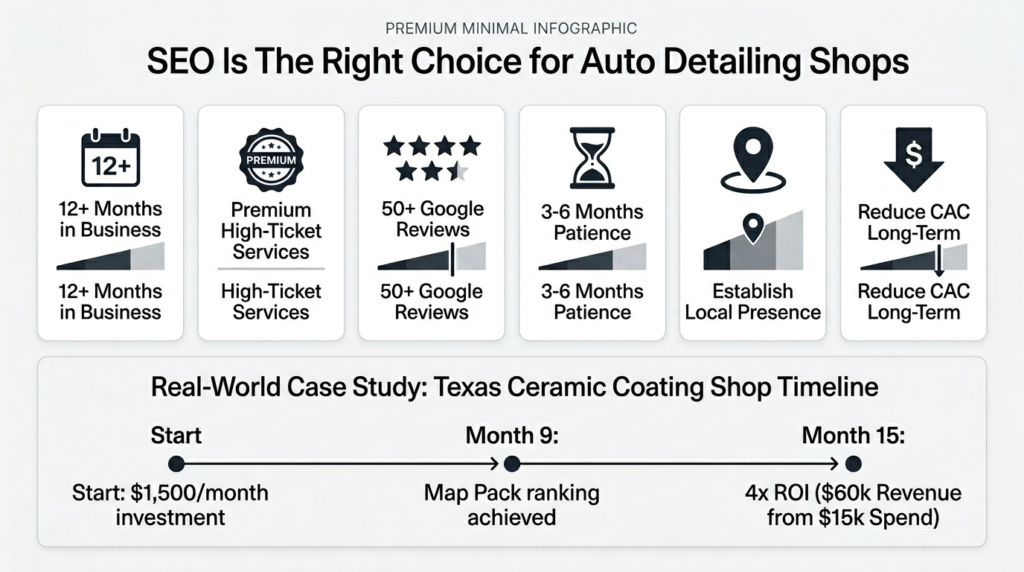
- You’ve been in business at least 12 months with stable cash flow
- You offer premium services like ceramic coating, PPF, or paint correction (higher tickets justify SEO’s longer payback period)
- You have or can generate consistent reviews (50+ Google reviews minimum)
- You can wait 3–6 months for compounding returns
- You have a physical location with strong local search opportunity
- You want to reduce long-term customer acquisition cost
Real-World Example: Ceramic Coating Shop That Scaled with SEO
A ceramic coating studio in a mid-sized Texas market started SEO investment in their second year. Initial monthly investment: $1,500. By month nine, they were ranking in the Map Pack for “ceramic coating [city]” and three surrounding suburbs. By month fourteen, organic search was generating 60% of their leads at roughly one-quarter the CPL of their previous paid ad campaigns. They reduced ad spend by 70% and reinvested savings into capacity expansion.
When Paid Ads Are the Right Choice for Your Detailing Shop
Signs Paid Ads Should Be Your Primary Channel
Paid ads are the right primary investment when:
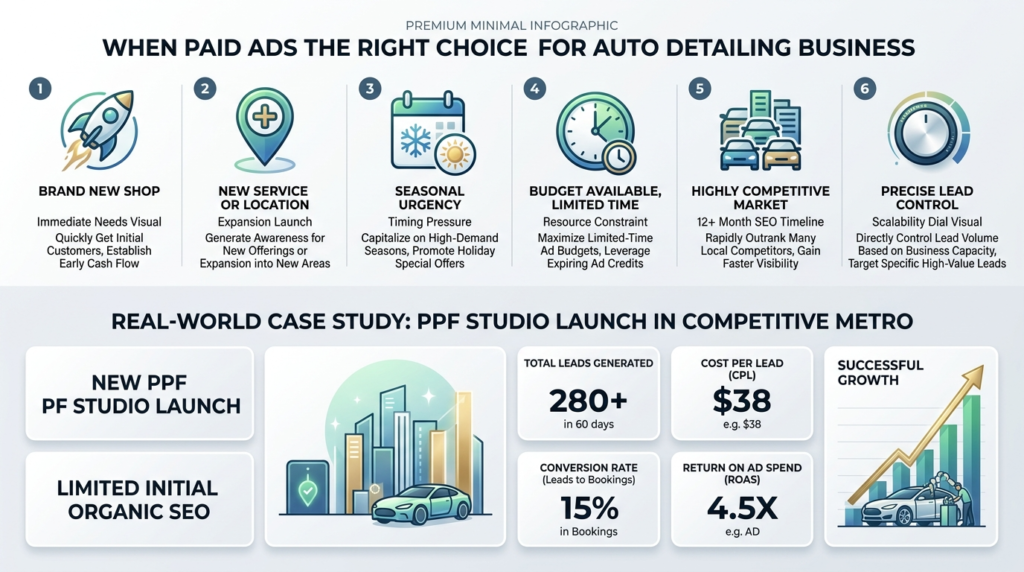
- You’re brand new and need leads immediately
- You’re launching a new service or location
- You have seasonal urgency (pre-summer ceramic coating push, winter window tint promotion)
- You have available budget but limited time horizon
- You operate in a highly competitive market where SEO will take 12+ months
- You want precise control over lead volume
Real-World Example: New PPF Studio That Launched with Google Ads
A new PPF studio opened in a competitive metro market and needed leads immediately. They invested $4,000/month in Google Search Ads and Local Services Ads, with dedicated landing pages for each PPF package. Within 30 days, they were generating 20–25 qualified consultations per month at an average CPL of $85. Average ticket: $3,200. ROAS: 8.4x. They ran paid-ads-only for ten months while building SEO foundations in parallel.
The Hybrid Strategy — Why Most Successful Shops Use Both
Here’s a truth most agencies won’t tell you: the SEO vs. paid ads debate is mostly false. The most successful detailing shops in the industry don’t choose — they orchestrate both channels strategically.
The 70/30 Rule for Established Detail Shops
Established shops (3+ years) typically allocate roughly 70% of marketing investment to SEO and 30% to paid ads. SEO drives the majority of consistent baseline leads at low CPL, while paid ads handle promotions, seasonal pushes, and new service launches.
The 30/70 Rule for New Detail Shops
New shops (under 12 months) flip the ratio: 30% to foundational SEO work, 70% to paid ads. This generates the immediate cash flow needed to survive while SEO investments compound in the background.
How SEO and Paid Ads Compound When Combined
The two channels make each other stronger:
- Retargeting organic visitors with paid ads — someone reads your ceramic coating service page but doesn’t book? Retarget them with a Facebook ad showing your portfolio.
- Using paid ad data to inform SEO content — the keywords converting in your Google Ads account are gold for content strategy.
- Brand searches increase from paid exposure — people who see your Facebook ads later search your shop name on Google, helping organic rankings.
- Reviews from paid leads strengthen organic rankings — every customer is a potential review, and reviews are the #1 local SEO ranking signal.
How to Decide — A Step-by-Step Framework for Your Shop
Stop debating. Use this framework to make the actual decision.
Step 1: Audit Your Current Lead Sources
Pull the last 90 days of leads. Where did they come from? If you don’t know, that’s your first problem. Install proper tracking before changing anything.
Step 2: Define Your 90-Day Revenue Goal
How many bookings do you need to hit your revenue target? Work backward from there to lead volume requirements.
Step 3: Calculate Your Realistic Marketing Budget
Healthy detailing shops invest 5–10% of revenue in marketing. New shops should invest closer to 10–15% to fuel growth.
Step 4: Choose Your Channel Mix Based on Shop Stage
Use the recommendations above:
- New shop: 30/70 SEO/Paid
- Growing shop: 50/50
- Established shop: 70/30
Step 5: Set Tracking Before You Spend a Dollar
Install Google Analytics 4, Google Tag Manager, and CallRail (or equivalent call tracking) before launching any campaign or SEO push. If you can’t measure it, you can’t improve it.
Common Mistakes Detailing Shops Make with Both Channels
Top 5 SEO Mistakes (And How to Avoid Them)
- Ignoring the Google Business Profile. Treating it as an afterthought instead of the primary asset it is.
- One generic services page. Every service (ceramic coating, PPF, window tinting, detailing) needs its own dedicated, optimized page.
- No review generation system. Not asking every happy customer for a Google review.
- Inconsistent NAP information. Different addresses or phone numbers across Yelp, Facebook, BBB, and your website.
- Slow, mobile-unfriendly websites. Customers searching from phones leave in seconds if your site is slow.
Top 5 Paid Ads Mistakes (And How to Avoid Them)
- No conversion tracking. Running ads blind.
- Sending traffic to the homepage. Every campaign needs a service-specific landing page.
- Boosting posts instead of running structured campaigns. Boosting is not strategy.
- Targeting too broadly. Spending budget on people who’ll never become customers.
- No retargeting. Letting 95% of visitors leave forever instead of bringing them back.
Choosing the Right Marketing Partner for Your Detail Shop
If you decide to hire help — and most shop owners eventually should — here’s how to choose well.
What to Look for in a Detailing Industry Marketing Partner
- Proven detailing industry experience (not “we’ve worked with auto repair shops”)
- Transparent pricing with no hidden fees
- Documented case studies with real client data
- Clear reporting showing trackable ROI
- Understanding of your services — they should know the difference between a ceramic coating and a paint sealant
Red Flags to Watch For
- Guarantees of “#1 ranking” (impossible to honestly promise)
- Long-term contracts with no performance metrics
- No specific examples of detailing or automotive aftermarket clients
- Vague reporting that emphasizes vanity metrics over leads and revenue
- Pressure tactics or unrealistic promises
Questions to Ask Before Hiring
- “Can I see case studies from detailing or automotive aftermarket clients?”
- “How will you track leads, calls, and revenue — not just rankings?”
- “What does month-by-month reporting look like?”
- “What happens if I want to leave?”
- “Who specifically will be working on my account?”
Final Verdict — Your Next Move
After all this analysis, here’s the honest bottom line:
If your shop is brand new and you need bookings this month, paid ads are your answer. Start with Google Search Ads and Local Services Ads, build proper landing pages, and track everything.
If your shop is established and you want to lower customer acquisition cost while building a sustainable lead engine, SEO is your answer. Start with Google Business Profile optimization, dedicated service pages, and a review generation system.
If you’re somewhere in between — which is most shops — you need both, weighted toward whichever stage you’re in.
The worst decision is no decision. Every month you spend debating is another month a competitor is investing, ranking, and capturing the customers who should be yours.
Whether you choose SEO, paid ads, or both, choose with intention, track relentlessly, and commit long enough to actually see results. Your shop deserves better than another year of guessing.
Frequently Asked Questions About SEO for Auto Detailing Businesses
Most healthy detailing shops invest 5–10% of monthly revenue in marketing, with newer shops investing closer to 10–15% to fuel growth. For a shop generating $40,000/month, that's roughly $2,000–$6,000 in marketing investment, split between SEO, paid ads, content creation, and tools depending on shop stage and goals.
For a brand new auto detailing business, Google Ads is better in the first 6–12 months because it generates leads immediately while SEO compounds over time. New shops typically need cash flow fast, and paid ads can deliver booked appointments within 24–72 hours. Smart owners run paid ads for immediate revenue while building SEO foundations in the background.
SEO typically takes 3–6 months to produce meaningful results for a ceramic coating or PPF shop, with significant compounding ROI usually arriving between months 6 and 12. The first 90 days focus on Google Business Profile optimization, on-page service pages, citations, and review generation, with measurable ranking improvements usually appearing in months three and four.
The average cost per lead for auto detailing Google Ads ranges from $15–$40 for standard detailing, $35–$90 for ceramic coating, $50–$150 for PPF installation, and $20–$60 for window tinting. These figures assume properly optimized campaigns with conversion tracking, dedicated landing pages, and tight geo-targeting. Poorly managed campaigns can run two to three times higher.
You can absolutely handle the basics of SEO yourself — optimizing your Google Business Profile, requesting reviews, posting weekly photos, and ensuring your website loads fast on mobile. However, technical SEO, schema markup, citation cleanup, and competitive content strategy typically require professional expertise, especially in competitive markets where ranking battles are fierce.
Google Ads charges per click and lets you write your own ad copy targeting specific keywords, while Local Services Ads charge per lead and require background checks and "Google Guaranteed" verification. Local Services Ads appear above all other results and typically convert better for established, vetted shops, but require licensing and insurance verification that newer shops may lack.
Google should be your top priority because that's where buying intent lives, but Facebook and Instagram add tremendous value for trust-building, retargeting, and showcasing visual work like PPF installations and ceramic coating water-beading footage. Most successful detailing shops maintain active Google presence as the lead engine and use social media for brand-building and customer engagement.
Yes — Google reviews are arguably the single most important local SEO ranking factor for detailing businesses, alongside Google Business Profile optimization. Shops with 100+ recent reviews averaging 4.7 stars or higher consistently outrank competitors with fewer or older reviews, and reviews directly influence customer decisions in one of the most trust-sensitive industries online.
You'll know your marketing agency is working if they provide monthly reports showing leads, calls, conversions, and revenue — not just rankings, impressions, or clicks. Demand transparent reporting that ties marketing activity to actual booked appointments. Reputable agencies welcome this scrutiny; unreliable ones deflect with vanity metrics like "page views" or "ad reach."
If you have zero marketing budget, claim and fully optimize your Google Business Profile today — it's free and the highest-impact action you can take. Add complete business information, upload 20+ photos of your work, post weekly updates, request reviews from every happy customer, and respond to every review. This alone can transform local visibility within 60–90 days.
Yes, paid ads still work in competitive cities — but they require tighter targeting, better landing pages, and more sophisticated campaign structures than smaller markets. Expect higher costs per click, longer optimization periods, and the need for professional management. Local Services Ads and hyper-targeted Google Search Ads typically perform better than broad Facebook campaigns in competitive metros.
Yes, running ads during slow seasons is often the smartest time to advertise because competition decreases, ad costs drop, and you fill capacity that would otherwise sit empty. Many successful window tint and ceramic coating shops run aggressive promotions during winter or rainy seasons specifically to capture price-sensitive customers and stay top-of-mind for spring.
Look for marketing agencies with documented case studies from detailing or automotive aftermarket clients, Google Partner certification, transparent month-to-month contracts, and references you can actually call. Avoid agencies that promise guaranteed rankings, lock you into long contracts without performance clauses, or can't explain the difference between ceramic coating and paint protection film.
Track marketing effectiveness by installing Google Analytics 4, Google Tag Manager, and a call tracking service like CallRail before spending any marketing dollars. Use unique phone numbers for each marketing channel, track form submissions with proper conversion events, and reconcile leads against actual booked appointments monthly. If you can't tie marketing spend to revenue, you can't improve it.
Focus your marketing primarily on your highest-margin or fastest-growing service — usually PPF or ceramic coating for premium shops — while maintaining baseline visibility for all services. Specialized landing pages and ad campaigns for high-ticket services like XPEL PPF installation or multi-year ceramic coating packages typically generate dramatically higher ROI than generic "auto detailing" campaigns.
Ready to stop guessing about marketing and start building a system that actually fills your bays? The right channel mix is different for every shop — and choosing wrong costs more than just money. It costs momentum.