What Is SEO for Auto Detailers and Why Does It Matter? (The 2026 Guide)
Your competitor down the street ranks #1 on Google. His ceramic coating peels in eight months. His PPF installs have lifted edges. His Google reviews are mediocre at best. And yet, every week, his bay is full and yours has openings.
The difference isn’t craftsmanship. It’s visibility.
SEO for auto detailers is the single most undervalued lever in this industry — and once you understand how it actually works, you’ll never look at your marketing budget the same way again. This guide breaks down what auto detailing SEO is, why it matters more for your business than for almost any other type of company, and exactly what a strong SEO foundation looks like for detailing, paint protection film, ceramic coating, and window tinting shops in 2026.
The Hidden Reality: Why Most Detailing Shops Are Invisible Online
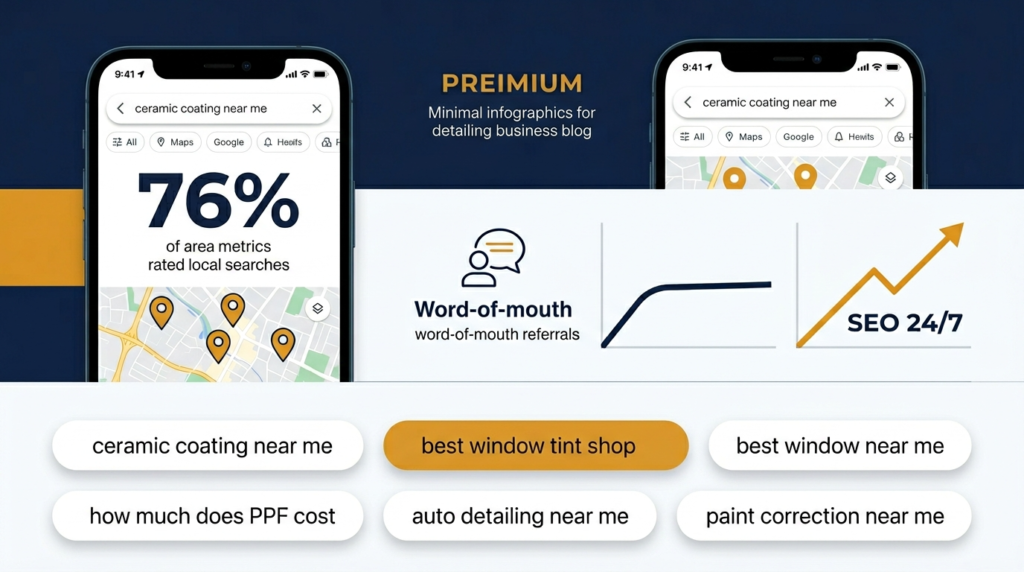
Here’s a stat that should sting: 76% of consumers who search for a local business on their smartphone visit one within 24 hours, and 28% of those searches result in a purchase. That means every “ceramic coating near me” search happening in your city right now is a customer who is already ready to spend money — they’re just choosing whoever Google shows them first.
If your shop isn’t in the top three results on Google Maps (The Local Pack), you’re effectively invisible to the majority of people actively trying to give you their money. It doesn’t matter how flawless your two-bucket wash technique is or how perfect your PPF wrap looks — if a potential customer can’t find you, you don’t exist to them.
The “Word-of-Mouth Trap” Holding Detailers Back
Most detailing shops were built on referrals. Your first 20 customers came from friends, family, and the local car community. That’s a beautiful foundation, but it’s also a ceiling.
Word-of-mouth is unpredictable, slow to scale, and brutally seasonal. When summer winds down and your phone goes quiet, referrals can’t save you. SEO can — because it works 24/7, even when your shop is closed and your existing customers aren’t actively recommending you.
How Customers Actually Find Detailing Services Today
The modern car owner doesn’t ask their neighbor for a detailing recommendation anymore. They pull out their phone and type — or speak — one of these queries:
- “ceramic coating near me”
- “best window tint shop in [city]”
- “how much does PPF cost”
- “auto detailing near me open now”
- “paint correction near me”
Each of these searches triggers Google’s local algorithm, which decides — in milliseconds — which three businesses appear in the Map Pack. Your job, with SEO, is to be one of those three.
What Is SEO? A Plain-English Definition for Detailing Business Owners
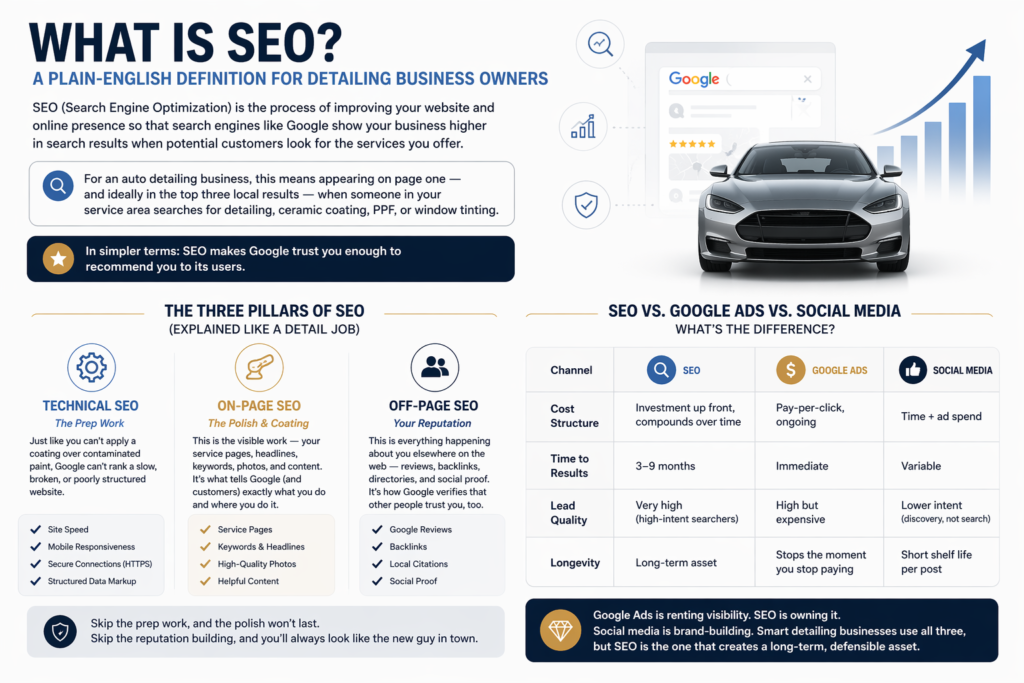
SEO (Search Engine Optimization) is the process of improving your website and online presence so that search engines like Google show your business higher in search results when potential customers look for the services you offer. For an auto detailing business, this means appearing on page one — and ideally in the top three local results — when someone in your service area searches for detailing, ceramic coating, PPF, or window tinting.
In simpler terms: SEO makes Google trust you enough to recommend you to its users.
The Three Pillars of SEO (Explained Like a Detail Job)
Think of SEO like a full ceramic coating service. There are three distinct stages, and skipping any one of them ruins the result:
- Technical SEO is the prep work. Just like you can’t apply a coating over contaminated paint, Google can’t rank a slow, broken, or poorly structured website. This includes site speed, mobile responsiveness, secure connections (HTTPS), and structured data markup.
- On-Page SEO is the polish and coating. This is the visible work — your service pages, headlines, keywords, photos, and content. It’s what tells Google (and customers) exactly what you do and where you do it.
- Off-Page SEO is your reputation. This is everything happening about you elsewhere on the web — Google reviews, backlinks from other websites, local citations on directories, and social proof. It’s how Google verifies that other people trust you, too.
Skip the prep work, and the polish won’t last. Skip the reputation building, and you’ll always look like the new guy in town.
SEO vs. Google Ads vs. Social Media — What’s the Difference?
Here’s how the three main digital marketing channels stack up for a detailing business:
Channel | Cost Structure | Time to Results | Lead Quality | Longevity |
SEO | Investment up front, compounds over time | 3–9 months | Very high (high-intent searchers) | Long-term asset |
Google Ads | Pay-per-click, ongoing | Immediate | High but expensive | Stops the moment you stop paying |
Social Media | Time + ad spend | Variable | Lower intent (discovery, not search) | Short shelf life per post |
Google Ads is renting visibility. SEO is owning it. Social media is brand-building. Smart detailing businesses use all three, but SEO is the one that creates a long-term, defensible asset.
Why SEO Matters More for Auto Detailers Than Almost Any Other Industry
There are industries where SEO is helpful. For auto detailing, PPF, ceramic coating, and window tinting, it’s foundational. Here’s why.
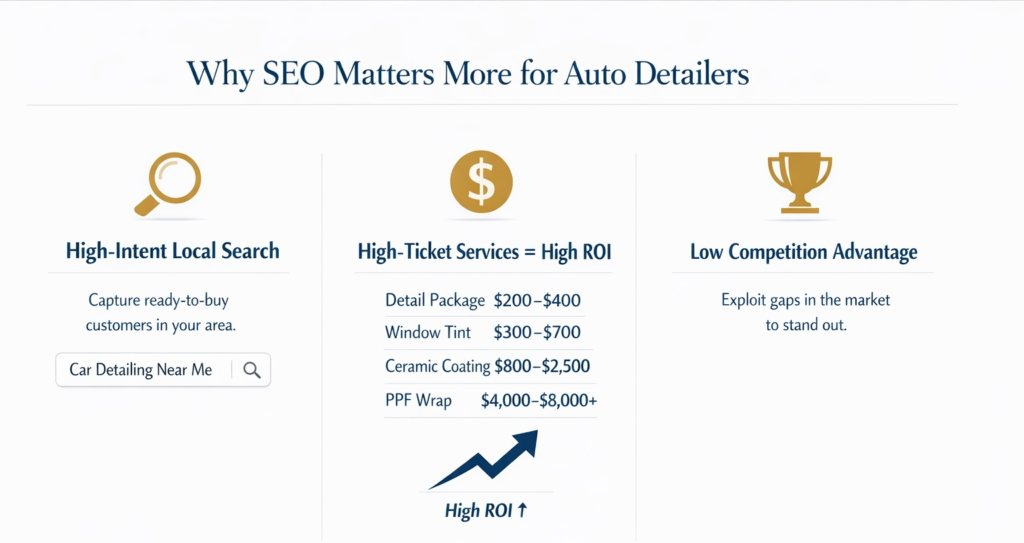
Detailing Is a High-Intent, Local Search Business
When someone Googles “best ceramic coating shop near me,” they aren’t browsing. They aren’t doing research for a school project. They’re a buyer with a credit card, looking to book — usually within days. This is the highest-intent traffic on the entire internet, and it’s free if you rank for it.
Compare that to a clothing brand running Facebook ads to people who weren’t even thinking about shopping. You don’t need to convince a search-intent customer that they want ceramic coating. They’ve already decided. You just need them to find you first.
High-Ticket Services = High SEO ROI
Run the math on your services:
- An average detail package: $200–$400
- A full window tint job: $300–$700
- A full ceramic coating: $800–$2,500
- A full-vehicle PPF wrap: $4,000–$8,000+
Now consider this: if a solid local SEO investment costs you $1,500–$3,000 a month and brings you just one extra PPF customer, you’ve already netted a profit. Bring in two ceramic coating customers, and you’ve doubled your money. The ticket sizes in this industry make SEO ROI mathematically lopsided in your favor.
Your Competitors Are Probably Already Doing It (Poorly)
Here’s the good news: most of your competitors are doing SEO badly, or not at all. Their websites are slow, their Google Business Profiles are half-completed, and their service pages read like they were written in 2014. The bar for being the most professionally installed and best-presented detailing shop online is shockingly low — which means a focused SEO push can leapfrog you past competitors who’ve been in business for a decade.
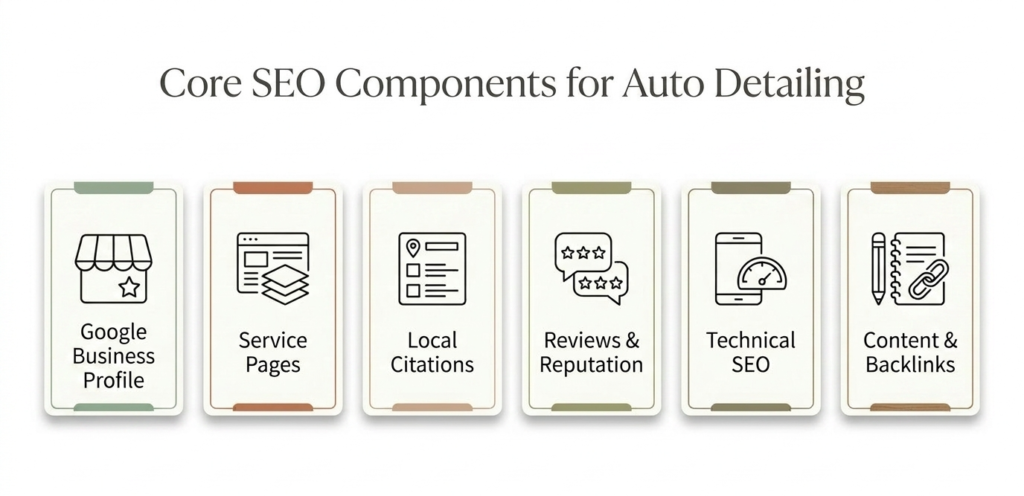
The Core Components of SEO for Detailing, PPF, Ceramic Coating, and Tinting Businesses
This is where the rubber meets the road. Below is the actual local SEO checklist for auto detailers — every component that matters, in order of priority.
Google Business Profile — Your #1 Asset
If you do nothing else from this entire guide, do this. Your Google Business Profile (formerly Google My Business) is the single most important SEO asset for any local detailing business. It’s what determines whether you appear in the Map Pack, and it’s free.
A fully optimized Google Business Profile includes:
- Accurate business name, address, and phone number (NAP) — exactly matching your website and other listings
- Correct primary and secondary service categories (e.g., “Car Detailing Service” as primary, “Window Tinting Service” as secondary)
- High-quality photos of your shop, your team, and — most importantly — before-and-after shots of real work
- Service descriptions for every service you offer, with keywords naturally included
- Regular Google Posts (think of them as mini social posts that appear in your profile)
- Active Q&A section — seed it with real questions customers ask
- Consistent review responses — every review, good or bad, gets a thoughtful reply
Don’t forget the equivalents on Apple Business Connect (for Apple Maps), Bing Places, and Yelp. They’re smaller traffic sources individually, but they all add up — and they reinforce your NAP consistency to Google.
On-Page SEO — Service Pages That Convert
Your homepage cannot rank for everything. You need dedicated, in-depth service pages for each major offering:
- A page for car detailing services
- A page for paint protection film (PPF)
- A page for ceramic coating
- A page for window tinting
- A page for paint correction (if offered)
Each page should have a unique title tag, meta description, optimized headers, hero photos, before-and-after galleries, transparent pricing or starting prices, FAQs, and clear calls to action. If you serve multiple cities or neighborhoods, you also need location pages — one for each major service area, not stuffed with duplicate content but genuinely useful and unique.
Local Citations and NAP Consistency
A citation is any online mention of your business name, address, and phone number — on Yelp, Yellow Pages, Foursquare, industry directories, supplier sites, and local chamber of commerce listings. Google uses NAP consistency across these citations as a trust signal. If your phone number is different on three different sites, Google starts to question whether you’re a legitimate business.
Tools like BrightLocal, Yext, and Moz Local can help you audit and fix citation inconsistencies. Don’t skip this — it’s unglamorous but it moves the needle.
Reviews and Reputation Management
Google reviews are arguably the second most important ranking factor for local businesses, right behind Google Business Profile optimization. They influence:
- Your position in the Local Pack
- Your click-through rate from search results
- Your conversion rate once people land on your profile
Build a system that asks every happy customer for a review — text follow-up the day after service is the highest-converting method. Aim for a steady drip of new reviews rather than a sudden flood (Google’s algorithm flags review velocity spikes as suspicious). Always respond, always thank, and address negatives professionally.
Technical SEO and Site Speed
Google has been mobile-first since 2019 and ranking sites based on Core Web Vitals since 2021. If your website takes more than three seconds to load on a phone, you’re losing both rankings and bookings. Key technical priorities:
- Mobile responsiveness — your site must look and function perfectly on a phone
- Page speed — under 3 seconds, ideally under 2
- HTTPS / SSL certificate — non-negotiable
- Schema markup — specifically LocalBusiness, Service, and FAQ schema, which help Google understand your content and qualify you for rich results
Content Marketing — Blogs, Videos, and Before-and-Afters
Content marketing is what takes you from “ranking for your shop name” to “ranking for every relevant search in your city.” Topics that work well for detailing businesses:
- “Ceramic coating vs. wax: which is right for your car?”
- “How much does PPF cost in [city]?”
- “How long does window tint take to cure?”
- “Best ceramic coating for daily drivers”
Pair every blog post with original photos and, ideally, short videos. Your Instagram and TikTok content can be embedded into blog posts, doubling their value as both social and SEO assets.
Backlinks and Local Authority Building
Backlinks — links from other websites pointing to yours — remain one of Google’s strongest ranking signals. For detailing businesses, the highest-value backlink sources include:
- Manufacturer and supplier sites — XPEL, SunTek, 3M, LLumar, Gtechniq, CQuartz, and IGL Coatings often link to certified or authorized installers
- Industry organizations — the International Detailing Association (IDA) and IWFA directories
- Local sponsorships — car shows, cars and coffee events, local charities
- Local press — features in city blogs, news outlets, and lifestyle publications
- Partner businesses — body shops, dealerships, and performance shops in your area
Becoming an authorized XPEL installer or IDA-certified detailer doesn’t just give you credibility with customers — it gives you backlink opportunities that boost your domain authority.
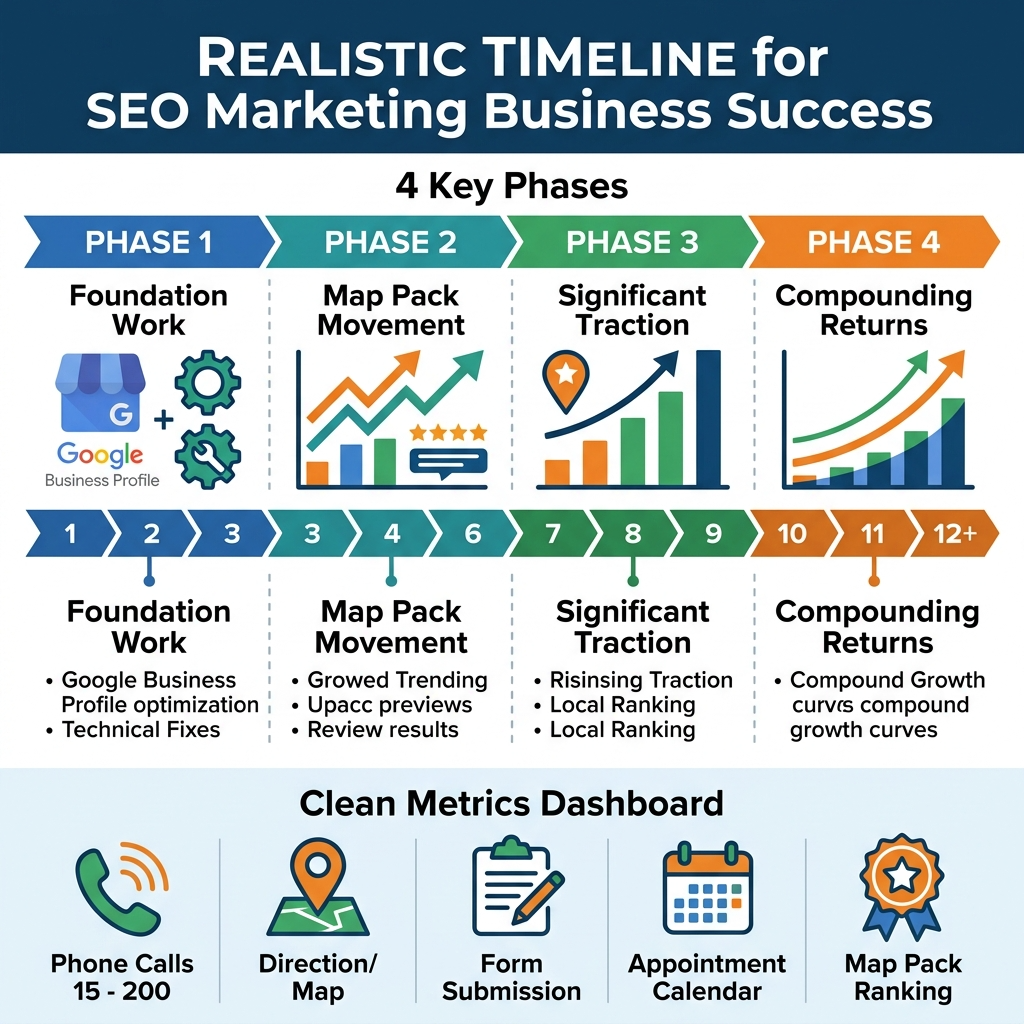
Real Results — What SEO Can Realistically Do for Your Detailing Business
Let’s talk honestly about what to expect, because unrealistic promises are the fastest way to disappointment.
The Realistic Timeline — Why SEO Isn’t Instant
For a typical detailing business starting from a weak SEO foundation, here’s what a realistic timeline looks like:
- Months 1–3: Foundation work. Google Business Profile fully optimized, technical issues fixed, service pages rewritten, citations corrected. You may see early movement on long-tail and brand searches.
- Months 3–6: Map Pack movement begins. Reviews accumulate. Local rankings climb for less competitive keywords.
- Months 6–9: Significant traction. You’ll start ranking for primary terms in your service area and seeing measurable lead increases.
- Months 9–12+: Compounding returns. New blog posts and pages each contribute. Your business becomes a fixture in the top results.
Anyone promising you a #1 ranking in 30 days is selling something they can’t deliver. Real SEO is a long-term asset that compounds — like the difference between buying a house and renting one.
How to Measure SEO Success
Vanity metrics are a trap. The metrics that actually matter for a detailing business:
- Phone calls from Google Business Profile (tracked in your GBP insights dashboard)
- Direction requests (people navigating to your shop)
- Form submissions and quote requests through your website
- Booked appointments attributed to organic search (track via Google Analytics 4)
- Map Pack ranking for your top 10 target keywords (tracked monthly)
Don’t obsess over total website traffic. A detailing shop with 500 visitors a month that converts 8% of them into bookings is winning over a competitor with 5,000 visitors and a 0.5% conversion rate.
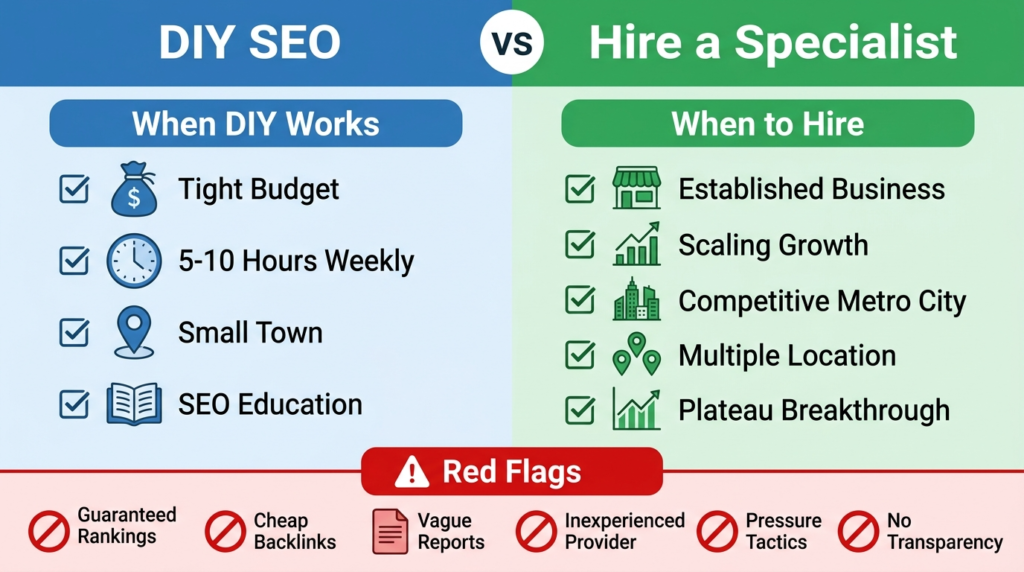
DIY SEO vs. Hiring a Specialist — Which Path Makes Sense?
There’s no universally right answer here. It depends on where your business is, how much time you have, and how aggressive your growth goals are.
When DIY SEO Works
DIY SEO is a smart move if:
- You’re brand new and have a tight budget
- You enjoy marketing and have 5–10 hours a week to dedicate
- You’re in a low-competition market (smaller town, fewer detailing shops)
- You’re comfortable learning and willing to be patient
Start with Google Business Profile optimization, get your service pages dialed in, and build a steady review pipeline. You can move the needle significantly without spending a dollar on an agency.
When to Hire a Specialist
Bringing in a professional makes sense if:
- You’re an established shop ready to scale aggressively
- Your time is worth more producing detail jobs than writing meta descriptions
- You operate in a competitive metro market
- You have multiple locations or service areas to optimize
- You’ve tried DIY and hit a plateau
Look for an SEO professional or agency with specific experience in the auto detailing, PPF, ceramic coating, or window tinting industry. Generic SEO agencies often don’t understand the buyer journey, the seasonality, or the technical vocabulary of this niche.
Red Flags When Choosing an SEO Provider
Walk away immediately if you hear:
- “Guaranteed #1 ranking in 30 days”
- “We’ll build you 1,000 backlinks for $99”
- Vague monthly reports with no actual ranking or traffic data
- No experience with detailing, automotive, or local service businesses
- Pressure tactics or long-term contracts with no out clause
- Refusal to explain their process in plain English
A trustworthy SEO partner offers transparent pricing, no hidden fees, clear monthly reporting, and a free initial consultation or audit before asking for a commitment.
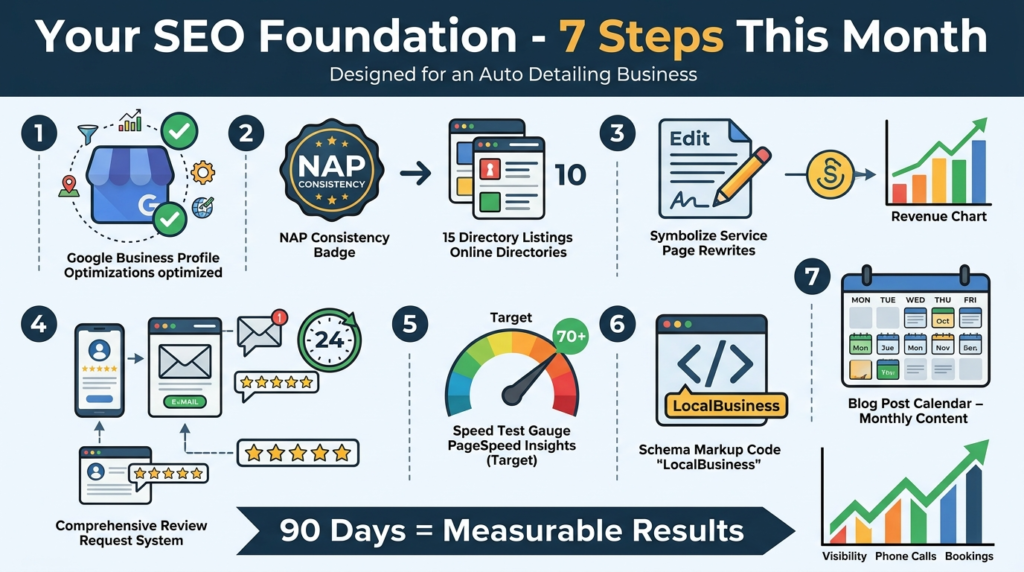
Your Next Steps — Building an SEO Foundation This Month
You don’t need to do everything at once. Start here, in this order:
- Claim and fully optimize your Google Business Profile — every field, every photo, every category
- Audit your NAP consistency across the top 10–15 directories in your industry
- Rewrite your top three service pages (the ones with the highest revenue potential)
- Set up a review request system — text or email every customer 24 hours after service
- Run a free site speed test at PageSpeed Insights and fix anything below a 70 score
- Add LocalBusiness schema markup to your homepage and service pages
- Publish one in-depth blog post per month answering a real question your customers ask
Do these seven things consistently for 90 days, and you will see measurable movement in your visibility, your phone calls, and your bookings. That’s a promise the math actually supports — not a marketing slogan.
Frequently Asked Questions About SEO for Auto Detailing Businesses
SEO for an auto detailing business typically costs between $800 and $3,500 per month for professional services, depending on your market size and competition level. DIY SEO costs nothing but your time — usually 5–10 hours per week. Higher-end packages for competitive metro markets or multi-location shops can range from $3,500 to $7,500 monthly. The investment usually pays for itself with just one or two additional ceramic coating or PPF jobs each month.
Most detailing businesses see meaningful SEO results within 3 to 6 months, with significant traction by month 9. Early wins — like ranking for your business name and long-tail searches — can happen in the first 30–60 days. Competitive keywords like "ceramic coating near me" in a major city typically take 6–12 months to crack the Local Pack. SEO is a compounding asset, so the longer you invest, the bigger the returns.
SEO and Google Ads serve different purposes, but SEO delivers far better long-term ROI for auto detailers. Google Ads gives you instant visibility but stops the moment you stop paying. SEO builds a permanent asset that continues generating leads month after month. Most successful detailing shops use both — Google Ads for immediate flow, SEO for long-term, lower-cost lead generation. Over a 24-month window, SEO almost always wins on cost-per-acquisition.
Yes, mobile detailing businesses can absolutely rank on Google without a storefront by setting up their Google Business Profile as a "service area business" (SAB). Instead of displaying a physical address, you specify the cities, zip codes, or radius you serve. You still get to appear in the Local Pack and Google Maps for searches within your service area. This is exactly how successful mobile detailers, mobile PPF installers, and traveling ceramic coating specialists rank.
Yes, you absolutely need a separate, dedicated page for each major service you offer. Google ranks pages, not websites — and a single "Services" page trying to cover ceramic coating, PPF, paint correction, and window tinting will rank for none of them well. Each service page should have its own keywords, photos, FAQs, pricing information, and calls to action. This is one of the highest-impact changes most detailing shops can make.
Local SEO focuses on ranking in geographic, location-based searches like "auto detailing near me" or "ceramic coating in Dallas," while traditional SEO targets broader, non-location-specific searches. For 99% of auto detailing, PPF, ceramic coating, and tinting businesses, local SEO is the priority because customers search locally. Local SEO emphasizes Google Business Profile, citations, reviews, and location-specific content — all of which matter much less for non-local businesses.
You'll know your SEO is working when you see measurable growth in three specific areas: phone calls and direction requests from your Google Business Profile, organic traffic to your website (tracked in Google Analytics), and your ranking position for your top target keywords in the Local Pack. Most importantly, you should see more booked appointments attributed to people who found you through Google search. If those numbers aren't climbing after 4–6 months, your SEO strategy needs adjustment.
SEO is completely safe when done correctly using ethical, "white-hat" practices that follow Google's guidelines. The risk only appears when shady providers use spammy tactics like buying low-quality backlinks, keyword stuffing, or creating fake reviews — all of which can result in Google penalties. Always work with an SEO partner who is transparent about their methods, provides clear monthly reporting, and avoids any guarantees that sound too good to be true.
Yes, local SEO is actually one of the few areas where small, independent detailing shops can outrank franchises. Google's local algorithm rewards relevance, proximity, and review quality — areas where a focused independent shop with great craftsmanship and engaged customers often beats large chains with generic, templated content. Your authentic before-and-after work, real customer reviews, and specialized expertise are competitive advantages a franchise simply can't replicate.
Start by fully optimizing your Google Business Profile — it's free, takes about two hours, and delivers more immediate ROI than any other single SEO action. Add high-quality photos of your work, fill out every service category, write detailed service descriptions, ask your last 10 happy customers for reviews, and start posting weekly Google Posts. This single step puts you ahead of 70% of your local competitors and starts moving your visibility within weeks.
Ready to stop watching less-skilled competitors win the work that should be yours? The detailing shops dominating their markets in 2026 won’t be the ones with the best Instagram aesthetic — they’ll be the ones who built a real, defensible SEO foundation while everyone else was still hoping for word-of-mouth to save them.